

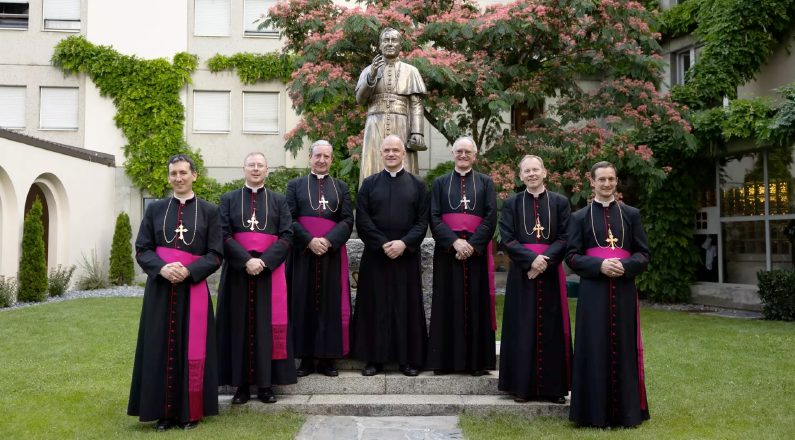
(ZENIT News / Rome, 07.14.2026).- The confrontation between the Holy See and the Society of St. Pius X (SSPX) has entered a new and highly technical phase. Less than two weeks after the Vatican declared the traditionalist group to be in schism following the illicit episcopal ordinations of four new bishops, the Society has formally launched a canonical challenge aimed at overturning the decree while temporarily suspending its effects.
According to a statement issued by the SSPX’s General House in Menzingen on July 13, the Society filed a preliminary administrative petition with the Dicastery for the Doctrine of the Faith on July 11, contesting the decree published on July 2. Rather than immediately pursuing a higher appeal, the Society has chosen the first procedural step required by the 1983 Code of Canon Law before any hierarchical recourse may be presented.
The move represents a significant development in one of the most serious canonical disputes the Catholic Church has faced in decades. By invoking canons 1734 and following, the SSPX argues that it is exercising a right recognized by Church law for anyone who believes an administrative act has caused unjust harm. The Society insists that its request is made «with respect for ecclesiastical authority» and in pursuit of «justice, truth, and the good of the Church.»
The central legal issue concerns the effect of the appeal itself. The SSPX maintains that, under Canon 1353, the filing automatically suspends the execution of the decree imposing or declaring a canonical penalty while the competent authority examines the case. In practical terms, the Society contends that the excommunications cannot take effect until the Dicastery reaches a decision on its request.
Canon lawyers note that this initial petition is not yet the final appeal. Under the Church’s administrative judicial system, those challenging a decree must first ask the authority that issued it to revoke or amend its decision. Only if that request is denied may they proceed with a formal hierarchical recourse before the competent higher authority. The Code also grants the reviewing authority broad powers: it may uphold the decree, revoke it, declare it invalid, modify it, or replace it with a new decision.
The present controversy stems from the episcopal consecrations carried out on July 1 despite explicit warnings from Pope Leo XIV. The Holy See subsequently declared that the ceremony constituted a schismatic act, resulting in the excommunication of Bishop Alfonso de Galarreta, who presided over the ordinations, together with the four newly consecrated bishops—Pascal Schreiber, Michael Goldade, Michel Poinsinet de Sivry and Marc Hanappier. Bishop Bernard Fellay, who served as co-consecrator, was likewise declared excommunicated because of his participation in the schismatic act.
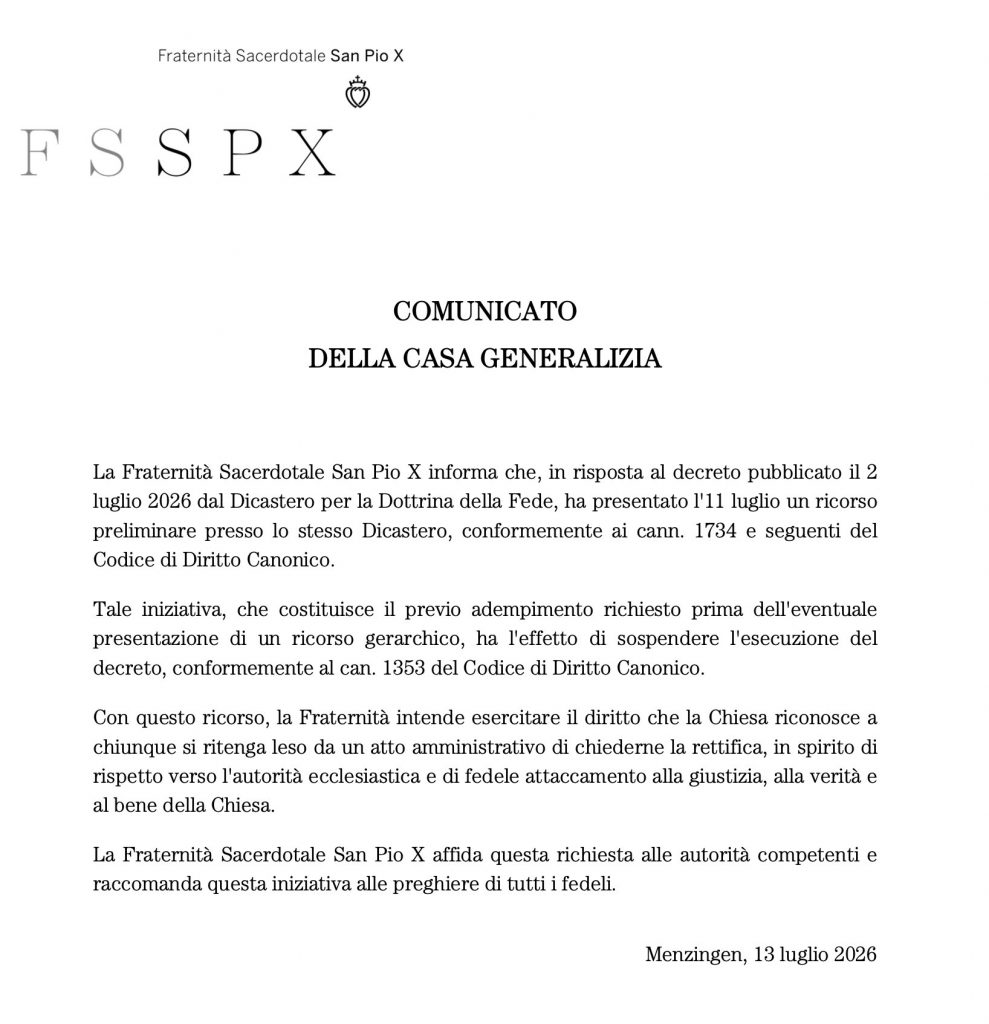
The SSPX, however, continues to reject both the canonical assessment and the resulting penalties. Before filing its latest petition, the Society had already written to Pope Leo XIV, arguing that the sanctions were «objectively unjust and invalid.» It has also maintained that the consecrations were motivated by what it describes as an ongoing crisis within the Church rather than by any intention to break communion with the Roman Pontiff. In its view, the legal conditions required to establish the crime of schism have therefore not been met.
The dispute has also revived memories of the historic rupture of 1988, when Archbishop Marcel Lefebvre illicitly consecrated four bishops without the approval of St. John Paul II, an act that resulted in his excommunication and formal declaration of schism. Those penalties were lifted by Pope Benedict XVI in 2009 as part of an effort to promote reconciliation, although full canonical regularization of the Society was never achieved. Ironically, two of those bishops—Bishop de Galarreta and Bishop Fellay—participated in this year’s disputed consecrations, placing themselves once again at the center of a major ecclesiastical conflict.
One aspect of the current case has attracted particular attention among canonists and commentators. By relying extensively on the procedures established by the 1983 Code of Canon Law, the Society is making use of the very legal framework that it has historically criticized. Some observers have suggested that this could represent a noteworthy shift in approach. The Italian publication MessainLatino, for example, described the decision as an encouraging indication that the SSPX now appears willing to recognize the juridical mechanisms established by the current Code, expressing hope that this development might eventually contribute to renewed dialogue between the Society and the Holy See.
Whether that optimism proves justified remains uncertain. For now, the dispute has moved from public declarations to the structured procedures of canon law. The Dicastery for the Doctrine of the Faith must now decide whether to uphold, amend or withdraw its decree, after which further appeals remain possible.
Beyond questions of procedure, the case ultimately concerns one of the fundamental principles of Catholic ecclesiology: the relationship between episcopal authority and communion with the Successor of Peter. Whatever the outcome of the appeal, the Vatican’s response will likely shape not only the future of the Society of St. Pius X but also the Church’s broader efforts to address divisions within traditionalist circles while safeguarding ecclesial unity.
Thank you for reading our content. If you would like to receive ZENIT’s daily e-mail news, you can subscribe for free through this link.

Publicaciones relacionadas:
 Trump and Vance prolong the conflict with Leon XIV as Russia and Brazil join the controversy
 On the Controversy with Trump, Leo XIV Denounces a «Not Entirely Accurate Narrative»
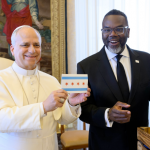 Trump takes another swipe at the Pope following the audience granted by Leo XIV to the mayor of Chicago
 Does the Devil Exist? The Vatican newspaper unnecessarily suggests that he does not. A controversy in the middle of summer
