

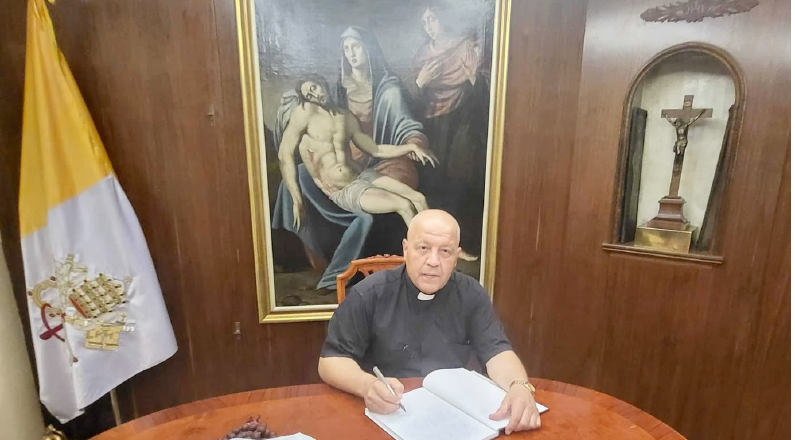
(ZENIT News / Rome, 03.11.2026).- The killing of a Catholic priest in southern Lebanon has become one of the most poignant symbols of the human cost of the escalating conflict in the Middle East. As bombardments intensify along the Lebanese-Israeli border, the death of Father Pierre El-Rahi has sparked condemnation from Church leaders and renewed appeals for peace from the Vatican.
Pope Leo XIV expressed “deep sorrow” for the victims of the recent attacks in the region and said he is following the developments “with concern,” praying that “all hostilities may cease as soon as possible.” In a message released through the Holy See Press Office, the pontiff recalled the many innocent victims of the latest violence, including numerous children, and paid particular tribute to the Maronite priest who died while trying to assist those wounded in an attack.
The priest, Father Pierre El‑Rahi, was killed on March 9 in the Christian village of Qlayaa, close to the Israeli border. He was 50 years old.
According to multiple accounts from local clergy and officials, the tragedy unfolded in the early afternoon. Around 2:00 p.m. local time, an Israeli tank reportedly fired at a house on the eastern edge of the village, wounding the homeowner, Clovis Boutros, and his wife. When the parish priest rushed to the scene with several young parishioners to help the injured, a second strike hit the same building.
The blast left Father El-Rahi and several others seriously wounded. He was rushed to the government hospital in nearby Marjayoun but died shortly after arrival.
Witnesses described the priest’s final moments as consistent with the way he had lived his ministry. “He was a true shepherd for the Christians of the area,” said Franciscan Father Toufic Bou Merhi, a member of the Custody of the Holy Land who serves Latin Catholic communities in Tyre and Deirmimas. “He was always beside his people, especially in these difficult days.”
A village that refused to abandon its land
Qlayaa is a predominantly Maronite Christian town of about 8,000 residents in southern Lebanon. Like several other villages in the region, it had received evacuation warnings from the Israeli military as fighting intensified between Israel and the Shiite militia Hezbollah.
Yet many residents chose to remain.
Father El-Rahi had publicly supported that decision, insisting that the community’s resistance was peaceful. Days before his death, he had declared that the people of his village would defend their homeland without weapons.
“Our only arms are peace, love and prayer,” he said during a public gathering.
In a telephone interview broadcast less than two hours before the attack, the priest reiterated that he and his parishioners intended to stay. “This land means everything to us,” he explained, recalling how generations before them had struggled to preserve it. “If we leave, we lose the hope of returning.”
His words circulated widely after his death, reinforcing the image of a pastor who chose to remain with his flock despite the risks.
Church leaders denounce the attack
The killing drew strong reactions from Catholic leaders in Lebanon and abroad.
Bechara Boutros Rai, the Maronite Patriarch of Antioch, described the priest’s death as a “martyrdom” and “a deep wound in the heart of the Church.” He condemned attacks against civilians, religious figures, and places of worship, warning that continued reliance on military force would only bring further destruction and displacement.
The patriarch also urged political leaders in Lebanon, the wider region and the international community to act quickly to stop what he called a “senseless war.”
Expressions of solidarity came from other parts of the Catholic world as well. Matteo Maria Zuppi, president of the Italian Bishops’ Conference, sent condolences to the Maronite patriarch, praising the priest for remaining with his people until the end and hoping that his witness might become “a seed of reconciliation in a time of hatred.”
Humanitarian groups also reacted strongly. The charity Aid to the Church in Need confirmed that Father El-Rahi had collaborated with its pastoral projects, supporting ministry to roughly 3,000 parishioners in the region.
A rapidly worsening humanitarian crisis
The priest’s death occurred amid a dramatic escalation of violence across Lebanon. According to the Lebanese Ministry of Public Health, by March 9 at least 486 people had been killed in recent Israeli strikes, with 1,313 injured.
The fighting has also triggered a massive wave of displacement. Lebanese authorities estimate that more than 600,000 citizens have already been forced from their homes.
Local clergy describe scenes of profound distress. Father Bou Merhi reported that the Franciscan convent in Tyre is currently sheltering about 200 displaced people—most of them Muslims—who fled bombardments elsewhere in the south.
Across the country, the numbers are staggering. Approximately 500,000 displaced people are now concentrated in the capital, Beirut, while nearly 300,000 have fled from southern Lebanon. Tens of thousands more have left the Bekaa Valley.
Many families, he said, are sleeping in cars or on the streets. “People know what they are leaving behind—their homes, their belongings, their history,” the Franciscan explained. “But they do not know where they can go.”
Even villages that had long resisted evacuation are beginning to empty. In the nearby Christian town of Alma al-Chaab, families recently departed under escort from the United Nations Interim Force in Lebanon.
The cost of war beyond the battlefield
For many clergy in Lebanon, the tragedy highlights not only the physical destruction caused by the conflict but also the deeper wounds inflicted on communities.
A Franciscan friar reflecting on the war described how the language of “collateral damage” often obscures the personal tragedies behind military statistics. Homes can eventually be rebuilt, he said, but the fear and trauma carried by civilians—especially children—are far harder to heal.
The death of Father El-Rahi has intensified those emotions in southern Lebanon. For years he had helped distribute basic supplies to families and served as regional chaplain for local charitable initiatives.
Now his parishioners mourn a priest who chose to remain with them despite the danger.
“He died doing exactly what he always did,” Father Bou Merhi said. “Responding to someone who needed help.”
Amid the destruction and displacement, the message coming from Lebanon’s Christian communities echoes the appeal repeatedly voiced by the pope: that the logic of war must give way to the search for peace.
“Enough war, enough violence,” the Franciscan priest said. “Weapons do not bring peace. They bring massacres and hatred. What people here ask for is simple—to live with a little dignity.”
Thank you for reading our content. If you would like to receive ZENIT’s daily e-mail news, you can subscribe for free through this link.

Publicaciones relacionadas:
 53 Humanitarian Organizations Denounce «False Narratives» to Sabotage Those Saving Lives in Palestine
 Between Drones, Settlers and Classrooms: How Violence and Administrative Israeli Pressure Are Reshaping Palestinian Life
 Lebanon requests diplomatic mediation from the Vatican to prevent Israel from attacking or displacing Catholic communities in the south of the country
 The last historic Christian village in the Holy Land, threatened with annexation by the Jewish state of Israel
