(ZENIT News / Rome, 04.23.2026).- For decades, religious life in the United States rested on a quiet but decisive sociological fact: women were its most consistent pillar. They prayed more, attended services more regularly, and were more likely to describe faith as central to their lives. In many parishes and congregations, they were not only the majority but also the driving force behind community continuity.
Recent data, however, suggest that this long-standing pattern is undergoing a significant transformation—one that could reshape the future of religion in America.
A report published on April 15 by the Public Religion Research Institute (PRRI) indicates that 43 percent of women under the age of 30 now identify as religiously unaffiliated. This marks a sharp increase from 29 percent in 2013. Notably, young women now surpass their male counterparts in disaffiliation, with 35 percent of young men describing themselves as having no religious identity. Overall, 39 percent of Americans under 30 fall into this category.
These figures challenge a narrative that has gained traction in some circles: that young Americans are returning to religion in significant numbers. While certain localized or digital phenomena may suggest renewed interest, the broader statistical picture points instead to a stabilization of decline, particularly among younger women.
The shift is even more striking when viewed against the historical backdrop. According to recent data from the Pew Research Center, the traditional gender gap in religiosity has nearly disappeared among younger generations. Approximately 57 percent of young women and 58 percent of young men now identify with a religion—a virtual parity that would have been unthinkable a generation ago.
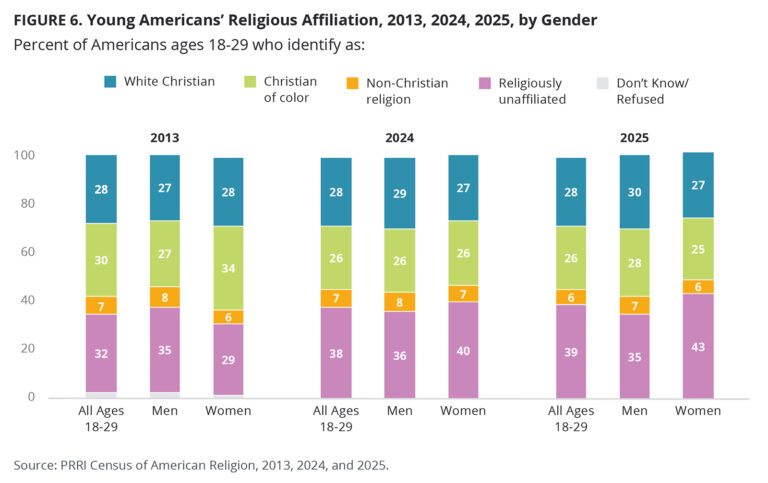
«Young Americans’ Religious Affiliation, 2013, 2024, 2025, by Gender» (Graphic courtesy of PRRI)
Yet the story is not one of simple abandonment. Religion in the United States is not collapsing; it is recalibrating. The proportion of Americans with no religious affiliation rose steadily from 16 percent in 2007 to 31 percent in 2022, before stabilizing at around 28 percent. This plateau suggests that the rapid secularization observed in previous decades may be slowing.
Within congregational life, women still maintain a strong presence. Around 60 percent of active participants in religious communities are female, according to research from the Hartford Institute. Even among younger cohorts, women remain more likely than men to belong to a congregation, despite attending services less frequently. At the same time, young people as a whole are underrepresented in churches: they make up only about 14 percent of members, while constituting roughly a quarter of the national population.
This apparent contradiction—declining identification alongside continued participation—reveals a more nuanced reality. For many young adults, especially women, the issue is not spirituality itself but the institutional forms through which it is expressed.
Analysts point to a growing tension between contemporary cultural expectations and the perceived positions of religious institutions. Some young women, researchers suggest, are distancing themselves from religious labels because they associate them with rigid or critical views on gender roles. In a social environment where autonomy and equality are strongly emphasized, traditional frameworks can be experienced as restrictive rather than liberating.
At the same time, the digital landscape has amplified voices that advocate a return to sharply defined gender norms. A small but visible group of online influencers—sometimes referred to as “TheoBros”—promotes highly traditional roles for women, occasionally extending to controversial positions such as questioning women’s suffrage. While these perspectives attract attention in certain online spaces, their broader appeal appears limited and, according to analysts, unlikely to drive significant religious growth.
The political dimension adds another layer to this evolving picture. Religious affiliation in the United States remains closely linked to party identity. Among Republicans, 84 percent identify as Christian, including 68 percent as white Christians, while only 13 percent claim no religious affiliation. Among Democrats, the landscape is more fragmented: 34 percent are unaffiliated, surpassing the 24 percent who identify as white Christians, while 58 percent identify as Christian overall and 8 percent belong to other religions.
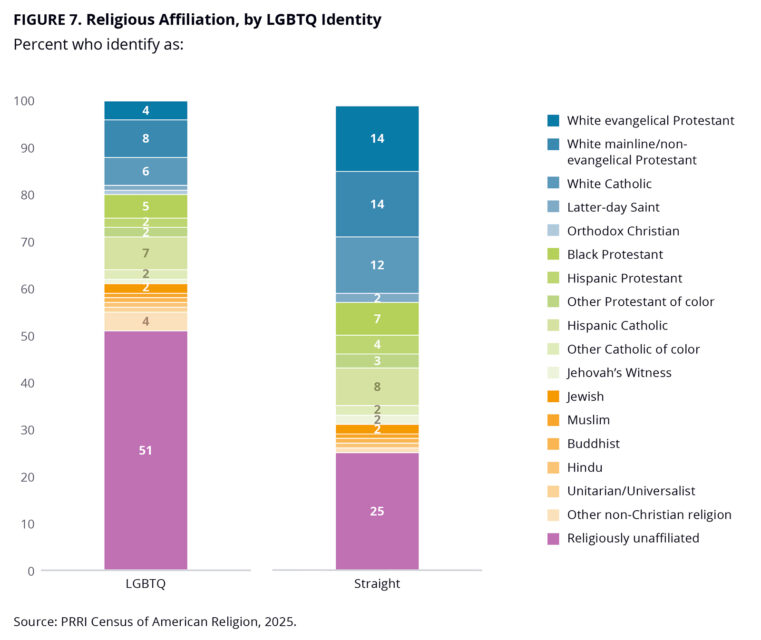
«YReligious Affiliation, by LGBTQ Identity» (Graphic courtesy of PRRI)
Differences are also evident across social groups. Half of Americans who identify as LGBTQ describe themselves as religiously unaffiliated, compared to 25 percent among heterosexual Americans. These disparities highlight how questions of identity, belonging and moral teaching intersect in complex ways.
From a broader perspective, the data point toward a paradox: the United States is often described as a society marked by increasing loneliness and fragmentation, particularly among younger generations. Yet the very institutions historically associated with community and belonging—religious congregations—are struggling to retain their appeal.
This tension raises a fundamental question: what kind of religious presence can speak credibly to a generation that is both skeptical of institutions and deeply in search of meaning?
For the Catholic Church and other Christian communities, the challenge is neither to dilute their message nor to retreat into defensive postures. Rather, it is to articulate a vision of faith that integrates truth with pastoral sensitivity, and moral coherence with a genuine capacity for encounter. The Christian understanding of the human person—grounded in dignity, relationality and vocation—retains a profound resonance, but its transmission requires forms that are both intelligible and convincing in today’s cultural context.
The current moment, therefore, should not be read solely in terms of decline. It is also a moment of discernment. The erosion of inherited patterns of religiosity may signal not the end of faith, but the end of its automatic transmission. What emerges in its place will depend largely on whether religious communities can respond to the deeper questions that statistics alone cannot capture: the desire for belonging, the search for truth, and the need for a hope that extends beyond the immediacy of individual experience.
In that sense, the future of religion in America may well hinge on the very group now appearing to drift away. Young women, long the backbone of religious life, could once again become decisive—this time not through inherited affiliation, but through a renewed and freely chosen engagement with faith.
Thank you for reading our content. If you would like to receive ZENIT’s daily e-mail news, you can subscribe for free through this link.