

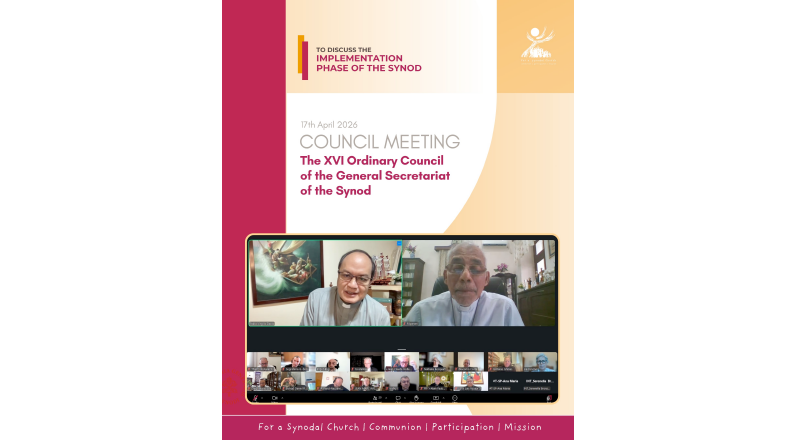
(ZENIT News / Rome, 04.21.2026).- The Catholic Church’s synodal process, often described as one of the most ambitious ecclesial undertakings of recent decades, is entering a new and decisive phase. Far from the immediacy of headlines, the work now unfolding in Rome reflects a quieter but structurally significant effort: translating broad consultations into concrete pathways for pastoral action, particularly in areas as sensitive and foundational as the family.
On April 17, the Ordinary Council of the General Secretariat of the Synod convened online to address what might appear, at first glance, as procedural matters. In reality, the agenda revealed the strategic depth of the current moment. The Church is not merely reviewing past discussions; it is designing mechanisms to evaluate their real impact across continents and cultures.
Central to the meeting was the preparation for a gathering scheduled from June 23 to 25, 2026. This event will serve as a preparatory stage for the Continental Evaluation Assemblies planned for early 2028. These assemblies are intended to assess how the conclusions of the Synod on Synodality are being implemented at the local level—a crucial step in ensuring that synodality does not remain an abstract concept but becomes a lived ecclesial practice.
The presence of representatives from Eastern Catholic patriarchates, international episcopal bodies, and major episcopal conferences—including those of the United States and Canada—underscores the global scope of this process. It also reflects a key theological intuition: the Church’s unity does not erase diversity but seeks to harmonize it through discernment.
The participation of the Pope in one of the working sessions of the June meeting adds a further layer of significance. It signals that this phase is not merely administrative but carries a pastoral and doctrinal weight that requires direct papal engagement. Synodality, as it is being shaped, is not a decentralization of authority but a rearticulation of communion, where listening and governance are intertwined.
Alongside this forward-looking agenda, attention is also turning to a milestone that invites both reflection and renewal: the tenth anniversary of Amoris Laetitia. Scheduled for October 7–14, 2026, a Vatican gathering will bring together presidents of episcopal conferences and leaders of the Eastern Catholic Churches to revisit the apostolic exhortation that has profoundly influenced the Church’s pastoral approach to marriage and family life.
This meeting, prepared by the Dicastery for Laity, Family and Life, is designed as a consultative forum. Its aim is not to reopen settled questions but to deepen the Church’s understanding of how to proclaim the Gospel within the complex realities faced by families today. The emphasis on “mutual listening” reflects a continuity with the broader synodal method, while also acknowledging that the family remains a primary locus where faith, culture, and moral challenges intersect.
The choice to revisit Amoris Laetitia is not incidental. Since its publication, the document has shaped pastoral practice worldwide, particularly in its call to accompany families with both truth and mercy. Ten years on, the Church appears intent on evaluating how this vision has been received—and where further clarity or development may be needed.
During the April meeting, another technical but important step was taken: the approval of the general structure of a document intended to guide the implementation phase of the Synod. This text, which will integrate guidelines issued in June 2025, seeks to provide a coherent framework for the forthcoming evaluation assemblies. Its publication, expected in early summer, will likely serve as a reference point for dioceses and episcopal conferences navigating the practical dimensions of synodality.
Such documents may not capture public attention, but they are essential in ecclesial governance. In the Catholic tradition, processes of discernment are not left to improvisation; they are supported by methodological tools that ensure coherence, accountability, and fidelity to the Church’s mission.
The meeting also included a gesture of institutional continuity, with members expressing gratitude for the service of a senior official transitioning to new responsibilities within the Roman Curia. Such moments, though discreet, reflect the human dimension of ecclesial structures—where service, rather than visibility, defines leadership.
The current phase of the synodal journey is less about conclusions than about foundations. The real test will come not in documents or assemblies, but in whether local communities can embody what has been discussed—transforming consultation into communion, and dialogue into lived witness.
Thank you for reading our content. If you would like to receive ZENIT’s daily e-mail news, you can subscribe for free through this link.

Publicaciones relacionadas:
 Pope Leo entrusts the important Dicastery that elects bishops to a Carmelite and canonist
 Pope Leo XIV: yes to synodality, but without undermining the authority of the bishop
 Following complaints from cardinals in pre-Conclave meetings, Pope Leo XIV summons cardinals to Rome for early 2026
 Pope Leo XIV continues to reshape the Roman Curia: Meet the new Australian prefect of the Dicastery for Legislative Texts
