

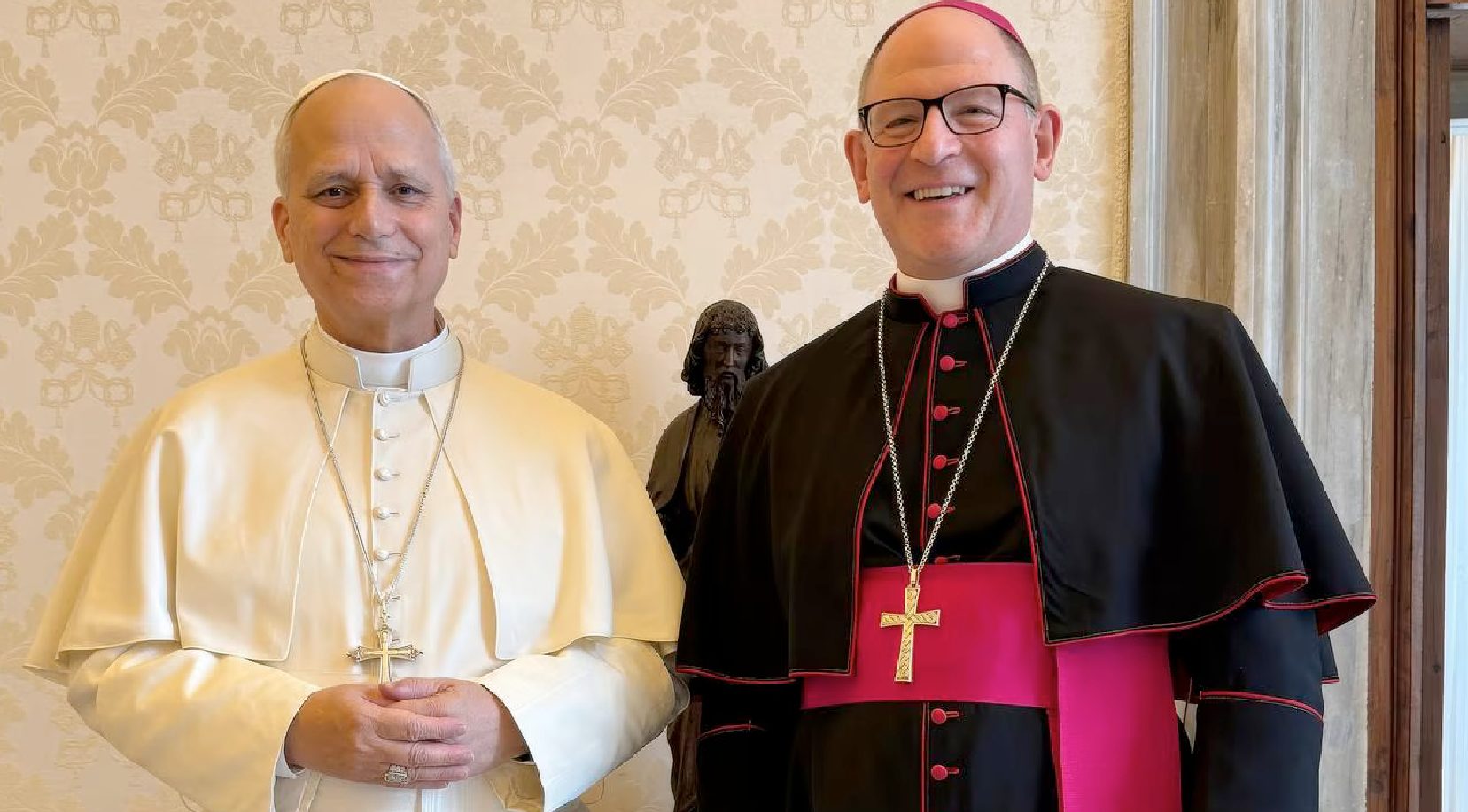
(ZENIT News / Vatican City, 03.26.2026).- Pope Leo XIV has appointed Australian bishop Anthony Randazzo as prefect of the Dicastery for Legislative Texts—one of the most technically influential offices in the Roman Curia and a key node in the governance of the Catholic Church’s legal system.
The appointment, announced on March 25, fills a strategic vacancy at the heart of the Vatican’s juridical machinery. Randazzo, 59, succeeds Filippo Iannone, who was transferred in September 2025 to lead the Dicastery for Bishops, the body responsible for vetting episcopal appointments worldwide. In a gesture that underscores the weight of his new role, the Pope has granted Randazzo the personal title of archbishop.
At stake is not merely administrative continuity, but the stewardship of canon law itself. The Dicastery for Legislative Texts is tasked with interpreting and updating the Church’s two principal legal codes—the Latin Code of Canon Law and its counterpart for the Eastern Catholic Churches. Its work often unfolds behind the scenes, clarifying ambiguities in ecclesiastical legislation and, when necessary, proposing modifications to the Pope in response to emerging pastoral or institutional challenges.
A profile shaped by law and crisis
Randazzo arrives in Rome with a profile that is both technically rigorous and pastorally seasoned. Born in Sydney in 1966 to a family of Sicilian origin, he was ordained a priest in 1991 for the Archdiocese of Brisbane. His academic formation includes advanced studies in canon law at the Pontifical Gregorian University, where he obtained a licentiate in 2000.
His Roman experience is not new. Between 2004 and 2008, he served at the Congregation for the Doctrine of the Faith—now the Dicastery for the Doctrine of the Faith—where he was involved in handling sensitive cases, including those related to clerical sexual abuse. This period coincided with intensifying global scrutiny of the Church’s response to abuse allegations, and with Australia’s own reckoning through a landmark public inquiry.
The Australian Royal Commission later found that 7% of Catholic priests in the country had been accused of abuse between 1950 and 2010, with 4,444 individuals identifying themselves as victims. Randazzo’s proximity to that era, both in Rome and in his home country, situates him among a generation of churchmen shaped by the institutional and moral pressures of the crisis.
This background may prove particularly relevant as debates continue over whether the Church’s canonical structures have adequately addressed such failures. While Pope Leo XIV has not publicly outlined a program of legal reform, the choice of a canonist with firsthand exposure to these issues is unlikely to be read as incidental.
A Vatican post with growing relevance
Beyond abuse cases, the dicastery’s remit extends to the legal architecture of the Vatican City State itself. Recent financial trials—most notably those involving senior clerics—have drawn attention to the limitations of the city-state’s penal and procedural codes, some of which critics consider outdated or inconsistently applied.
In this context, the appointment of a jurist fluent in both Anglo-Saxon legal culture and Roman canonical tradition introduces a potentially valuable hybrid perspective. Randazzo’s English-speaking background also reflects the increasingly global composition of the Church’s leadership, as well as the Vatican’s need to engage with diverse legal and cultural frameworks.
His career trajectory reinforces this international dimension. After serving as auxiliary bishop of Sydney from 2016, he was appointed bishop of Broken Bay in 2019. He has since held prominent roles within the Australian episcopate, including membership in canonical advisory bodies and leadership responsibilities tied to the Plenary Council process. He currently presides over the Federation of Catholic Bishops’ Conferences of Oceania, a role that has given him oversight of a geographically vast and culturally diverse region.
Notably, his appointment marks the first time since the late George Pell that an Australian has headed a Vatican dicastery. Pell, who died in 2023, was a central figure in early efforts to reform Vatican finances under Pope Francis, and his tenure underscored the growing role of non-European prelates in curial governance.
Transition and tone
In a public message following the announcement, Randazzo expressed gratitude for the Pope’s confidence and acknowledged the pastoral ties he leaves behind. He will remain in Australia for approximately three months as apostolic administrator of Broken Bay before relocating to Rome.
His remarks, while brief, emphasized continuity rather than rupture: a sense of service, ecclesial obedience, and awareness of the demands of the office. Yet the broader context of his appointment suggests that his mandate may extend beyond routine legal interpretation.
At a time when the Catholic Church faces sustained scrutiny over accountability, governance, and transparency, the dicastery he now leads occupies a subtle but decisive position. It does not legislate independently, but it shapes how laws are understood, applied, and, ultimately, reformed.
In that sense, the nomination of Anthony Randazzo may signal a recognition that the credibility of the Church’s legal system—its coherence, clarity, and fairness—has become an essential dimension of its moral authority.
Thank you for reading our content. If you would like to receive ZENIT’s daily e-mail news, you can subscribe for free through this link.

Publicaciones relacionadas:
 Pope Leo entrusts the important Dicastery that elects bishops to a Carmelite and canonist
 A New Phase in the Leonine Pontificate: Pope Reshapes His Inner Circle with a Surprising Appointment
 Pope Leo XIV to publish new document on Catholic education and declare Newman co-patron of Catholic education
 Liturgy and the Roman Curia are left out as topics for Leo XIV’s first consistory: this was discussed
