(ZENIT News / Washington, 03.25.2026).- A major national study is offering one of the most detailed portraits to date of how sexuality, religion and politics intersect in the United States—and the picture that emerges is one of both consolidation and fracture.
Published on March 19 by the Public Religion Research Institute, the report draws on more than 22,000 interviews and confirms a significant demographic shift: one in ten Americans now identifies as LGBTQ, a proportion that rises sharply among younger generations. Among those aged 18 to 29, the figure reaches 20 percent, compared with 11 percent among those aged 30 to 49, 5 percent among those between 50 and 64, and just 4 percent among those over 65.
This generational gradient is not merely statistical—it signals a cultural transformation that is reshaping both political alignments and religious affiliation. According to the study, LGBTQ Americans are far more likely than the general population to identify as Democrats (40 percent versus 28 percent nationally) and to describe themselves as politically liberal (51 percent compared to 26 percent). At the same time, a majority—51 percent—report no religious affiliation, nearly double the national average of 27 percent.
For Melissa Deckman, the institute’s chief executive, these patterns reflect long-term changes that cannot be reduced to a single factor. The research, she notes, focuses on three core areas: anti-discrimination protections, same-sex marriage, and the tension between civil rights and claims of religious liberty. The size of the sample, unusually large for this type of study, allows for a granular analysis across religious traditions.
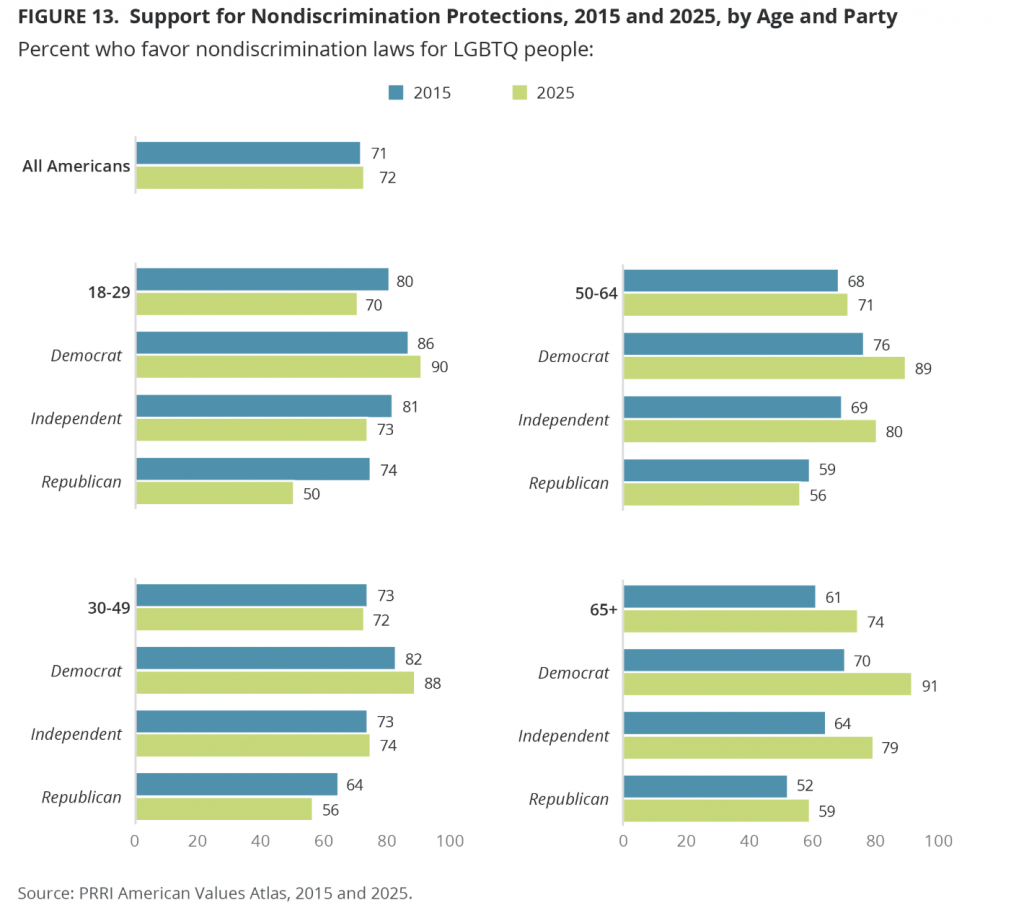
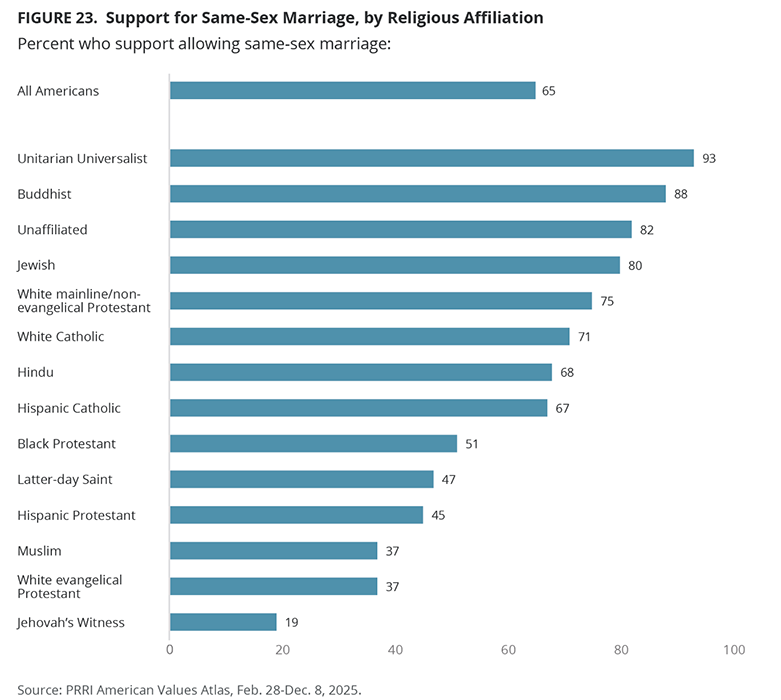
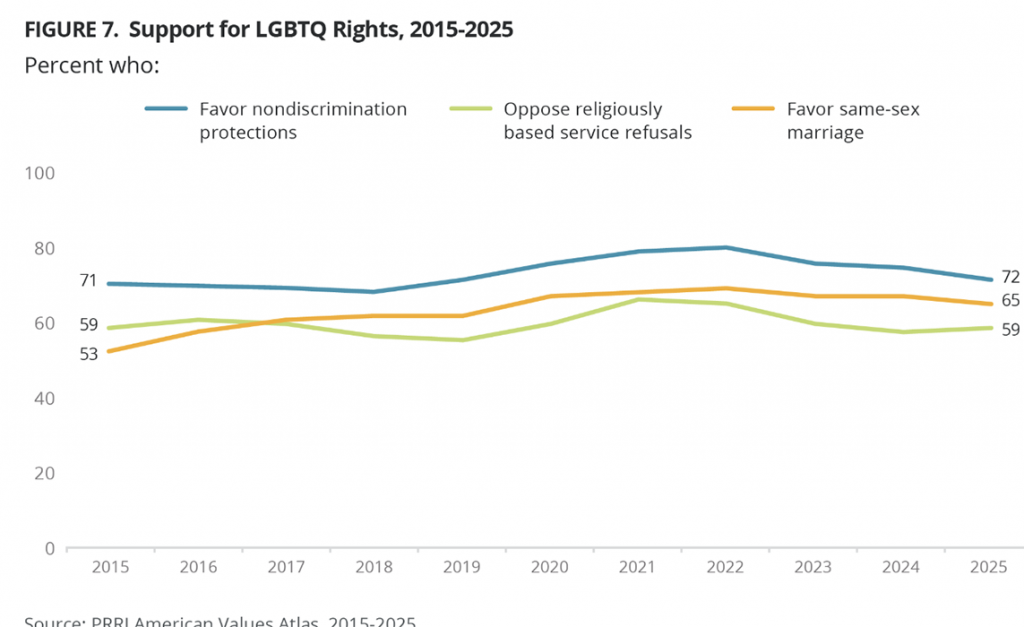
At the level of general principles, public opinion appears relatively stable. Support for legal protections against discrimination affecting LGBTQ individuals stands at 72 percent nationwide, with strong backing among Democrats (90 percent) and independents (76 percent), and a narrower majority among Republicans (56 percent). Similarly, 65 percent of Americans now support same-sex marriage—up from 53 percent a decade ago—suggesting a long-term upward trajectory.
Yet beneath these aggregate figures lies a landscape marked by sharp internal divisions. Geography remains a key variable: states such as Massachusetts, Maryland, Alaska and the District of Columbia show some of the highest levels of support for anti-discrimination measures, while Mississippi, Wyoming and Arkansas rank among the lowest. Notably, only Mississippi and Arkansas fall below majority support for same-sex marriage.
Religion introduces another layer of complexity. Contrary to common assumptions, majorities within most religious groups—including Christians—support anti-discrimination protections. The highest levels are found among the religiously unaffiliated (82 percent) and non-Christian groups (79 percent), followed by Christians of color (71 percent) and white Christians (66 percent). However, these figures mask significant internal variation. Among white Christians, for example, support drops to 54 percent among evangelical Protestants, compared to 74 percent among mainline Protestants and white Catholics.
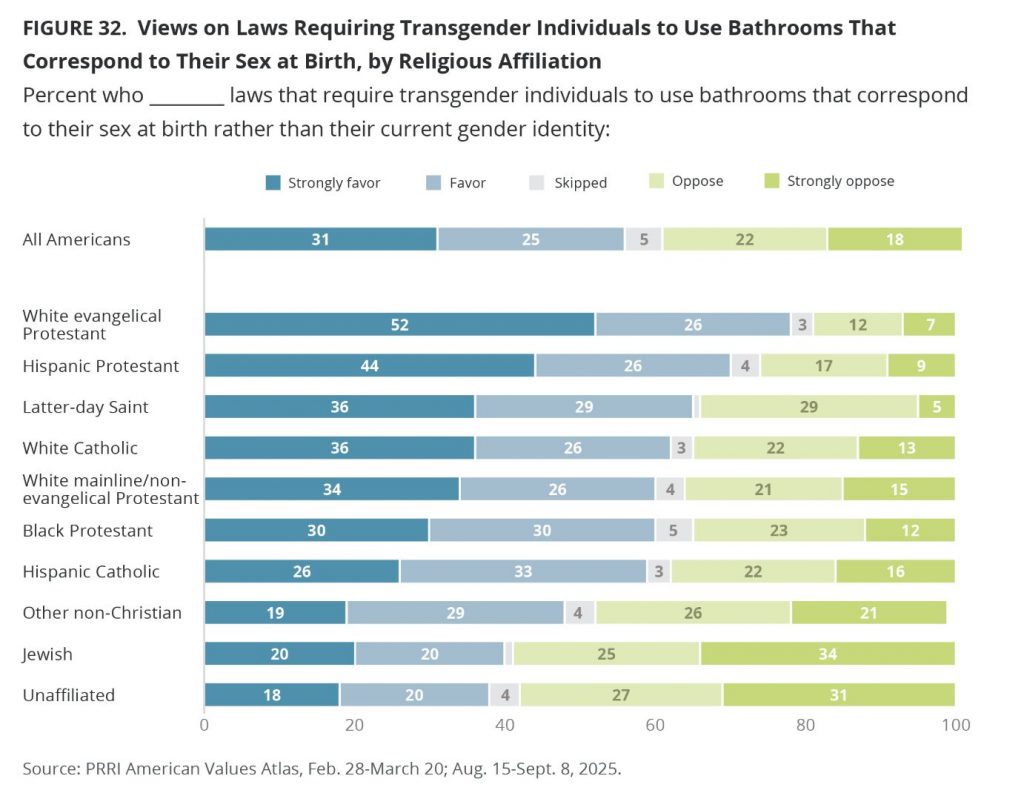
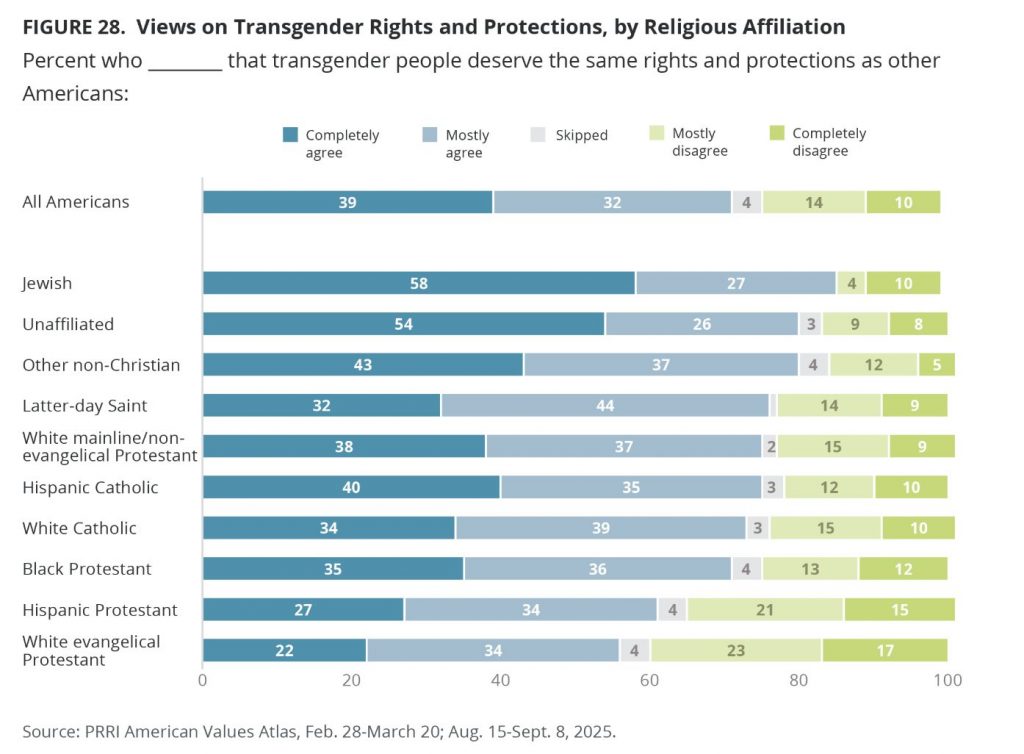
These distinctions become even more pronounced when examining specific policy questions. While 71 percent of Americans agree in principle that transgender individuals deserve equal rights and protections, support becomes more uneven when translated into concrete legislation. A majority—56 percent—backs laws requiring individuals to use bathrooms corresponding to their sex assigned at birth, revealing a gap between abstract endorsement of equality and attitudes toward particular measures.
Deckman describes this as a familiar dynamic in public opinion research: broad principles tend to command consensus, while policy details expose underlying tensions. This is especially evident in debates framed around religious liberty. Overall, 59 percent of Americans oppose allowing businesses to refuse service to LGBTQ individuals on religious grounds, but partisan differences are stark—82 percent of Democrats oppose such refusals, compared with 35 percent of Republicans.
Within Christian communities, the issue highlights a longstanding tension between conscience rights and anti-discrimination norms. The data suggest that this tension is not uniform: white evangelical Protestants and members of the Church of Jesus Christ of Latter-day Saints are among the least likely to oppose service refusals, whereas other Christian groups show higher levels of resistance to such exemptions.
The Catholic case is particularly illustrative of internal diversity. While official teaching does not endorse same-sex marriage, the attitudes of Catholic respondents broadly mirror national trends, with variations linked to ethnicity and social experience. Hispanic Catholics, for instance, tend to show slightly higher levels of support for LGBTQ rights than their white counterparts—a difference some analysts attribute to shared experiences of marginalization.
The report also identifies an important ideological factor: Christian nationalism. Among those who adhere strongly to this worldview, only 40 percent agree that transgender individuals should enjoy equal rights, compared to 92 percent among those who reject it outright. This gradient suggests that theological-political frameworks, rather than simple religious affiliation, play a decisive role in shaping attitudes.
Perhaps the most unexpected finding concerns younger Republicans. While younger Americans overall are more likely to identify as LGBTQ, support for anti-discrimination protections within this subgroup has declined—from 74 percent in 2015 to 50 percent in 2025. Among all Americans aged 18 to 29, support has also dropped, though less dramatically, from 80 percent to 70 percent. This trend challenges earlier assumptions that generational turnover would automatically produce more liberal positions within the Republican Party.
For Deckman, the explanation lies partly in political polarization. In recent years, debates over transgender rights in particular have become central to partisan identity, reshaping attitudes even among younger cohorts. Rather than moderating the party, younger Republicans who remain engaged appear to align more closely with its conservative base.
Taken together, the findings depict a society that has moved toward broader acceptance of LGBTQ individuals in principle, while becoming more divided over how that acceptance should be expressed in law and public life. The interplay between religion, politics and personal relationships—many Americans now report having close friends or family members who are LGBTQ—continues to drive change, but not in a uniform direction.
In this evolving landscape, the United States appears less like a country converging on consensus than one renegotiating its moral and legal boundaries in real time, with faith communities, political identities and generational shifts all playing decisive roles.
Thank you for reading our content. If you would like to receive ZENIT’s daily e-mail news, you can subscribe for free through this link.