

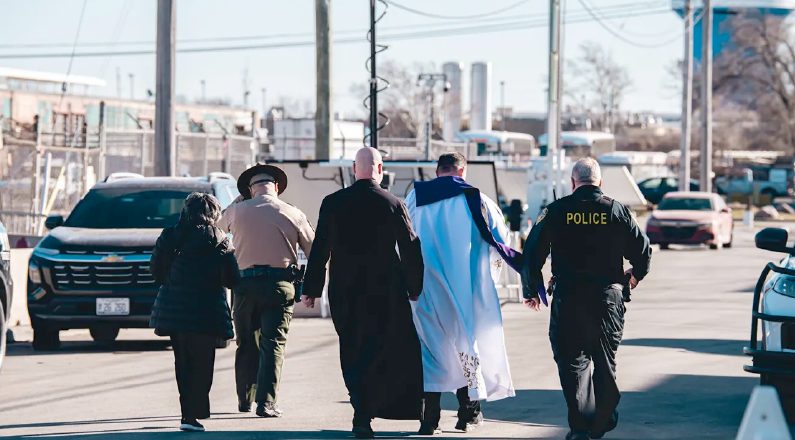
(ZENIT News / St. Paul, 03.24.2026).- A federal courtroom in Minnesota has become the latest arena where immigration policy, constitutional rights, and religious duty intersect, after a judge ruled that clergy must be allowed to minister to detainees held in a key federal facility.
On March 20, U.S. District Judge Jerry Blackwell granted a preliminary injunction requiring the Department of Homeland Security to permit in-person pastoral visits at the Bishop Henry Whipple Federal Building in Minneapolis. The ruling follows a lawsuit brought by Christian leaders—including a Jesuit priest—who argued that the government had effectively blocked them from fulfilling what they described as a core religious obligation: offering spiritual care to those in distress.
The case centers on a facility that, at the height of a large-scale immigration enforcement effort, became a focal point of controversy. Located in Minnesota and associated with the deployment of approximately 3,000 federal agents during the peak of operations, the Whipple building has drawn protests and scrutiny over both conditions and access. Named after a 19th-century Episcopal bishop known for his advocacy of human rights, the site now stands, according to the plaintiffs, in stark contrast to that legacy.
Among those directly affected was Jennifer Nagel, a Lutheran bishop who was turned away when she attempted to visit detainees on Ash Wednesday—one of the most significant days in the Christian liturgical calendar. For her and others, the denial of access was not merely administrative: ministry to the vulnerable, she argued, lies at the heart of religious vocation.
The lawsuit, supported by a broad coalition of religious actors—including Catholic, Lutheran, Jewish and interfaith organizations—framed the issue in constitutional terms. Denying clergy access, they contended, amounted to an infringement on the free exercise of religion, particularly when detainees themselves were seeking prayer, sacraments, or pastoral counsel during periods of acute uncertainty.
Judge Blackwell agreed that the plaintiffs had demonstrated a likelihood of success on the merits of their claim and that the restrictions imposed by the government risked causing “irreparable harm.” His order explicitly states that authorities cannot enforce a regime that excludes clergy under all circumstances. Instead, it requires the development of a formal, written protocol ensuring access, subject to reasonable security measures.
The ruling also sets deadlines: both parties must attempt to agree on operational details within four working days and submit a joint plan within seven days, or present competing proposals. A further status report is due by April 2, indicating that the legal process is far from concluded.
Federal officials had argued that the situation had already evolved. According to their account, the enforcement surge—known as Operation Metro Surge—ended on February 12, and the number of detainees has since declined. They also maintained that restrictions on visits had been eased in recent weeks and that clergy had been allowed entry under certain conditions.
Yet the court found these assurances insufficient. The absence of a consistent, enforceable policy left access contingent on discretionary decisions, raising concerns about arbitrariness and unequal treatment. Testimony from immigration authorities indicated that requests for visits were handled case by case, and that the facility itself was considered a temporary holding site, where standard visitation norms might not apply.
The controversy extends beyond clergy. Members of Congress from Minnesota were reportedly denied entry when attempting to inspect the facility, later raising concerns about detainee conditions. Access to legal counsel has also been contested: in a separate but related case, another federal judge recently ordered that detainees be granted prompt access to attorneys before any transfer, with a decision pending on whether that order will become permanent.
What distinguishes the current ruling is its broader symbolic resonance. Across the United States, religious leaders have increasingly pressed for access to immigration detention centers, particularly during periods such as Lent and Ramadan. Similar legal battles have unfolded elsewhere, including in Illinois and Texas, where clergy have encountered comparable barriers.
For the plaintiffs, the issue is not confined to institutional rights but touches on the lived reality of detainees. As one of their legal representatives noted, pastoral care is often most urgently needed precisely in environments marked by fear, isolation, and uncertainty. In such contexts, access to spiritual support becomes, in their view, inseparable from human dignity.
The government, for its part, continues to emphasize the need to balance such access with operational and security concerns. Judge Blackwell’s ruling reflects an attempt to navigate that balance, affirming that while restrictions may be justified, they cannot amount to a blanket exclusion.
Thank you for reading our content. If you would like to receive ZENIT’s daily e-mail news, you can subscribe for free through this link.

Publicaciones relacionadas:
 United States Restricts Visas to Chinese Officials for “Repression” of Religious and Ethnic Minorities
 USA: “Catholic” cases facing the Supreme Court that will have consequences for freedoms
 California’s Democratic government removes statue of Saint Junípero Sierra after lying about consulting the Archbishop of San Francisco
 Mexico: MORENA Party representative withdraws bill that restricted freedom of expression for clergy
