

(ZENIT News / Jerusalem, 05.20.2026).- For decades after the collapse of the Soviet Union, Russia appeared to be living through a remarkable religious revival. Churches that had once been closed reopened, monasteries were restored, and millions of people who had grown up under state atheism rediscovered a spiritual language their parents or grandparents had been discouraged from speaking. Yet new research suggests that the story of Russian Orthodoxy may be entering a more complex phase — not one of simple growth or decline, but of separation between cultural identity and active faith.
A survey commissioned by Moscow’s Saint Tikhon University and conducted by the Russian Public Opinion Foundation indicates that the proportion of Russians identifying as Orthodox Christians has fallen from 75 percent to 65 percent over the last decade. The same research also found that those who say they never attend religious services increased from 28 percent to 32 percent.
Published in mid-May 2026, the findings have attracted considerable attention because the Russian Orthodox Church remains the largest among the world’s universally recognized Eastern Orthodox Churches. Estimates vary, but some calculations place the number of Russian Orthodox believers worldwide at approximately 110 million people, including around 95 million in Russia itself. The number of actively practicing believers, however, is generally considered to be substantially lower.
The study, based on interviews with 1,501 adults conducted during February and March 2026, offers a snapshot of religious life in a country still marked by the social and political consequences of Russia’s war in Ukraine, launched in 2022 with public support from the Moscow Patriarchate.
Yet the most intriguing aspect of the data may not be the apparent decline itself, but the unexpected contrast hidden beneath it.
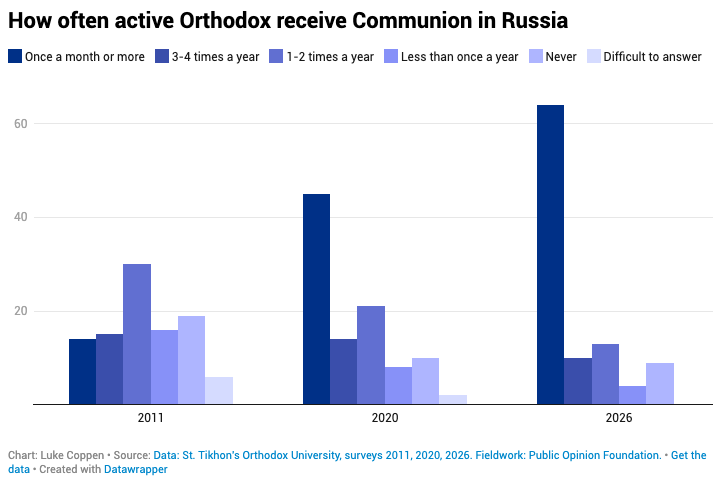
While overall identification with Orthodoxy appears to be weakening, those who actively participate in church life seem to be becoming markedly more committed. Among practicing Orthodox Christians, the proportion receiving Holy Communion at least once a month rose from 14 percent in 2011 to 45 percent in 2020, reaching 64 percent in 2026.
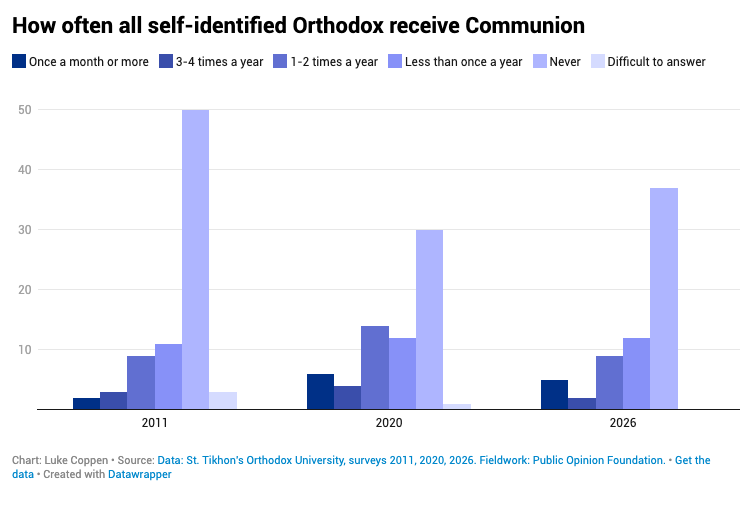
Looking at Russian Orthodox believers as a whole, the increase is far smaller, moving only from 2 percent to 5 percent over the same period. Still, the figures suggest that among those who remain engaged, religious practice may be deepening rather than fading.
For readers less familiar with Eastern Christianity, this distinction is significant. Frequent Communion in Orthodox life traditionally requires preparation through fasting, prayer, and recent sacramental confession. Unlike many Catholic communities where weekly Communion is common, Orthodox practice has historically involved stricter preparation. A rise in regular reception therefore may indicate not only attendance, but a more intensive sacramental life.
Elena Prutskova, a senior researcher specializing in the sociology of religion at Saint Tikhon University, suggested that the data reveal two increasingly distinct groups within Russian Orthodoxy: a committed core of believers and a broader population for whom Orthodoxy functions largely as a marker of cultural or national identity.
Professor Valentina Slobozhnikova pointed to a broader context, arguing that after nearly three decades of post-Soviet religious expansion, growth began slowing around 2019 before giving way to gradual decline. She linked this shift to wider European patterns, where younger generations increasingly approach religion through individual choice rather than inherited structures.
Still, she also suggested that contemporary pressures — including war and social uncertainty — may be intensifying commitment among practicing believers.
That may prove to be the most important lesson of the new figures. The Russian Orthodox Church may not simply be shrinking or expanding. Instead, it may be becoming more concentrated: smaller in its cultural reach, yet potentially stronger among those who continue to anchor their lives around faith, worship, and sacramental practice.
Thank you for reading our content. If you would like to receive ZENIT’s daily e-mail news, you can subscribe for free through this link.

Publicaciones relacionadas:
 The Problem of Suicide Among the Catholic Clergy: Alarm Raised Given the Increase in Some Countries
 Study reveals that non-churchgoers would go to Mass at Christmas if invited by someone else
 Religious Freedom Gains Momentum Across the United States, New Survey Reveals
 Four Years of the Russian Invasion of Ukraine: An Analysis from the Church
