

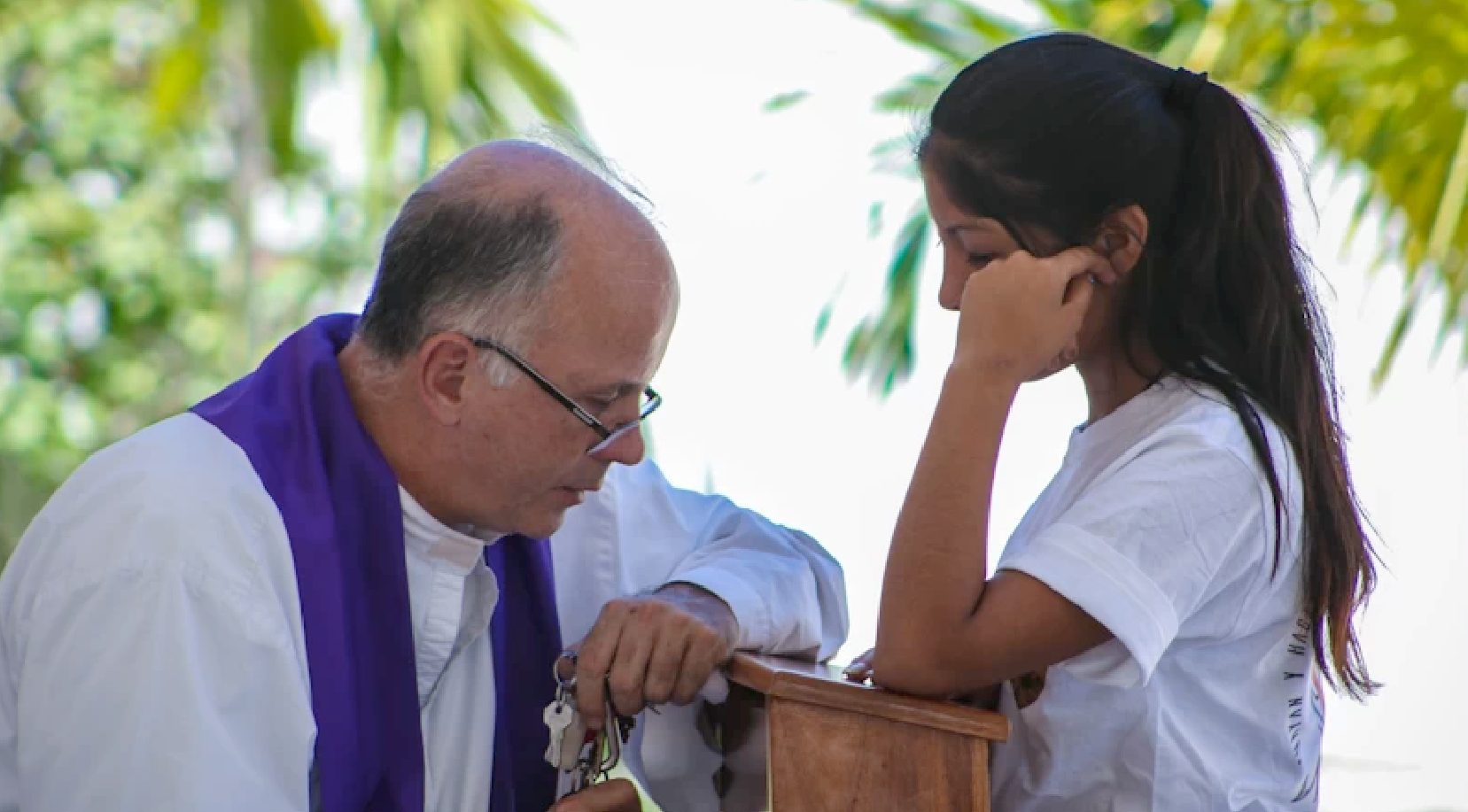
(ZENIT News – Porta Luz / Santiago, April 29, 2026) – A recent statistical study entitled «Catholic Pulse Report» reveals interesting data to understand what attracts Catholics to the Sacrament, what keeps them away, and why many remain open to returning.
The data comes from a survey conducted in the United States by Vinea Research, a Catholic think tank, which concludes: «Confession is one of the Church’s most powerful Sacraments, and one of the most misunderstood. The results do not reveal a declining devotion, but rather a people who, silently, yearn to return.»
The respondents’ answers bring good news. Specifically, 67% of Catholics who have not gone to Confession in the last year are willing to do so again, and almost half of them express a clear desire to do so.
Other key findings revealed that mercy is a motivating factor: 83% of Catholics who go to Confession cite it as the main reason for doing so; 75% of those who have not gone in the last year state that mercy is the reason they would return, making it the most frequent motivation in both groups.
They believe in Mercy, but Shame Weighs More
Among those who go to Confession, approximately two-thirds report experiencing a clear sense of forgiveness, the certainty of receiving God’s mercy, and inner peace.
The most common barrier to not go to Confession with a priest is the belief that one can seek God’s forgiveness directly (63% overall; 73% among those who have not confessed in the last year).
Shame is also a factor. Among those who have not confessed in more than a year, 50% say they haven’t done so because they feel ashamed to talk about their sins, while 53% consider the Sacrament, in general, uncomfortable.
Are They Saying What the Interviewer Wants to Hear?
Surprisingly, among those who infrequently go to Confession, 43% say they would go more often if they heard their pastors speak more frequently about how normal it is to always struggle with the same sins; and an identical percentage indicate they wish the pastors of the Church would place more emphasis on mercy than on judgment.
For the research team, this reveals a common paradox in these studies. They refer to the potential bias in the responses: Is this really what people think, or are they simply saying what they believe the interviewer wants to hear? Vinea Research asks.
A Reality That Began Decades Ago
Vinea’s study is not the first research to focus on Confession. A similar study of the University of Notre Dame in the mid-1980s revealed that the number of Catholics who confessed at least once a month was only 6%; the same study found that 26% of «active» Catholics no longer went to Confession.
In 2005 and again in 2008, the Center for Applied Apostolic Research at Georgetown University — a national research center dedicated to conducting sociological studies on the Catholic Church — revealed that three-quarters of Catholics never participated in the Sacrament of Reconciliation, or did so less than once a year.
Similarly, a 2025 Pew Research Center study indicated that only 23% of Catholics reported going to Confession at least once a year.
Priority Priests Should Have
Although more data is unavailable, unless priests themselves prioritize this Sacrament – in terms of calling their parishioners to Confession, educating their parishioners, dedicating daily time to the Sacrament, and going to Confession themselves frequently — nothing will improve.
In fact, Vinea Research points out that, while simply scheduling Confession times will not, in itself, generate the desire to go to Confession, «it can at least eliminate practical obstacles for Catholics who are already willing to return to this Sacrament.»
Vinea discovered that conflicts with schedules posed an obstacle for 34% of those surveyed, but also that more than half of the Catholics who have not gone to Confession in a long time say that more convenient Confession times would eliminate this obstacle and encourage them to go.
It also noted that «the results suggest that Catholics respond better to greater availability, and that weekday afternoons and Sunday mornings appear to be the most promising additions to the traditional Saturday schedule.»

Publicaciones relacionadas:
 Ecclesiology today: the crisis of Christianity and what we need now
 Religious Freedom Under Siege: ACN Report Highlights Escalating Persecution
 Russia Calls Patriarch Bartholomew “Antichrist in a Cassock”
 Holy Shroud, medieval painting? The response of three Italian scientists to a Brazilian “researcher”
