

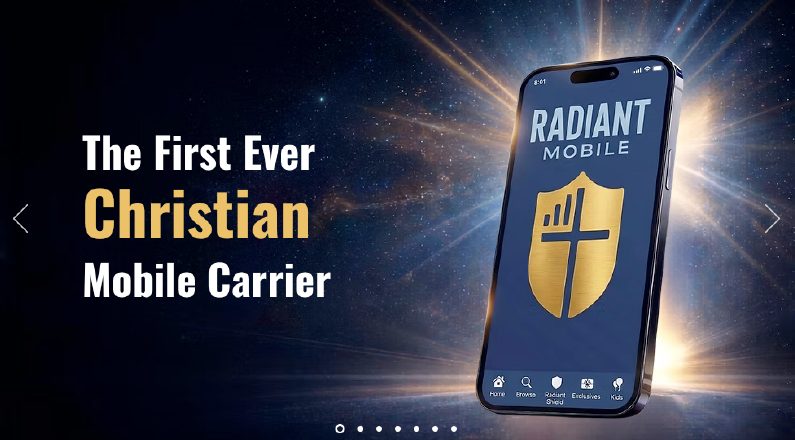
(ZENIT News / Washington, 05.09.2026).- A new American mobile phone company is attempting something that goes far beyond traditional parental controls or optional content filters. Its ambition is not merely to provide wireless coverage, but to reshape the digital environment itself according to explicitly Christian moral principles.
The company, called Radiant Mobile, is entering the crowded U.S. telecommunications market with a model that combines mobile connectivity, religious identity, and network-level censorship of online content. In practice, this means certain websites and categories of material are blocked before they ever reach the user’s device.
The experiment places Radiant Mobile at the center of some of the most sensitive debates in modern society: pornography, sexual ethics, freedom of conscience, technological power, parental authority, and the growing question of whether digital life should be curated according to moral worldviews.
Unlike a browser extension or accountability application, Radiant’s filtering system operates directly through the mobile network itself. The company functions as a mobile virtual network operator, or MVNO, meaning it does not own cellular towers but instead leases infrastructure from larger carriers — in this case, T-Mobile — while building its own services on top of that network.
What makes the initiative distinctive is the technological layer sitting between the internet and the customer. According to the company, filtering technology developed by the Israeli cybersecurity firm Allot classifies websites into more than 100 categories and blocks selected content automatically at network level.
Pornography is the clearest example. Users cannot simply disable the restriction. The filtering is permanent within the service architecture itself.
Yet the restrictions do not stop there.
Radiant says its system can also limit access to content related to gender ideology, transgender topics, self-harm, violent material, malware, gaming categories, and what it describes as “cults,” including satanism. One example repeatedly cited by the company illustrates how granular the filtering can become: a university website such as yale.edu could remain accessible while a subdomain specifically dedicated to LGBTQ+ themes might be blocked.
That distinction reveals the deeper nature of the project. This is not merely cybersecurity or child protection. It is editorial judgment embedded into telecommunications infrastructure.
Founder Paul Fisher, a former modeling agent, described the project to MIT Technology Review as an effort to create what he called a “Jesus-centered environment,” explicitly “free of pornography,” “free of LGBT content,” and “free of trans content.”
Such language guarantees controversy in a cultural climate where debates over sexuality and freedom of expression increasingly dominate public discourse. Supporters see the initiative as a long-overdue attempt to help families resist destructive digital habits. Critics view it as ideological filtering masquerading as telecommunications.
For many Christian communities, however, the concern about pornography is neither abstract nor marginal. Clergy, counselors, and family ministries across denominations have spent years warning about the psychological, spiritual, and relational consequences of addiction to explicit content, particularly among adolescents. The Catholic Church, along with many Protestant communities, has repeatedly described pornography as harmful to human dignity and family life.
Chris Klimis, a pastor in Orlando who serves as Radiant’s chief operating officer, framed the issue in urgent pastoral terms. He said he joined the project because he believed Christian communities were facing a severe pornography crisis and needed stronger tools than voluntary accountability software.
“We have to find a way to shut the door to the digital space,” he said.
That phrase captures the company’s philosophy. Rather than helping users navigate temptation, Radiant aims to remove large portions of temptation altogether.
In one sense, the concept is not entirely new. Filtering software such as Covenant Eyes already allows users to monitor or restrict explicit content and notify accountability partners if safeguards are bypassed. Schools, libraries, and governments worldwide also use network-level filtering technologies.
What is new is the attempt to build an entire mobile ecosystem around explicitly religious moral criteria.
Radiant is also trying to establish a broader social and financial infrastructure tied to churches. Fisher says the company has relationships with thousands of congregations throughout the United States and has enlisted Christian influencers to promote the service. Subscription plans reportedly cost around $30 per month, with part of the revenue directed toward participating churches.
The model therefore blends commerce, digital infrastructure, and faith communities into a single ecosystem — one designed not only to connect users but to shape habits and moral environments.
The project emerges at a moment when many religious believers feel increasingly alienated from mainstream digital culture. Battles over gender identity, children’s online exposure, algorithmic radicalization, and explicit content have intensified across the United States and Europe. Some families now actively seek alternative technological spaces aligned with their convictions.
At the same time, the initiative raises difficult questions.
Who decides which ideas or identities become inaccessible? What happens when moral filtering becomes technically invisible to users? Could similar tools someday be used by governments or corporations to impose ideological restrictions from entirely different worldviews?
Those concerns are especially relevant because the technical capability itself is not unique to Christian companies. The infrastructure enabling Radiant’s filtering could theoretically be adapted for political, ideological, or state-driven censorship elsewhere.
T-Mobile, whose network infrastructure underlies the service, has stated that it does not directly manage Radiant’s operations and works instead through an intermediary MVNO management company. That distance is common in telecommunications agreements, but it leaves unresolved questions about responsibility when filtering occurs at network level rather than through optional applications.
Radiant already appears to be thinking internationally. The company has expressed interest in expanding into countries with large Christian populations, including Mexico and South Korea. That suggests its founders see the project not as a niche American experiment, but as a potentially exportable model for faith-based digital environments.
Whether that model succeeds may depend less on technical performance than on cultural appetite. Modern consumers routinely accept invisible filtering already — through algorithms, moderation systems, app store policies, and recommendation engines — but many react differently when the underlying values are openly religious instead of corporate or secular.
In that sense, Radiant Mobile exposes a deeper question shaping the future of digital civilization: if every technological ecosystem inevitably reflects moral assumptions, who should be allowed to define them?
Thank you for reading our content. If you would like to receive ZENIT’s daily e-mail news, you can subscribe for free through this link.

Publicaciones relacionadas:
 The Papamobile Goes Electric: Mercedes-Benz Delivers First All-Electric Vehicle to Pope Francis
 Brazil: Christ the Redeemer in Rio de Janeiro sees increase in number of sacraments celebrated
 Secularized Netherlands joins list of countries showing percentage growth in conversions to Catholicism
 London’s Trafalgar Square to Host Landmark 15th Anniversary Performance of the Passion of Jesus on Good Friday
