

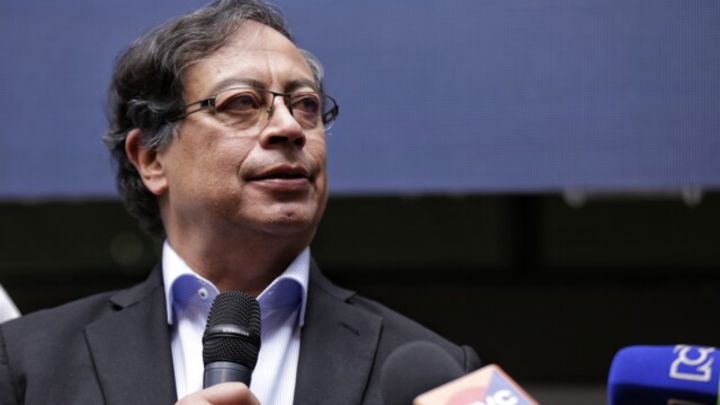
(ZENIT News / Bogotá, 04.21.2026).- A controversy unfolding in Colombia has brought into sharp focus a recurring fault line in Latin America: the uneasy relationship between political authority and religious expression. What began as a local dispute involving a parish priest in Bogotá has escalated into a national debate about the limits of free speech, the role of the Church in public life, and the protection of religious liberty in a polarized electoral climate.
At the center of the storm is President Gustavo Petro, who, during a recent cabinet meeting, publicly rebuked a priest from the Parish of the Holy Family in Bogotá. According to the president’s own account, the priest had used his homilies to warn against communism, prompting Petro to react with unusual bluntness: “If you don’t like it, be quiet,” he said, before instructing the national police chief to “look into what they are doing.”
The remarks, delivered in a visibly agitated tone, have raised concerns not only because of their content but also because of their institutional implications. A head of state calling on law enforcement to scrutinize a priest’s preaching inevitably touches on the sensitive boundary between legitimate oversight and undue interference in religious affairs.
Petro justified his reaction by invoking the electoral context. Colombia is in a politically charged period, and the president argued that sermons perceived as politically biased could influence voters inappropriately. “Here there is freedom of belief, but not to unleash violence,” he stated, linking the priest’s alleged rhetoric to broader historical patterns of conflict. In a striking and controversial comparison, he referenced mid-20th-century Spain, suggesting that anti-communist preaching had once contributed to social violence, drawing a parallel with Colombia’s own history of political bloodshed.
🇨🇴⛪️El presidente de Colombia y ex guerrillero, acosó en directo a sacerdote católico por hablar contra el comunismo. Sucedió a mediados de abril de 2026 pic.twitter.com/X7B6zAXjx1
— P. Jorge Enrique Mújica, LC (@web_pastor) April 21, 2026
Yet this line of argument introduces a delicate question: can moral or ideological teaching from a pulpit be equated with incitement? Within the Catholic tradition, preaching often addresses social, economic, and political realities, especially when they intersect with moral principles. The Church’s social doctrine, developed over more than a century, explicitly encourages engagement with public life, while insisting that such engagement must respect human dignity and promote the common good.
From this perspective, the tension is not new. Latin America has long experienced friction between ecclesial voices and political power, particularly when clergy address issues such as ideology, governance, or human rights. What distinguishes the current episode is the directness of the presidential response and the implicit suggestion that state mechanisms might be mobilized in response to a homily.
Petro also framed his critique in theological terms, offering his own interpretation of the Christian message as one centered on “peace, life and truth,” detached from ideological or economic frameworks. This rhetorical move, while appealing on the surface, risks reducing a complex theological tradition to a selective reading that excludes legitimate moral critique. The Catholic understanding of peace, for example, is not merely the absence of conflict but the fruit of justice—a concept that can require confronting ideas or systems perceived as harmful.
The broader concern emerging from this episode is the safeguarding of religious freedom. In democratic societies, this freedom does not imply that religious leaders are above criticism. However, it does require that their right to preach, within the bounds of the law, is protected from coercion or intimidation. When political leaders publicly admonish clergy and call for official scrutiny, the balance can quickly tilt toward pressure rather than dialogue.
This is particularly significant in a region where Christians, including Catholics, have at times faced hostility or marginalization. While Colombia does not fall into the category of countries where persecution is systematic, incidents that blur the line between criticism and intimidation can contribute to a climate of self-censorship. For communities already navigating social tensions, such signals matter.
What is ultimately at stake is not merely a dispute between a president and a parish priest, but a deeper question about the place of faith in public life. Can religious convictions be expressed openly without being perceived as political interference? Can political authorities respect that expression without fearing its influence?
Thank you for reading our content. If you would like to receive ZENIT’s daily e-mail news, you can subscribe for free through this link.

Publicaciones relacionadas:
 Poignant: Was the Departure of Mother Teresa’s Nuns, Expelled from Nicaragua by Daniel Ortega’s Regime
 Chinese Bishop Is Arrested for Celebrating Mass, Marking the Beginning of the Jubilee Year, Without the Permission of the Communist Government
 After one month of Nicolás Maduro’s imprisonment, the Venezuelan government restores Cardinal Porras’ passport
 Nicaragua: A Holy Week with Many Restrictions, But More Faith from Local Catholics
