(ZENIT News / Madrid, 04.24.2026).- At a time when secularization has long been treated as an irreversible trend in Western Europe, new data indicate that a significant segment of Spanish youth may be rediscovering religious identity, and doing so in ways that challenge both sociological assumptions and pastoral expectations.
Preliminary findings from the forthcoming “Spanish Youth Report 2026,” produced by the SM Foundation and based on data collected in 2025, suggest that 45 percent of young people in Spain identify as Catholic. The figure marks a notable increase from 31.6 percent in 2020, representing a rise of nearly 50 percent in just five years. Even before the full publication of the report, scheduled for April 28 in Madrid, this single data point has already sparked debate.
The contrast with other measurements is striking. Spain’s Center for Sociological Research estimated in 2025 that only 28 percent of young people identified as Catholic. While methodological differences exist—most notably that the official survey includes only adults, whereas the SM Foundation begins at age 15—the gap between 28 percent and 45 percent is too wide to ignore and raises questions about how religious identity is being measured.
Beyond self-identification, the data point to a deeper shift in attitudes. Today, 38.4 percent of young Spaniards say religion is “fairly” or “very” important in their lives, the highest level recorded in this series. The trajectory is clear: 16 percent in 2016, 22 percent in 2020, and now a figure approaching two in five young people. This suggests not merely cultural affiliation, but a renewed perception of religion as meaningful.
Understanding this change requires looking beyond statistics. Several converging dynamics appear to be at work. One is demographic: religious families, including but not limited to Catholic ones, tend to have higher birth rates and transmit faith more consistently. Immigration also plays a role, bringing younger and often more religious populations into Spain’s social fabric.
Yet these structural explanations only go so far. Equally significant is the cultural climate in which this generation has come of age. The pandemic of 2020, followed by economic uncertainty, precarious employment, and difficulty accessing housing, has contributed to a broader sense of instability. For some young people, this has translated into a renewed openness to transcendence, a search for meaning that material prosperity alone has not satisfied.
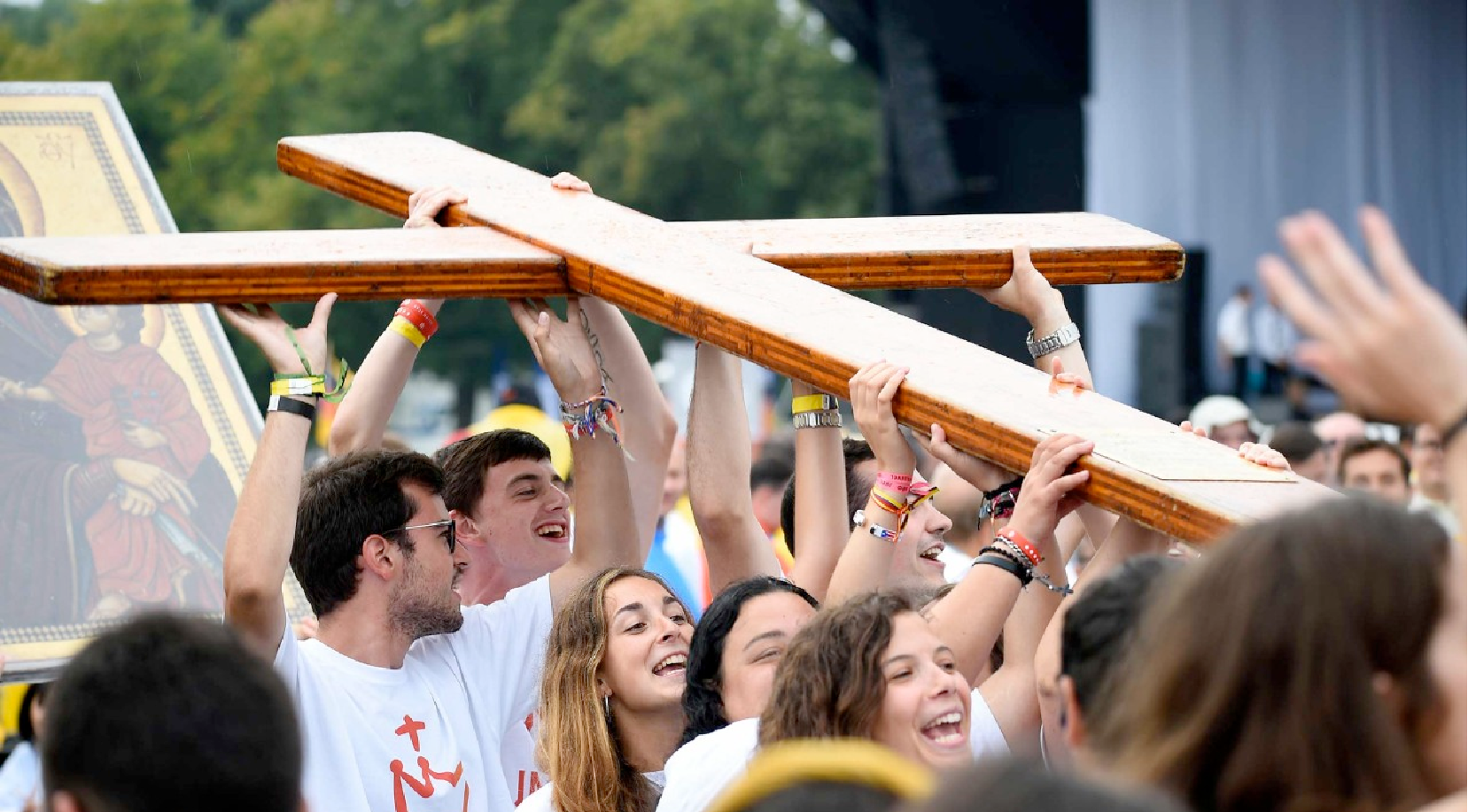
Another factor is the transformation of evangelization itself. What Saint John Paul II once described as “new methods, new ardor, and new expression” appears to be taking concrete form. Youth-oriented initiatives—ranging from structured catechetical programs to retreats such as Effetá or Bartimeo—have expanded rapidly since 2020. These experiences often combine personal testimony, communal life, and emotionally engaged forms of prayer, creating environments where faith is encountered not as an abstract doctrine but as a lived reality.
Digital culture, often blamed for secularization, has paradoxically become an instrument of religious transmission. Social media platforms, podcasts, and online video channels allow young people to access a wide range of voices, from priests to lay witnesses, and to form communities that extend into real-life gatherings. In this sense, the internet does not replace religious practice but facilitates pathways toward it.
The experiential dimension of Catholicism also appears to resonate with a generation shaped by virtual interactions. In a world saturated with screens, the tangible elements of the faith—liturgy, sacraments, pilgrimage, communal worship—acquire renewed significance. The insistence on physical presence, particularly in the Eucharist, offers a counterpoint to the disembodied nature of digital life.
Equally important is the social dimension. In a context marked by fragile relationships and fragmented family structures, the Church can function as a space of belonging. Youth groups, movements, and parish communities provide not only spiritual formation but also networks of friendship and support. The appeal is not purely doctrinal; it is relational.
There is also a paradoxical attraction in the countercultural character of Catholicism. For some young people, embracing a faith that is often marginalized in public discourse becomes a way of asserting identity and resisting prevailing norms. This dynamic should not be overstated, but it helps explain why religious commitment can coexist with, and even emerge from, a highly secular environment.
At the same time, caution is warranted. The data do not necessarily indicate a uniform revival across all segments of youth, nor do they guarantee long-term retention. The history of religious affiliation in Europe suggests that identification does not always translate into sustained practice. Moreover, discrepancies between different surveys highlight the need for methodological clarity before drawing definitive conclusions.
Even so, the emerging picture is more complex than the narrative of steady decline that has dominated in recent decades. If confirmed, these trends would suggest that the relationship between youth and religion in Spain is entering a new phase—one marked not by simple abandonment, but by selective rediscovery.
For the Catholic Church, the implications are significant. The apparent growth is not driven by institutional inertia, but by initiatives that emphasize encounter, community, and coherence of life. It points to a generation that, despite its distance from traditional structures, remains open to questions of meaning, truth, and belonging.
Thank you for reading our content. If you would like to receive ZENIT’s daily e-mail news, you can subscribe for free through this link.