

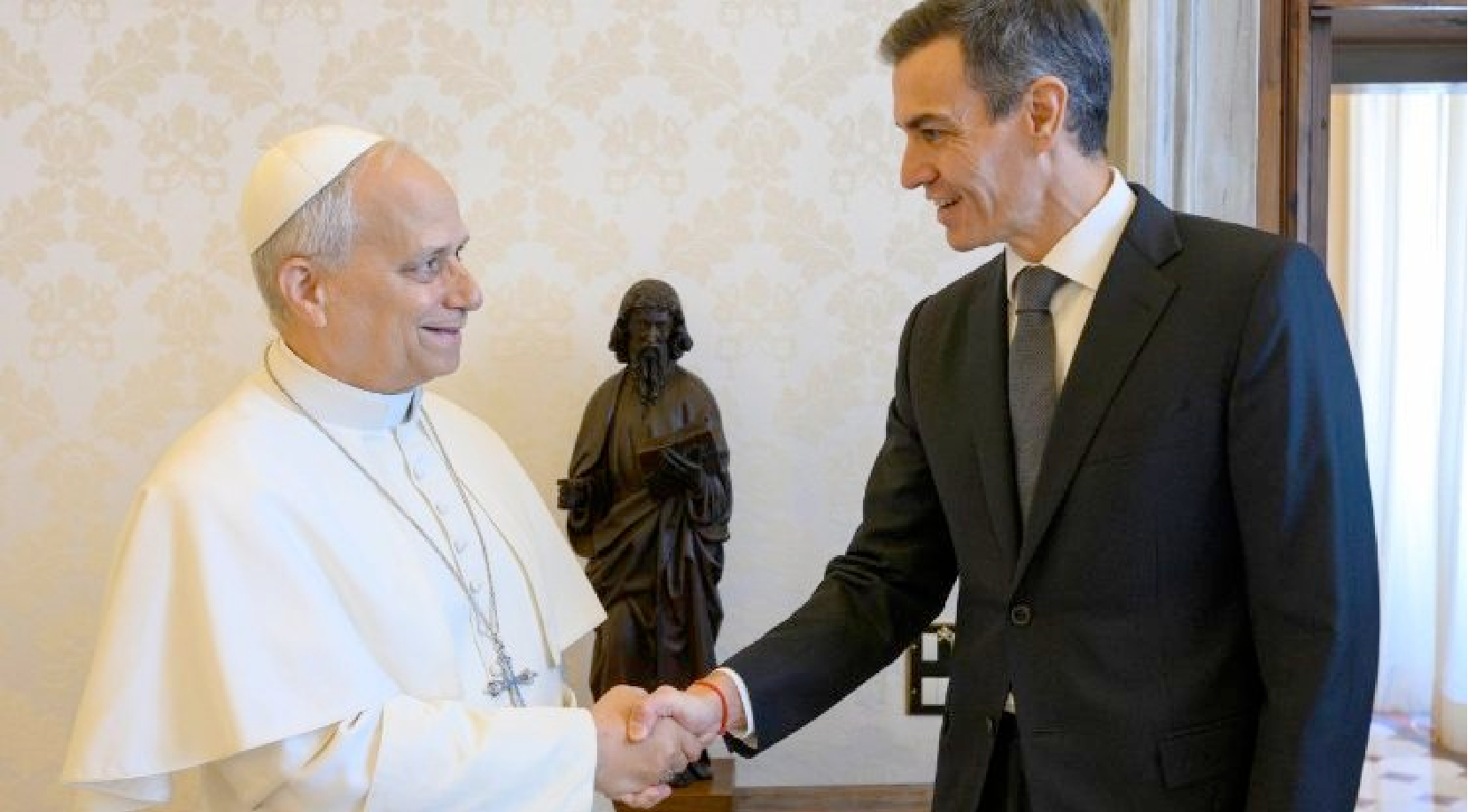
(ZENIT News / Vatican City, 05.27.2026).- As Spain enters one of its most politically charged moments in recent years, Prime Minister Pedro Sánchez arrived at the Vatican. He came amid judicial controversy at home, growing political pressure, and only days before Pope Leo XIV begins what is expected to become a closely watched apostolic journey across Spain.
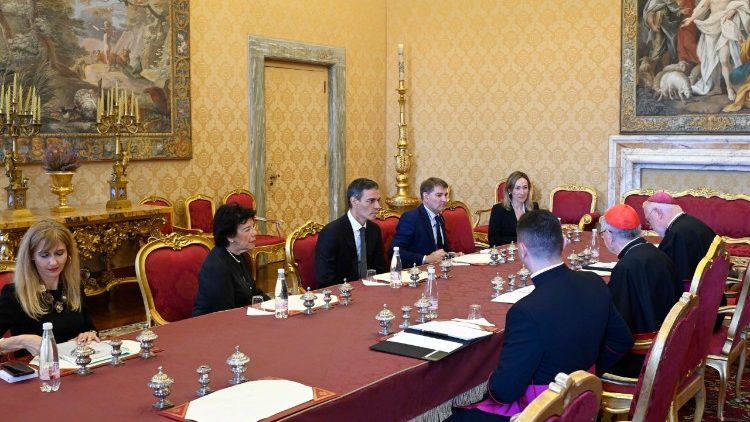
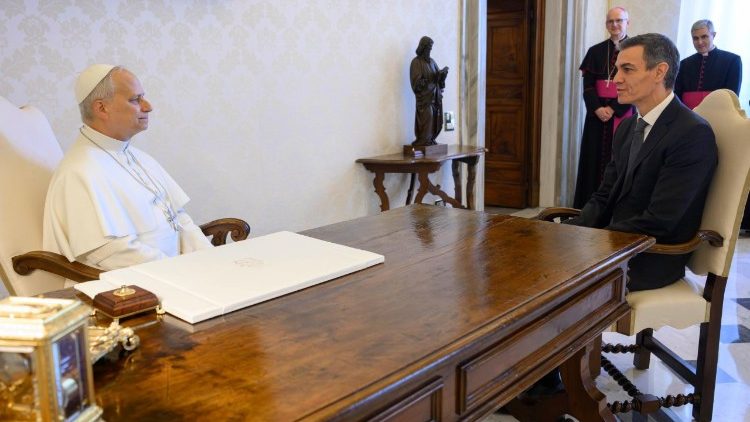
The approximately 45-minute private audience between Sánchez and the Pope unfolded against a turbulent domestic backdrop. On the same day, Spanish political debate was dominated by developments involving investigations linked to the Socialist Party and the legal scrutiny surrounding former Prime Minister José Luis Rodríguez Zapatero. Yet inside the Apostolic Palace, the conversation appears to have moved onto different terrain: peace, migration, international law, and the relationship between public institutions and civil society.
According to the Holy See, the discussions highlighted the importance of fostering a «fruitful dialogue» between local Churches, governments, and the various actors of civil society, grounded in mutual respect and directed toward the common good. That wording may sound diplomatic, but in Catholic social thought the phrase carries substantial meaning. The «common good» is not merely a political slogan; it refers to social conditions allowing individuals and communities to flourish together.
The Vatican also noted broad discussion of global concerns: armed conflicts, migration, multilateral cooperation, and the need for a sustained commitment to peace. On several of these themes, Spain and the Holy See have frequently found themselves speaking similar languages in recent years, especially regarding the defense of international law and efforts to avoid escalation in international crises.
Following the meeting, Sánchez described Pope Leo XIV as a «moral compass» whose voice promotes empathy and reason over what he characterized as the law of force. He also emphasized what he called a strong convergence between his government and the Church regarding migration, presenting both institutions as sharing a humanitarian approach.
Yet Sánchez also sought to avoid transforming the Pope’s visit into a partisan event. Asked whether Leo XIV might validate his government’s policies during his June 6–12 journey to Spain, the prime minister insisted that the Pontiff’s presence rises above domestic political divisions.
That distinction may prove important. Papal visits often create unusual political moments because they simultaneously belong to religion, diplomacy, and culture while resisting complete ownership by any of them. A Pope arrives not only as head of the Catholic Church but also as head of state and a moral figure whose message often escapes conventional political categories.
The upcoming trip itself already carries unusual significance. Among the most anticipated moments is Leo XIV’s scheduled address before Spain’s Congress of Deputies on June 8 — a highly symbolic event and an unprecedented occasion in modern Spanish political life. Stops in Madrid, Barcelona, and the Canary Islands are also expected, alongside public liturgies and meetings with social and civic groups.
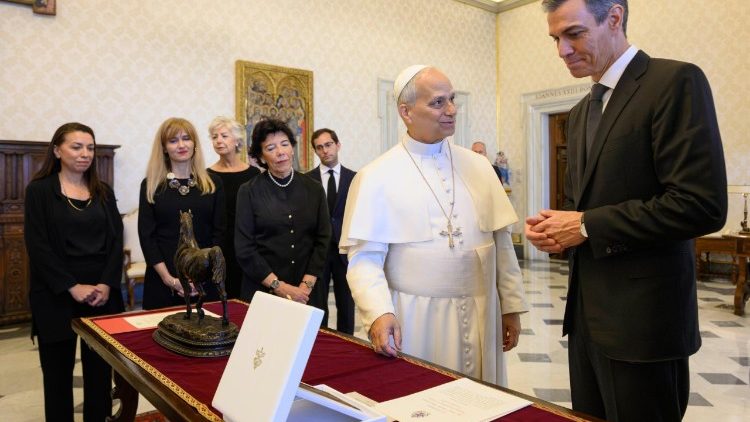
The exchange of gifts after the audience reflected another dimension of the encounter. Sánchez presented the Pope with a sculpture of a Spanish horse, recalling the historical bond between Spanish horses and the papacy — a connection recently renewed through the introduction of three Spanish horses into the Borgo Laudato Si project at Castel Gandolfo, an initiative combining ecological stewardship, education, and social formation.
Leo XIV, in return, offered Sánchez a copy of his first encyclical, Magnifica Humanitas, an art volume, and a symbolic plaque depicting a pillar rising from ruins. According to Spanish officials, the Pope described it as a reminder of hope and of humanity’s obligation to build peace.
Outside Vatican walls, however, Spanish politics quickly reasserted itself. Sánchez defended Zapatero and reaffirmed his commitment to cooperating with judicial authorities, while rejecting calls for early elections. Stability, he argued, remains necessary as Spain continues implementing major economic and European initiatives.
But perhaps the most revealing aspect of the day was not what was said publicly. Amid legal headlines and political calculations, Rome briefly offered a different setting: one where governments and the Church attempted, at least for an hour, to discuss questions larger than electoral cycles.
Thank you for reading our content. If you would like to receive ZENIT’s daily e-mail news, you can subscribe for free through this link.

Publicaciones relacionadas:
 For the first time, a pope (Leo XIV) will receive the U.S. Medal of Freedom: here’s what you need to know
 A Church Against the Logic of War: Vatican Voices, Middle East Realities, and the Risk of a Vanishing Christianity
 Trump responds to Pope Leo XIV: I don’t want a ceasefire
 Between Kyiv and Jerusalem: Vatican Diplomacy in Full Swing During Holy Week. Pope Leo XIV Speaks with the Ukrainian and Israeli Presidents
