

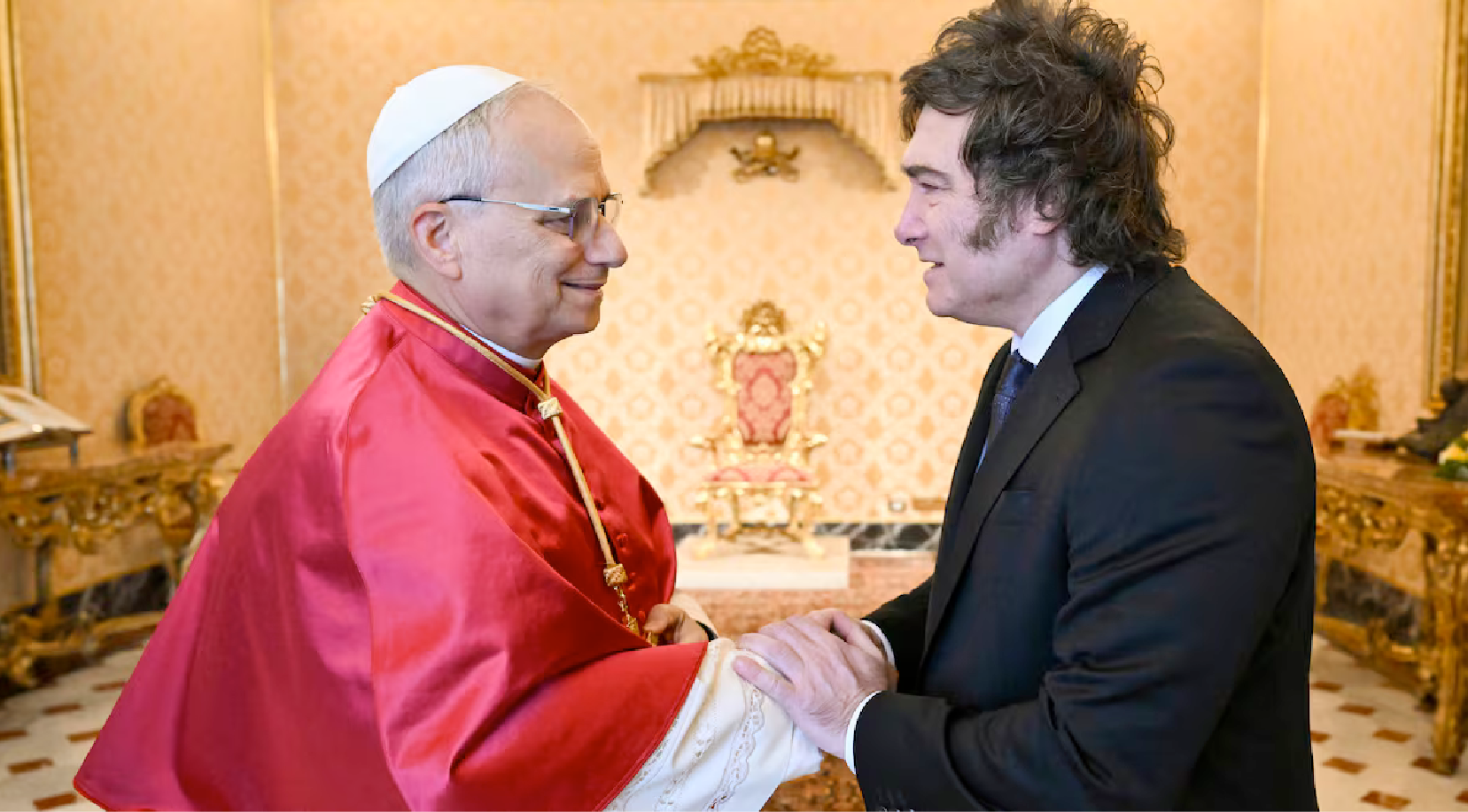
(ZENIT News / Buenos Aires, 05.27.2026).- For years, Argentine Catholics grew accustomed to a paradox that often surprised the rest of the world: the homeland of pope Francisco had never welcomed him back as pontiff. Now another chapter may be opening. Nearly four decades after the last papal visit to Argentina, expectations are rapidly growing that Pope Leo XIV could arrive in November as part of a broader South American journey.
The possibility, once treated as diplomatic speculation, has begun to acquire greater political and ecclesial weight. Argentine President Javier Milei stated on May 26 that, “unless a tragedy occurs,” it is “highly probable” that the Pope will visit the country later this year. He credited the progress largely to the efforts of Foreign Minister Pablo Quirno, describing the negotiations as having successfully aligned the necessary positions.
The optimism did not emerge overnight. Diplomatic groundwork appears to have been taking shape for months. In February, Quirno traveled to Rome and personally delivered a letter from Milei inviting the Pope to Argentina. After the meeting, he emphasized the shared desire to strengthen cooperation for peace, international understanding and the peaceful resolution of conflicts. Government sources at the time reportedly estimated the probability of a papal visit at more than 70 percent.
More recently, public signals further fueled anticipation. After meeting with Milei at the presidential residence in Olivos, Quirno wrote on social media that he had brought “good news that will make the Argentine people happy,” adding an intriguing phrase: “Only the date remains to be defined — what a beautiful spring.” The President amplified the speculation with a brief response: “It is coming,” accompanied by two lion emojis, an unmistakable reference to Leo.
Yet in the Catholic Church, symbolism never replaces procedure. Enthusiasm is being tempered by institutional caution.
Archbishop Jorge García Cuerva of Buenos Aires, while acknowledging what he described as very real possibilities, urged restraint. “We must be prudent and respectful,” he said, noting that only the Holy See can formally confirm a papal trip. Still, he openly expressed his hope that Leo XIV would come, describing such a journey as “a message of peace and agreement” capable of bringing something positive to the country.
His words reveal something larger than travel logistics. Argentina continues to navigate political polarization, economic tensions and social fatigue. In that context, a papal visit often acquires a significance extending far beyond religious practice. Historically, papal journeys to Latin America have functioned not merely as ecclesiastical events but also as moments of national reflection.
Interesting signals have also emerged from neighboring Uruguay. Carlos Enciso, mayor of Florida and a former ambassador to Buenos Aires with Vatican contacts, stated that Leo XIV is expected to travel through Argentina, Uruguay and Peru during the first half of November. Uruguay itself is already preparing for what local authorities consider a nearly certain papal stop.
If that regional itinerary materializes, it would create a journey rich in symbolism. Peru occupies a deeply personal place in Leo XIV’s story after decades of missionary service there. Uruguay represents one of Latin America’s most secular societies. Argentina, meanwhile, carries a different significance: a nation where Catholic identity remains culturally influential even amid growing religious diversification and political debate.
For now, the final word still belongs to the Vatican. Neither the Argentine Episcopal Conference nor its Uruguayan counterpart has yet received formal notification. Even Cardinal Daniel Sturla of Uruguay, who described the Pope’s presence as “almost certain,” indicated that no official announcement would likely come before mid-June.
But sometimes diplomacy speaks through gestures long before documents arrive. And in Argentina, many appear to believe that the signs are increasingly pointing in one direction: toward November, toward South America, and perhaps toward a papal arrival that would become one of the defining moments of the year.
Thank you for reading our content. If you would like to receive ZENIT’s daily e-mail news, you can subscribe for free through this link.

Publicaciones relacionadas:
 3 very interesting challenges from the Pope to politicians and rulers at a meeting at the Vatican
 Pope Leo XIV receives Zelensky: open doors to Russia and Ukraine for negotiations and invitation to visit Ukraine
 Two years after the massacre in Israel: Leo XIV speaks out and discusses other current issues, such as his first trip as Pope
 Pope Leo XIV Speaks Again About Trump and the War (and It Is Announced That the Pope Will Carry the Cross Throughout the Stations of the Cross on Good Friday)
