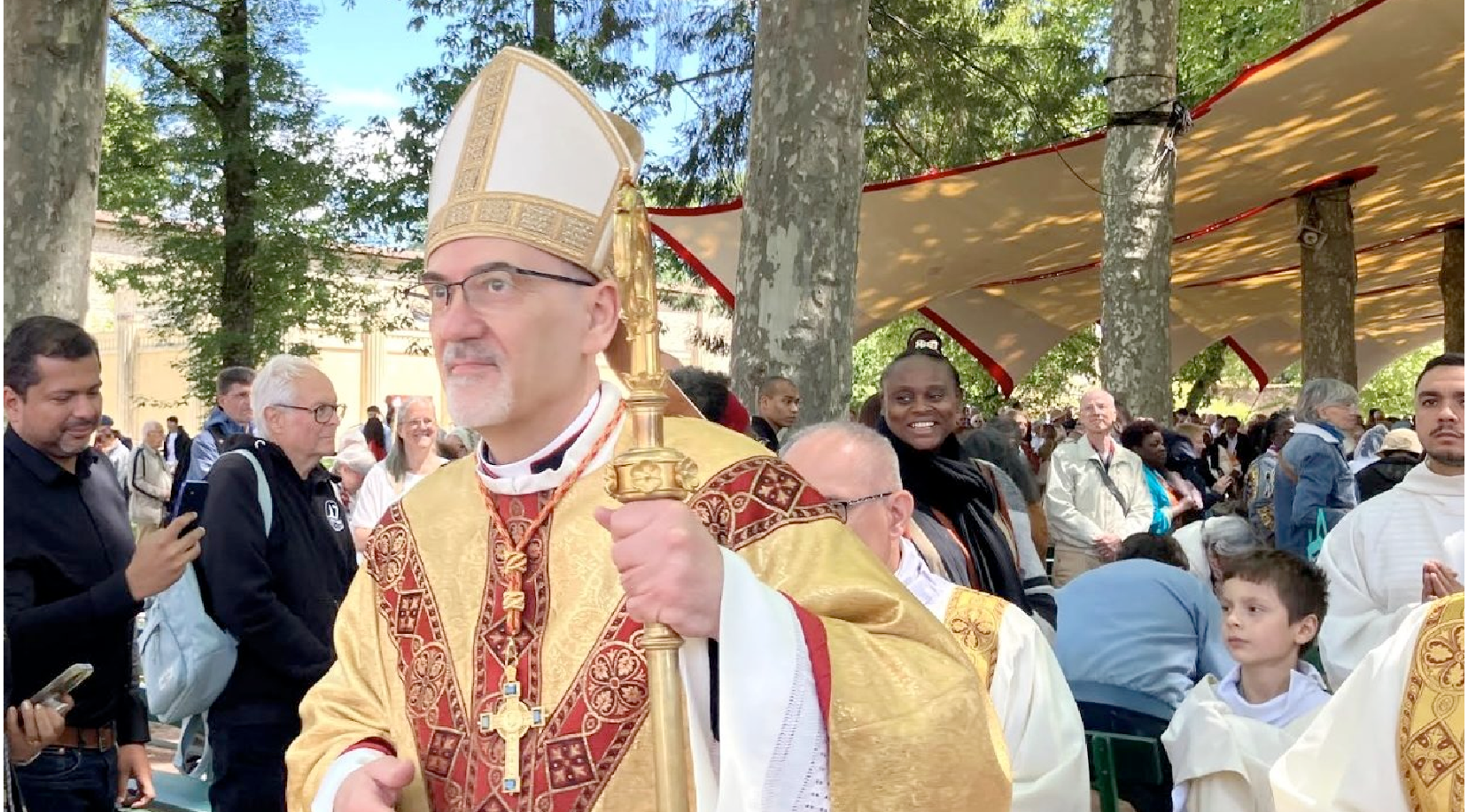
(ZENIT News / Paris, 06.18.2026).- Cardinal Pierbattista Pizzaballa, Latin Patriarch of Jerusalem since 2020, is one of the most prominent figures of the Catholic Church in the Holy Land. An Italian Franciscan, he has lived in the Middle East for over thirty years and has a deep understanding of the region’s religious, social, and political realities. A man of principle in both word and deed, he was named Cardinal by Pope Francis in 2023. He works tirelessly in service to Christian communities and to foster dialogue among peoples and religions. ZENIT met with him in Paray-le-Monial, during his trip to France from June 8 to 14, 2026.
* * *
ZENIT: How have you experienced your stay in France, and in particular in Paris, where you received the insignia of Knight of the Legion of Honor?
Cardinal Pizzaballa: This honorary title has not been bestowed upon me alone, as it is intended for the entire Church in the Holy Land, with special attention to the numerous French Catholic institutions, especially in Jerusalem. We appreciate their presence on the ground and all that they accomplish, far beyond the Christian community. This is how I interpret the honor bestowed upon me!
Furthermore, these three days in Paris were truly very interesting. We had numerous institutional meetings, during which I met with the President of the Republic, the Minister of Foreign Affairs, the Senate, and other authorities. I was very impressed by their knowledge and analysis of the situation in our country, but also by their interest in understanding our perspective. Christian leaders also expressed great concern about our presence in the Holy Land.
ZENIT: Next, I’m traveling to Paray-le-Monial to participate in the Sacred Heart celebrations. What is the significance of Jerusalem in the spirituality of the Heart of Jesus?
Cardinal Pizzaballa: The profound meaning of the Sacred Heart of Jesus is a life of self-giving out of love. Jerusalem is the place where this became a reality, on Calvary. But it is not only a life given out of love, but also forgiveness granted out of love. That is why it is of great importance to us in the Holy Land, where hatred powerfully fuels political, social, and religious conflicts and tensions. The Sacred Heart reminds us of where we come from and how we were born into the Christian life. It also gives us direction for our lives: in a certain way, the Sacred Heart marks our political position, if we may use this expression, that is, a life given out of love.
ZENIT: But how can we bring this message of love and mercy to this torn land?
Cardinal Pizzaballa: On Calvary, the disciples were asleep; they betrayed Jesus and abandoned him. Jesus was thus left completely alone, rejected, and abandoned. In this context, the Sacred Heart is a lesson we must continue to transmit to the whole world, and our Christian community in the Holy Land is called to do so. It is very easy to speak of love, mercy, and forgiveness when everything is going well. That is why we must give our own witness. We are a small Christian community in the Holy Land, and we cannot presume to understand everything or claim that our attitude will change the future. But we must remain in this land, even though we are few. Because our presence shows another way of living in the midst of conflict.
ZENIT: What does it mean for you, both practically and spiritually, to be the Pastor of this diocese, which spans four such different countries?
Cardinal Pizzaballa: It’s not easy, because the borders don’t make things easy between Jordan, Israel, Palestine, and Cyprus. Getting around and traveling is complicated at all times. However, every week I travel to a parish to meet with those who are suffering, whether they are believers or not, and I also go to the West Bank. In my case, I can travel, but not everyone can.
Palestinians can’t go to Israel, Jordanians have difficulty entering Israel, Israelis can’t enter Palestine, and so on. So, from a practical point of view, it’s complicated! That’s why maintaining the unity of the diocese remains a challenge and an experience for us. From a spiritual point of view, I must be true to myself and try to present all these challenges before God.
ZENIT: During Holy Week you wrote a Pastoral Letter: «They returned to Jerusalem with great joy.» What was your message to the Catholics of the diocese?
Cardinal Pizzaballa: This extensive Pastoral Letter is, above all, an analysis of the situation, an acknowledgment of the intense and profound conflict we are experiencing in the Holy Land. I begin with this analysis and pose some questions: How, as Christians, can we live in the midst of this conflict? What should we do? What is our specific vocation? I attempt to answer these questions with practical pastoral implications. I also use the image of the heavenly Jerusalem to present a concrete vision of Jerusalem, which is the image of the Church. First, this Jerusalem has walls, but its gates are always open. And it is a matter of adopting this attitude: always being open to others, not closing ourselves off in a context where identity tends to become self-contained. I also explain that in the heavenly Jerusalem there is no Temple, no Church, and that the presence of God is a lamp. This means that we must not only open ourselves to others, but also be able to interpret this reality in light of the Paschal event, of salvation. And then there is the river that gives life, along with the Tree of Life, whose leaves are meant to heal the nations. Therefore, we must interpret the reality of the Holy Land in the light of Jesus, and we must also be promoters of healing.
ZENIT: What is it that allows you today to maintain hope for coexistence among peoples and for lasting peace despite the difficulties?
Cardinal Pizzaballa: Coexistence is inevitable, whether we like it or not, because people live here and the vast majority will remain in the Holy Land. Therefore, we must find a way to achieve this coexistence, which is not easy: that is the great question for the future. But we must not confuse hope with a solution, because at the moment there is no solution. That is why we must persevere. For me, hope is there when I see young people committing themselves and when I meet people who reject all hate speech. It will be the generation of tomorrow that will rebuild what we have destroyed! Currently, pilgrimages are unfortunately interrupted due to the situation, but it seems that a Peace Agreement is going to be signed. And so it is. After that, we can begin to gradually restore communication channels. We miss the pilgrims.
ZENIT: Finally, how have you received the Pope’s announcement of a major ecumenical meeting in Jerusalem in 2033?
Cardinal Pizzaballa: The year 2033 is, above all, an important date for all the Churches, and it will arrive soon! The heart, of course, is Jerusalem. Therefore, it is inevitable to consider that, with a view to 2033, it is in Jerusalem that we must reflect on how to proceed and prepare for it. Because Jerusalem remains, despite all the wounds, the place where the Church was born. There it is both one and many, and it continues to be the symbol of unity.

Publicaciones relacionadas:
 The Grammar of Hate: An Interview with Bishop Rafic Nahra, Auxiliary Bishop of Jerusalem, on the Situation in the Holy Land
 Cardinal of Jerusalem: both Palestinian and Israeli Catholics are suffering. What should the Church do?
 Vatican Secretary of State reiterates Holy See’s position on total invasion of Gaza
 Fr Sliman: As war affects daily life in Kuwait, the Church responds to the uncertainty