

(ZENIT News / Madrid, 07.12.2026).- Spain’s religious heritage is proving to be far more than a treasured legacy of the past. It has become one of the country’s most dynamic tourism engines, drawing millions of visitors each year while reinforcing the enduring cultural and spiritual significance of Christianity in one of Europe’s most historically Catholic nations.
A new report, Religious Tourism in Spain: A Journey into a Transforming Sector, prepared by ObservaTUR together with tourism consultancies ReiniziaT and Task ONE, concludes that Spain has firmly established itself among the world’s premier destinations for religious tourism, standing alongside Italy and the Holy Land thanks to its extraordinary sacred heritage and internationally renowned religious celebrations.
The country’s ecclesiastical treasures help explain that prominence. The Catholic Church safeguards 78 cathedrals, 3,161 officially protected cultural monuments and 18 UNESCO World Heritage sites. Many of Spain’s most recognizable landmarks—from the Cathedral of Burgos and the Monastery of Montserrat to the Basilica of Our Lady of the Pillar in Zaragoza and the Cathedral of Santiago de Compostela—are inseparable from both the nation’s identity and its Christian history.
According to the study, between 17 and 20 million people travel to Spain every year for religious, spiritual or cultural reasons. The sector is expanding at an estimated annual rate of 10%, making it one of the fastest-growing segments of the country’s tourism industry.
Researchers identify Pope Leo XIV’s apostolic visit to Spain last June as a major catalyst for that growth. Beyond its pastoral significance, the papal journey generated what the report describes as a powerful international «showcase effect,» producing an estimated economic impact of €125 million while drawing renewed global attention to Spain’s religious destinations.
Among the country’s greatest attractions, the Camino de Santiago continues to occupy a unique place. For centuries, pilgrims have walked the ancient routes leading to the tomb traditionally associated with St. James the Apostle, making it one of Christianity’s oldest and most important pilgrimages. Today, that spiritual tradition continues to attract believers, cultural travelers and hikers from around the world.
The report also highlights the international appeal of Holy Week celebrations, together with major Marian sanctuaries such as El Rocío, Montserrat and the Basilica of Our Lady of the Pillar, all of which have become symbols of Spain’s living religious traditions rather than simply historical monuments.
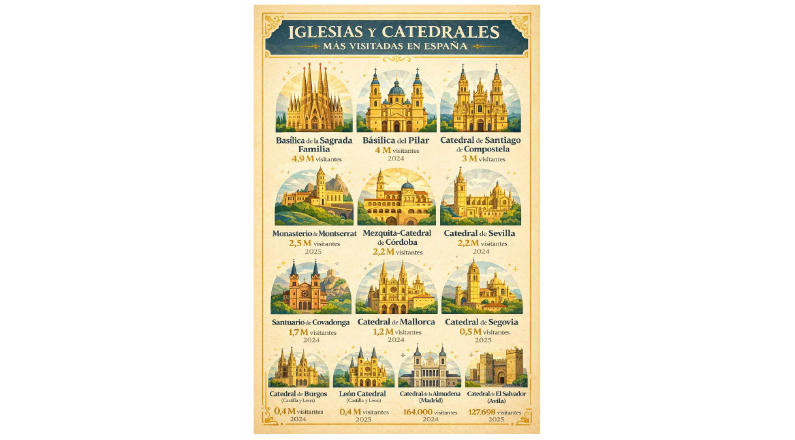
Barcelona’s Basilica of the Sagrada Família tops the ranking of Spain’s most visited churches, welcoming nearly five million visitors. Antoni Gaudí’s unfinished masterpiece recently reached another historic milestone with the completion of the Tower of Jesus Christ, making it the tallest church in the world. During his visit to Barcelona, Pope Leo XIV blessed the newly completed tower, further increasing international interest in the basilica.
The Basilica of Our Lady of the Pillar ranks second with approximately four million visitors during 2024. Closely behind stands the Cathedral of Santiago de Compostela, receiving around three million visitors annually and remaining Spain’s most visited cathedral.
The Benedictine Monastery of Montserrat attracted approximately 2.5 million visitors in 2025, while both the Mosque-Cathedral of Córdoba and Seville Cathedral welcomed about 2.2 million each.
Further north, the Sanctuary of Covadonga, nestled among the mountains of Asturias, receives roughly 1.7 million visitors every year, significantly surpassing the Cathedral of Palma. Among Castile’s great Gothic cathedrals, Segovia, Burgos and León each attract between 400,000 and 500,000 visitors annually. Madrid’s Almudena Cathedral recorded 164,000 visitors in 2024, while Ávila Cathedral approached 128,000.
Some prominent churches are notably absent from the rankings, including the cathedrals of Toledo, Granada, Málaga and Barcelona, as well as Madrid’s Basilica of the Holy Cross in the Valley of the Fallen. The report explains that comprehensive visitor figures have either not been collected or have not been made public by the respective cathedral chapters. Even so, researchers conclude that visitor numbers across Spain’s principal churches remain consistently robust.
The economic contribution of religious tourism extends well beyond individual monuments. Spain’s Holy Week celebrations alone involve more than 5,000 confraternities, approximately one million members and 167 officially recognized festivals of tourist interest. Together, these events generate an estimated €10 billion in economic activity and support around 150,000 jobs.
The findings also illustrate an often-overlooked reality. Although Europe is frequently described as increasingly secular, millions of people continue to visit churches, monasteries and shrines every year. Their motivations are diverse—faith, history, architecture, art or personal reflection—but the destinations themselves testify to the enduring influence of Christianity on Spain’s cultural landscape.
For the Catholic Church, preserving this vast patrimony involves responsibilities that extend well beyond maintaining historic buildings. These sacred places continue to serve as centers of worship while welcoming visitors from every continent, allowing masterpieces of architecture and art to remain what they were originally intended to be: living spaces where faith, culture and history meet.
Thank you for reading our content. If you would like to receive ZENIT’s daily e-mail news, you can subscribe for free through this link.

Publicaciones relacionadas:
 Index of Religious Freedom USA 2024: Seven Key States in Presidential Elections Show Worst Results
 National liturgical donation: 4,000 American seminarians will receive the Liturgy of the Hours free of charge
 Taiwan’s president writes to Pope Leo XIV: ‘Taipei wants peace, human rights, and democracy’
 U.S. and African Bishops Call for Continuing Solidarity and Lifesaving Assistance to Africa in Joint Statement
