(ZENIT News / Rome, 03.12.2026).- As the conflict between the United States, Israel and Iran spreads across the Middle East, the voice of the Catholic Church has become increasingly insistent: the war risks spiraling into a regional catastrophe, and diplomacy must prevail before the destruction becomes irreversible.
In recent days, appeals for peace have come from multiple levels of the Church—from the Vatican itself to bishops in the region and prominent Catholic leaders in the United States—while the conflict continues to widen geographically and politically.
A papal appeal amid mounting violenc
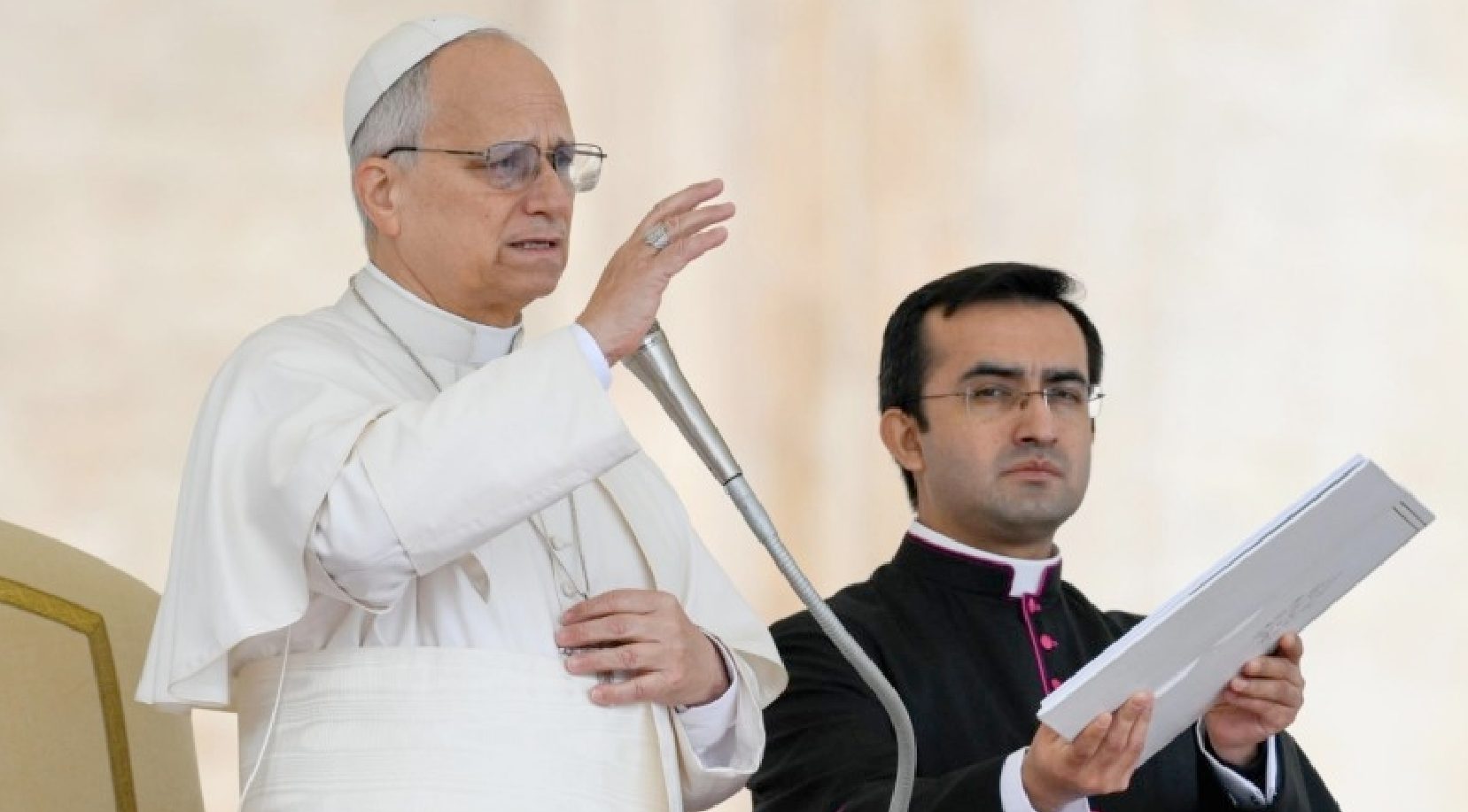
At the conclusion of the general audience on March 11, Pope Leo XIV addressed the growing turmoil in the Middle East, urging the faithful to pray for an end to the fighting and for the many civilians caught in the violence.
The pope specifically mentioned Iran and the broader region, lamenting the suffering of civilians, “including many innocent children,” and calling prayer “a seed of hope for the future.”
Leo XIV also drew attention to the situation in Lebanon, where the escalation of hostilities between Israel and the Shiite militia Hezbollah has renewed fears of a broader war. In particular, he mourned the death of the Maronite priest Pierre El-Raii, a 50-year-old parish priest killed on March 9 in southern Lebanon after rushing to assist parishioners wounded in a bombardment.
“He was a true pastor,” the pope said, describing the priest as someone who remained close to his people with the sacrificial love of the Good Shepherd. Leo prayed that the priest’s “spilled blood may become a seed of peace for beloved Lebanon.”
The crisis in Lebanon has deepened in recent days. Israeli airstrikes have targeted Hezbollah positions in the southern outskirts of Beirut, while other attacks have struck locations in southern Lebanon, reportedly killing civilians. At the same time, evacuation orders issued by the Israeli military for neighborhoods in southern Beirut have affected around 700,000 residents, raising fears of a major humanitarian emergency.
A war spreading across the region
The violence that began on February 28 with joint U.S. and Israeli attacks on Iran has expanded dramatically in scope.
Airstrikes have struck oil facilities in Tehran and in the province of Alborz, generating massive fires and thick clouds of smoke over the Iranian capital. According to Iranian sources, the attacks killed several people and damaged key energy infrastructure. Civil defense authorities have warned residents of possible toxic emissions and even acid rain caused by burning petroleum depots.
The broader human toll is mounting. Iranian officials report that more than 1,200 people have died and over 10,000 have been injured since the beginning of the attacks.
Meanwhile, the conflict has spilled far beyond Iran’s borders. Iranian missiles and drones have targeted several countries in the Persian Gulf region, including Kuwait, Qatar, Bahrain and the United Arab Emirates. Explosions have been reported in Tel Aviv following missile launches from Iran, while tensions have risen in the strategic Strait of Hormuz after Tehran threatened to attack U.S. and Israeli vessels.
Even distant countries have felt the ripple effects. In Oslo, an explosion damaged an entrance to the U.S. embassy, though no injuries were reported.
The war has also transformed the political landscape inside Iran. The country’s supreme leader, Ali Khamenei, was killed at the outset of the conflict, and Iran’s clergy chose a successor: the son of the assassinated ayatollah.
Diplomacy as the Vatican’s only weapon
The Vatican has responded to the unfolding crisis with its traditional strategy: persistent diplomacy and moral appeals.
Speaking in Rome during an interreligious Ramadan-Iftar initiative, Pietro Parolin, the Vatican secretary of state, emphasized that the Holy See maintains dialogue with all parties involved.
“The Holy See speaks with everyone,” Parolin explained, including American and Israeli leaders, in order to propose paths toward peace. He warned that the tragedy now unfolding could easily widen if diplomatic efforts fail.
Parolin acknowledged that the Vatican lacks coercive tools to enforce its vision, relying instead on “the instruments of the word, of reason and of wisdom.” Still, he insisted that these tools must continue to be used in order to defend the principles of peaceful coexistence between nations.
The cardinal also voiced concern for Christian communities in the region. War, instability and rising hatred, he warned, threaten the survival of ancient Christian populations in the Middle East.
Communities on the brink
Nowhere are those fears more palpable than in Iraq, where Christian leaders say the region’s fragile communities could once again face displacement.
In Iraqi Kurdistan, missiles have struck areas around Erbil, including sites near the city’s Chaldean Catholic institutions. Ankawa, the Christian district of Erbil and one of the largest Christian neighborhoods in the Middle East, lies only a few hundred meters from a U.S. military base and is therefore exposed to possible attacks.
According to local Christian activist Dilan Adamat, the situation is especially unsettling because the current conflict lacks a clear front line. Missiles and drones can strike almost anywhere, leaving civilians unsure where safety lies.
The anxiety is compounded by demographic decline. Iraq’s Christian population, once estimated at over one million, has shrunk dramatically in recent decades. Today only about 130,000 Christians remain in a country of roughly 46 million people.
Church leaders fear that a new regional war could trigger another wave of emigration, further threatening one of the oldest Christian communities in the world—one that still speaks Aramaic, the language traditionally associated with Jesus.
Religious voices calling for peace
Several Catholic leaders have publicly criticized the moral legitimacy of the war.
Robert McElroy, archbishop of Washington, argued that the conflict fails to meet the Catholic Church’s traditional criteria for a “just war.” According to McElroy, the United States did not respond to a verifiable imminent attack, the war’s objectives remain unclear, and the damage caused may far exceed any potential benefits.
Similarly, Blase Cupich, archbishop of Chicago, condemned a social-media video published by the White House that combined real footage of airstrikes with scenes from action films.
“A real war, with real death and real suffering, treated as if it were a video game,” he said, warning that modern society risks turning warfare into a spectacle rather than confronting its human cost.
For Cupich, the deeper problem is moral desensitization: violence, he argued, is increasingly consumed as entertainment while thousands of people—families, children and soldiers—lose their lives.
An appeal from within Iran
In a striking development, a prominent Iranian cleric has also turned to the pope for help.
Ayatollah Seyed Mostafa Mohaghegh Damad Ahmadabadi published an open letter addressed to Leo XIV, urging the pontiff to intervene morally with the United States and advocate for restraint.
Damad framed his appeal in explicitly religious terms, emphasizing that peace and justice are fundamental values shared by all monotheistic traditions. His message condemned attacks on civilian infrastructure and called for respect for international law.
Observers note that such appeals reflect a long history of dialogue between the Vatican and Shiite religious authorities. Contacts between Tehran and the Holy See have existed for decades, and interreligious dialogue has intensified since the early 2000s.
The background to this relationship includes the historic 2021 meeting between Pope Francis and the Iraqi Shiite authority Ali al‑Sistani in Najaf, a moment widely interpreted as a milestone in Catholic-Shiite relations.
Whether Damad’s letter will influence the course of events remains uncertain. But the gesture itself highlights the moral authority that the papacy still carries in moments of global crisis.
An uncertain road ahead
For now, the war shows few signs of ending.
U.S. President Donald Trump has said the conflict could conclude soon, though he has also suggested that further military operations may be necessary. Iranian commanders, by contrast, warn that the confrontation could last years and insist they are prepared for a prolonged struggle.
Meanwhile, the conflict continues to ripple across the Middle East—from Lebanon and Iraq to the Gulf states—while energy markets, international diplomacy and fragile religious communities remain under strain.
In the midst of that uncertainty, the Vatican’s message remains consistent: the path of war cannot deliver lasting peace.
Instead, as Leo XIV reminded the faithful in St. Peter’s Square, the world must continue to pray, to speak, and to search tirelessly for the fragile but indispensable path of reconciliation.
Thank you for reading our content. If you would like to receive ZENIT’s daily e-mail news, you can subscribe for free through this link.