

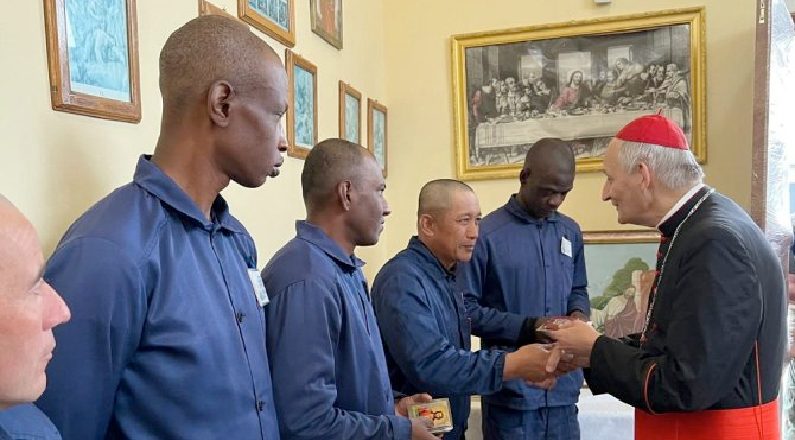
(ZENIT News / Lviv, Ukraine, 07.15.2026).- The most revealing scene of Cardinal Matteo Zuppi’s latest journey to Ukraine did not take place in a government building or diplomatic conference room. It unfolded inside a prison, where men captured while fighting for Russia waited for an uncertain future—and where the representative of Pope Leo XIV spoke to them not as enemies, but as human beings.
On July 14, Zuppi, the Archbishop of Bologna and president of the Italian Bishops’ Conference, began a four-day visit to Ukraine by travelling to Zakhid-1, a detention facility in the Lviv region, accompanied by the Apostolic Nuncio, Visvaldas Kulbokas, and Ukraine’s ambassador to the Holy See, Andrii Yurash. The camp is one of five facilities in the country holding prisoners captured while serving in the Russian army.
In a war increasingly defined by long-range missiles, drone attacks and diplomatic deadlock, the cardinal went to a place where the consequences of the conflict are immediate and personal.
He carried three gifts: a key ring bearing the papal emblem, an image of the Salus Populi Romani, the ancient image of the Virgin and Child venerated in Rome, and a photograph of Pope Leo XIV.
The key ring came with a message that was both simple and profoundly concrete. Zuppi told the prisoners that he hoped they would soon place on it the key to their own homes, so that they could open the door and embrace the people waiting for them.
The image of the Virgin, he explained, could be understood by Christians as an image of their Mother, but by everyone as an image of hope. The photograph of the Pope carried an equally direct message: Leo XIV had sent him to say that he was praying for peace, for the end of the war and for the prisoners themselves.
That gesture had a significance beyond Catholic devotion. The men inside the facility do not all share the same nationality, language or religion. Reports indicate that 53 nationalities are represented at Zakhid-1, including Belarusians, Congolese, Koreans, Peruvians, Nigerians and Filipinos. Some are Catholics; others are not Christians at all.
The international character of the camp reflects a broader reality of Russia’s war effort. Moscow has recruited fighters from numerous countries, and Ukrainian authorities estimate that the number of foreign mercenaries serving Russia could reach approximately 18,000 in 2026.
Among those Zuppi met were men from Latin America and Africa, with whom he could speak in Spanish or French. One young Colombian reportedly told him that he had made a terrible mistake by signing a contract that sent him to a devastating front. A Belarusian prisoner showed the cardinal the leg he had lost to a land mine and said that, despite everything, he thanked God to be alive.
For the Catholic prisoners, the encounter took on a more explicitly religious dimension. Some asked for rosaries and Bibles for their rooms. Others requested a blessing. In the camp chapel, around twenty prisoners gathered for prayer.
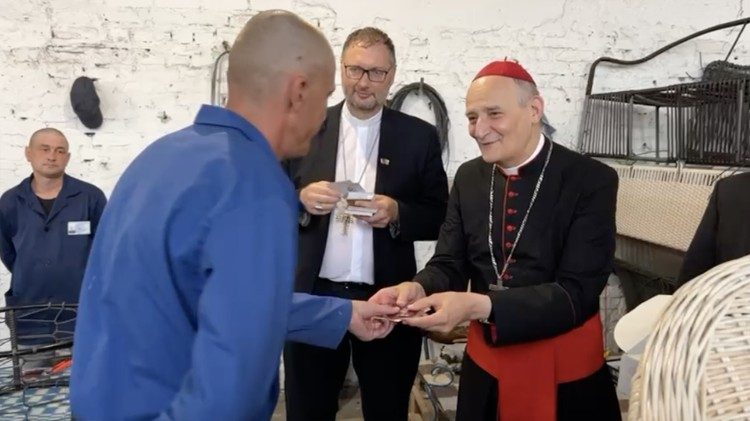
Yet Zuppi’s message was not simply that they should wait passively for release. He urged them to look toward a future beyond captivity and, even within the prison, to begin a different kind of transformation.
They had seen terrible things, he told them. But evil, he warned, must not be allowed to grow within them. The cardinal’s words reflected one of the most difficult dimensions of Christian ministry in wartime: the conviction that the dignity of a person does not disappear because he has fought for an enemy army, while moral responsibility for violence also cannot simply be erased.
That tension is at the heart of the Catholic Church’s approach to war and captivity. The humane treatment of prisoners is not a reward for political sympathy. It is a demand arising from the dignity of every human person, including those who have participated in a conflict. Zuppi’s visit therefore carried a message that was simultaneously pastoral and diplomatic: prisoners must not become invisible casualties of a war that has already consumed too many lives.
The facilities shown to the delegation included renovated showers, living quarters, common areas, personal belongings, a small shop, a chapel and a medical unit treating shrapnel wounds, trench-related illnesses and other health problems. Prisoners also carry out tasks such as carpentry and receive modest payment for their work.
Ukraine’s government clearly understood the symbolic value of the visit. Ambassador Yurash presented the facility as meeting international standards and as open to those wishing to inspect the conditions in which prisoners are held. For Kyiv, the visit offered an opportunity to demonstrate that even amid a brutal invasion, it seeks to present itself as a state committed to dialogue, lawful treatment and the possibility of a just and lasting peace.
For the Holy See, however, the journey forms part of a longer humanitarian effort.
Zuppi first travelled to Ukraine in 2023 at the request of Pope Francis, later visiting Moscow, Washington and Beijing. The mission achieved little in terms of a broad diplomatic breakthrough, but it helped maintain channels of communication and contributed to humanitarian efforts involving prisoners, children and the return of bodies.
During the four years of war, 67 prisoner exchanges between Russia and Ukraine have reportedly taken place, enabling approximately 7,000 people to return to Ukraine. The Vatican has also sought to support mechanisms connected with the return of Ukrainian children whom Kyiv says were forcibly taken to Russia.
Three years after his first mission, Zuppi has returned to a conflict that has become even more destructive. According to the United Nations Human Rights Monitoring Mission in Ukraine, at least 293 civilians were killed and 1,990 injured in Ukraine during June 2026. It was reportedly the second-deadliest month for civilians since April 2022.
Since Russia’s full-scale invasion began in February 2022, the United Nations has verified 16,431 civilian deaths in Ukraine, including 803 children. The actual toll is higher, since the United Nations has been unable to establish the number of victims in some areas, including cities such as Mariupol and Lysychansk that are now under Russian control. Russian authorities, for their part, have reported 250 civilian deaths in Russian territory during the first half of 2026.
Against this backdrop, Zuppi’s visit to a prison camp may seem modest when measured against the scale of the war. It is not a peace treaty, a prisoner exchange or a diplomatic breakthrough.
But the Church’s humanitarian diplomacy often begins in precisely such places: with a conversation, a prayer, a message carried across a front line, or a reminder that even an enemy prisoner has a home to return to and people who may still be waiting for him.
The cardinal’s final prayer at Zakhid-1 was therefore also a summary of the Church’s position in the conflict: that the prisoners should find their way home, that the war must end, and that a new life must eventually begin.
The challenge is that peace remains distant while the killing continues. Yet in a prison chapel, surrounded by men from dozens of countries who had been drawn into a war not all of them fully understood, the cardinal insisted on a principle that modern warfare repeatedly threatens to destroy: no political objective can make human dignity disposable.
«War must end,» Zuppi told them.
The prisoners answered: «Amen.»
Thank you for reading our content. If you would like to receive ZENIT’s daily e-mail news, you can subscribe for free through this link.

Publicaciones relacionadas:
 Pope Leo’s visit to Argentina unofficially confirmed after audience with President Milei
 Pope Francis’ confessor dies in Argentina at age 98
 Andorra will approve abortion despite the fact that its head of state is a Catholic bishop
 Following Controversy at the Basilica of Guadalupe, the Cardinal of Mexico City Announced Reforms Inspired by Rome and Appointed a New Rector
