

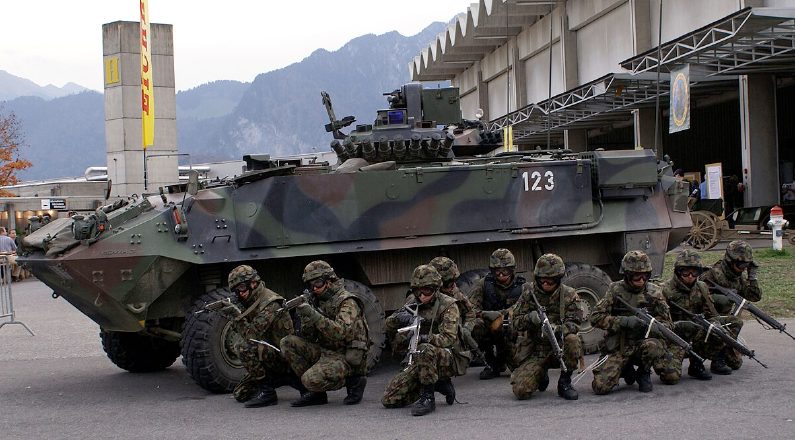
(ZENIT News / Bern, 07.17.2026).- Switzerland has long maintained a carefully calibrated division between military preparedness and civilian life. A new change to its military law is now disrupting one of the country’s oldest assumptions about the role of religious ministers.
Since June 1, 2026, priests, monks and members of religious orders are no longer automatically exempt from Switzerland’s compulsory military service. The reform has already resulted in nine members of the clergy being called up, prompting Christian leaders to question whether the country has underestimated the importance of spiritual care in times of crisis.
Swiss men deemed fit for military service are generally required to complete approximately eight months of service, normally between the ages of 18 and 30. For generations, clergy were excluded from that obligation because they were considered essential to the civilian population, particularly in wartime.
That principle has now been abandoned.
The government has defended the change by arguing that the original purpose of the exemption—to ensure access to spiritual care for civilians during conflict—no longer reflects the realities of modern Swiss society. With religious disaffiliation increasing sharply, the authorities reportedly concluded that the ministry of priests can no longer be considered essential in the same way.
The argument has provoked a direct response from Bishop Alain de Raemy, Auxiliary Bishop of Lugano and head of the Swiss military chaplaincy. Speaking to the public broadcaster RTS, he described the legislation as showing a «lack of respect toward the population».
His objection is not simply about protecting priests from military service. It concerns the underlying assumption that religious ministry has become dispensable.
De Raemy pointed to the Covid pandemic as evidence that spiritual care can become particularly important when societies face fear, death and uncertainty. If priests are required to serve in the military during a future war or major crisis, he asked, who will provide that support to civilians?
«How will we manage in times of war and future crises if priests have to serve in the army?» he asked. «What is the Federal Council’s plan?»
The Swiss Association of Free Churches has also criticized the reform, arguing that religious communities affected by the change were not properly consulted. The association said such consultation would normally be expected when legislation directly alters the position of religious communities.
The dispute exposes a striking paradox in modern Switzerland. The country is becoming less religious in demographic terms, yet the decline of formal religious affiliation does not necessarily mean that the need for spiritual care disappears during emergencies.
According to government statistics, 32 percent of the population identifies as Catholic and 20 percent as Evangelical Reformed. At the same time, people without a religious affiliation now represent approximately 34 percent of the population, compared with only 1 to 2 percent roughly fifty years ago.
That transformation is central to the government’s reasoning. It is also the basis of the critics’ concern.
A secularizing society may reasonably conclude that the state should not privilege religious institutions. But the question of whether spiritual care is socially valuable is different from the question of how many people formally belong to a religion.
Hospitals, prisons, military units and communities facing disasters often confront questions of grief, guilt, death, hope and meaning that cannot be reduced to technical or administrative problems. The argument advanced by Switzerland’s Christian leaders is that the presence of chaplains is not necessarily justified by the religious statistics of the population, but by the needs of people confronted with extreme circumstances.
The practical consequences of the new law remain uncertain.
It is not yet clear whether clergy called up for military service will be permitted to fulfil their legal obligations through military chaplaincy or whether some could be required to serve in other military roles, potentially including combat-related functions.
Swiss citizens with conscientious objections to military service may generally be permitted to perform civilian service, although they must serve for a longer period. For clergy, however, the issue is more complex. Their objection is not necessarily to military service itself, but to the consequences of removing religious ministers from the civilian population precisely when a crisis could make their work most necessary.
The numbers involved also matter. Switzerland has approximately 2.7 million Catholics, served by an estimated 1,800 priests. Even if only a small number of clergy are called up at any given time, the impact could be significant in a country where the Catholic priesthood is already relatively limited.
The reform also arrives against the backdrop of Switzerland’s distinctive national history. For more than two centuries, the country has maintained a policy of military neutrality and has not participated in a foreign armed conflict since the late nineteenth century.
That history may make the debate appear theoretical. Yet neutrality does not eliminate the possibility of crisis. Switzerland still maintains compulsory military service precisely because national authorities recognize that security conditions can change.
The question raised by Bishop de Raemy is therefore broader than the status of priests in uniform.
If a government concludes that religious ministry is no longer essential because fewer people identify with organized religion, what happens when a society faces circumstances in which people suddenly seek precisely the forms of accompaniment that ordinary life has made less visible?
The answer will determine whether the new law represents a straightforward modernization of an outdated exemption or a failure to recognize that some forms of public service cannot be measured solely by their numbers.
Thank you for reading our content. If you would like to receive ZENIT’s daily e-mail news, you can subscribe for free through this link.

Publicaciones relacionadas:
 Colombian President Harasses Catholic Priest Live on Air for Speaking Out Against Communism
 Indian government wanted Easter 2024 to go unnoticed, but Catholic population rebelled
 Turkish Government Turns Ancient Christian Church Into a Mosque
 EU Court to Weigh Whether Baptismal Records Clash with Data Protection Laws
