

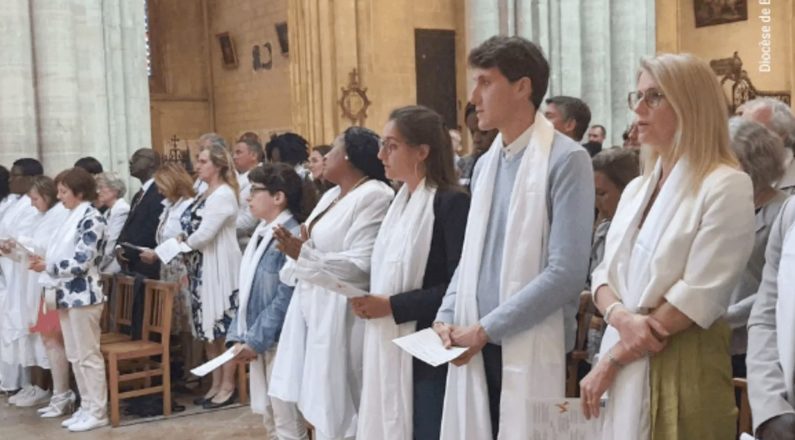
(ZENIT News / Paris, 03.28.2026).- In a country long considered emblematic of European secularization, the Catholic Church in France is preparing for an Easter unlike any in recent memory. During the 2026 Easter Vigil, approximately 21,386 catechumens—around 13,200 adults and 8,200 young people—are expected to receive baptism, marking the highest figure ever recorded.
The scale of the phenomenon is striking not only in absolute terms but also in its trajectory. Over the past decade, adult baptisms have more than tripled, rising from 4,124 in 2016 to over 13,200 this year. Compared to neighboring Germany, where 2,269 people entered the Catholic Church in 2025, France stands out as an anomaly in Western Europe: a country where religious practice has declined sharply, yet where a growing number of adults are choosing to enter the Church voluntarily.
This growth is not evenly distributed across age groups. It is being driven above all by young adults. Forty-two percent of those preparing for baptism are between 18 and 25 years old, and another 40 percent fall between 26 and 40. In other words, more than four out of five new adult Catholics belong to a generation often described as religiously disengaged. Nearly two-thirds are women.
Equally revealing is the diversity of their backgrounds. Only 45 percent come from a Christian family context. Almost as many—46 percent—were raised in non-religious or atheist households, while a smaller but notable 3 percent come from Muslim backgrounds. The data suggests that this is less a story of cultural continuity than one of personal rediscovery.
The pathways leading to baptism often pass through moments of rupture. According to a 2026 survey of 1,450 catechumens conducted by the French bishops, 40 percent traced their journey of faith to a personal crisis. Illness, bereavement, and existential questioning emerged as recurring catalysts. Another third reported a profound spiritual experience as decisive in their conversion.
Yet this return to faith is not primarily mediated by institutions or digital culture. A significant 61 percent had already begun reading the Bible independently before formally entering the catechumenate, indicating a pattern of self-initiated exploration. By contrast, only 11 percent cited social media influencers as a motivating factor—an unexpectedly modest figure in an era often defined by digital evangelization.
The increase is not limited to adults. Around 8,200 adolescents are also expected to be baptized this Easter, a 10 percent rise compared to the previous year, though more modest than the adult surge. At the same time, participation in other sacraments is also growing: in 2025, 11,218 adults received confirmation, continuing an upward trend observed since 2022.
Beyond the numbers lies a more complex pastoral reality. Surveys of 850 individuals baptized in 2025 reveal both encouraging signs and structural challenges. While 72 percent report feeling supported by their parish communities, one in four experienced periods of loneliness, and 8 percent lost contact with their parish shortly after baptism. The data underscores a critical issue: the transition from initiation to sustained ecclesial belonging.
Even so, levels of engagement among the newly baptized are notable. Half attend Mass every Sunday, with about one in nine participating several times a week. Another quarter attends at least monthly, while only 5 percent report rarely going. Moreover, 40 percent are actively involved in parish activities, and 42 percent have taken on specific ministries, ranging from catechesis to visiting the sick.
Faced with this unexpected influx, the Church in France is beginning to reflect structurally on its implications. The bishops of the Paris ecclesiastical province have announced a regional council to run from Trinity Sunday 2026 through the summer of 2027. Its focus is telling: not simply how to prepare catechumens for baptism, but how to integrate them fully into the life of the Church.
Among the questions under consideration are whether greater emphasis should be placed on the unity of the three sacraments of initiation—baptism, confirmation, and Eucharist—and how parishes can move from a model of sacramental administration to one of long-term accompaniment. There is also a growing awareness that the Church itself may need to learn from these new members, whose experience of faith is often marked by intensity, personal discovery, and a deliberate break with indifference.
What is unfolding in France does not easily fit conventional narratives of decline or revival. It suggests instead a more fragmented but also more intentional religious landscape, in which faith is less inherited than chosen. For a Church accustomed to measuring loss, the 2026 Easter Vigil may offer a different kind of datum: not the return of the past, but the emergence of something new.
Thank you for reading our content. If you would like to receive ZENIT’s daily e-mail news, you can subscribe for free through this link.

Publicaciones relacionadas:
 Pilgrimage Boom: Camino de Santiago Hits Record-Breaking Numbers in 2024
 Pilgrimage to the Christ the King Monument in Mexico’s Center Breaks Participation Record with at Least 60,000 Young People.
 The Cross Atop the Jesus Christ Tower of the Basilica of the Holy Family, which the Pope will Inaugurate in Barcelona, Is Now Visible
 Hong Kong will welcome 2,500 new Catholics this Easter in 2026
