

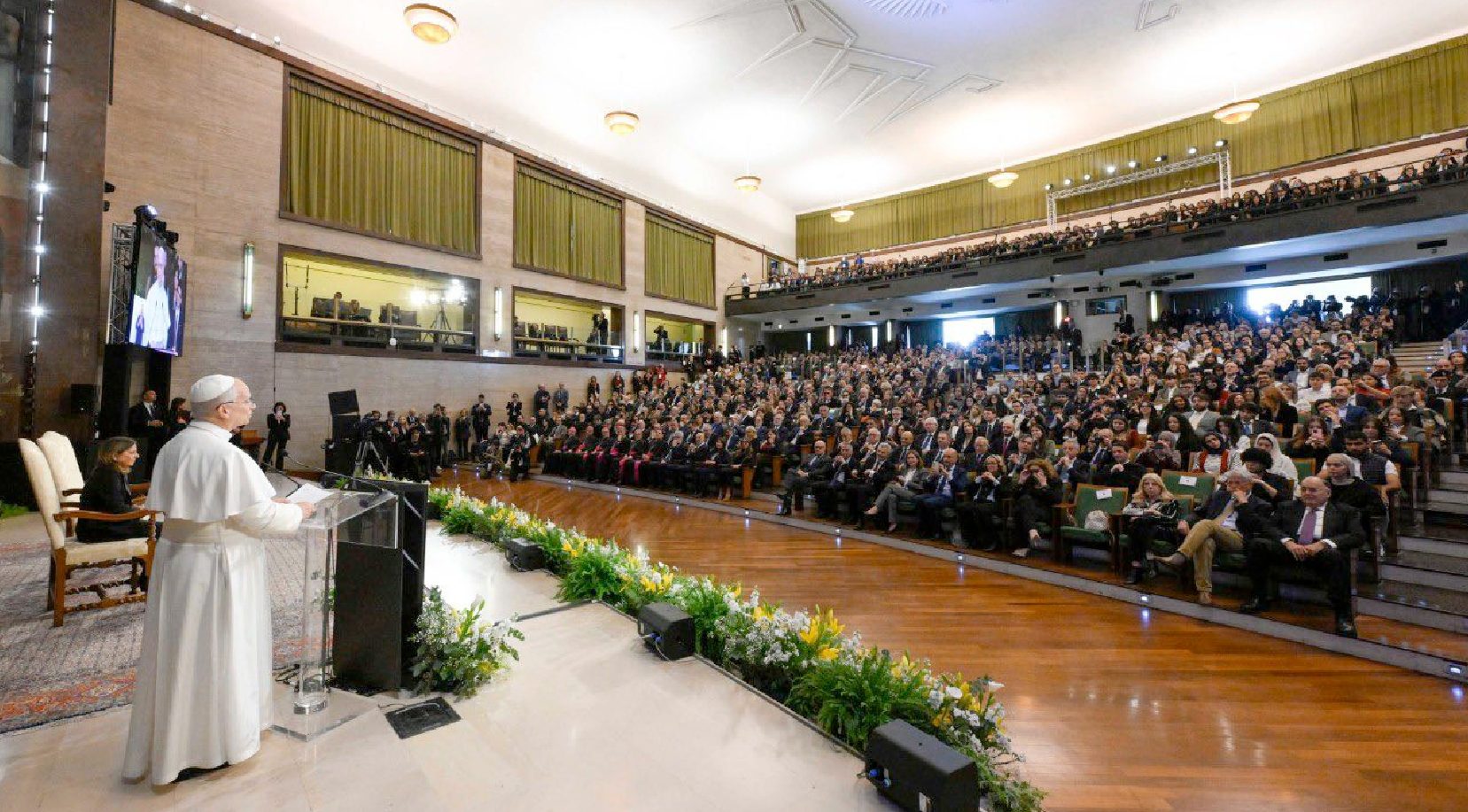
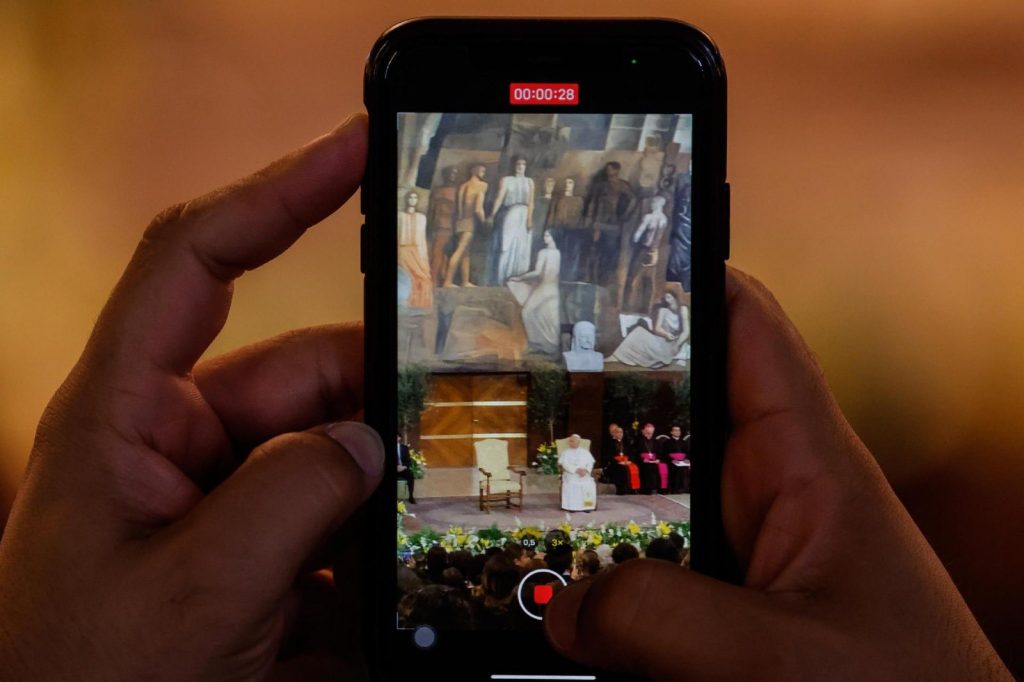
(ZENIT News / Rome, 05.14. 2026).- On Thursday morning, May 14, the Holy Father visited La Sapienza, Italy’s most important University, located in the country’s capital. It was at this University that, 18 years ago, Pope Benedict XVI was denied admission.
Below is ZENIT’s translation into English of the Pope’s address in Italian.
* * *
Magnificent Rector,
Political and Civil Authorities,
Distinguished Professors, Researchers, and Technical-Administrative Staff and, Above All, Dear Students!
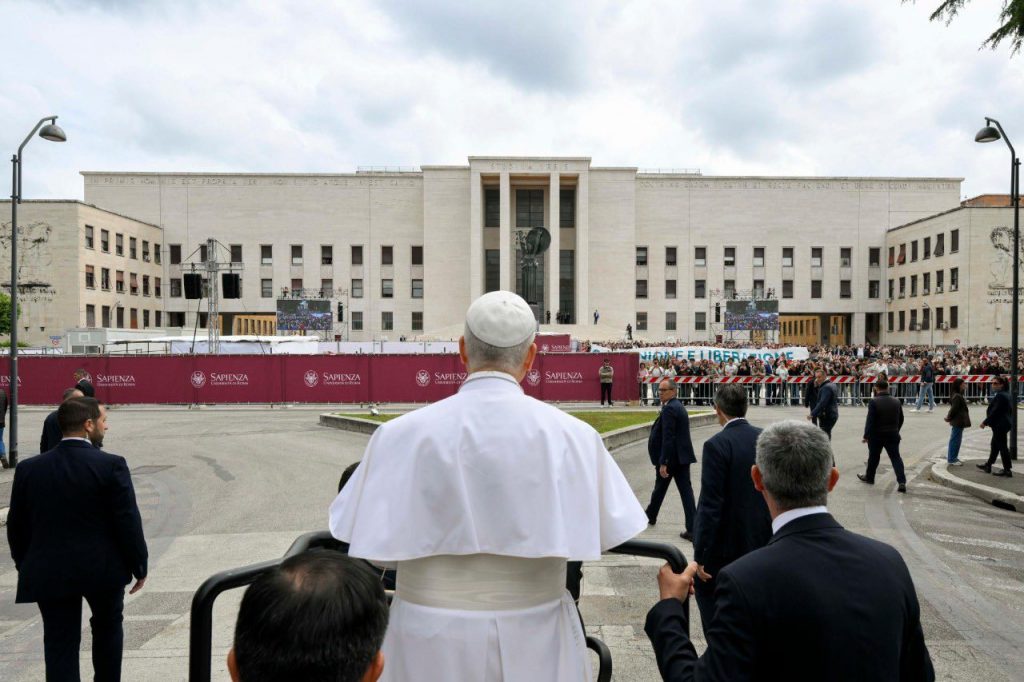
I have gladly accepted the invitation to meet with the University community of La Sapienza — University of Rome. Your University is characterized by being a center of excellence in various disciplines and, at the same time, by its commitment to the right to education, including for those with fewer economic resources, people with disabilities, prisoners, and those who have fled war zones. For example, I greatly appreciate that the Diocese of Rome and La Sapienza have signed an agreement for the opening of a University humanitarian aid corridor from the Gaza Strip. Therefore, it is important for me, as Bishop of Rome for just over a year, to be able to meet with you. With a shepherd’s heart, I would like to address myself first to the students and then to the professors.
The avenues of the university city, along which I have walked to get here, are traversed daily by many young people, filled with mixed emotions. I imagine you sometimes carefree, happy in your own youth, which, even in a turbulent world marked by terrible injustices, allows you to feel that the future is still to be written and that no one can steal it from you. Then, the studies you pursue, the friendships that arise in these years, and the encounter with various masters of thought are a promise of what can change us for the better, even before the reality that surrounds us. When the desire for truth becomes a quest, our audacity in study bears witness to the hope for a new world.
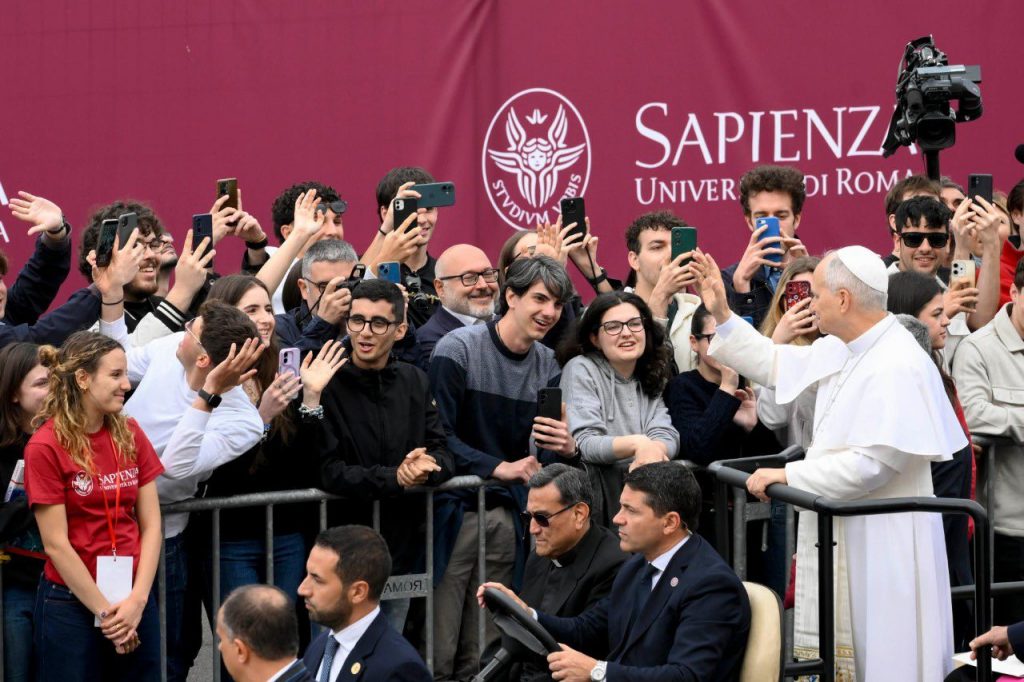
You know that I am spiritually connected to Saint Augustine, who was a restless young man: he also made serious mistakes, but nothing was lost of his passion for beauty and wisdom. In this regard, I have been pleased to receive a great number of questions from you — hundreds! Obviously, it is not possible to answer them all, but I am keeping them in mind, hoping that each of you will seek more opportunities for dialogue. This is also why the chaplaincies exist at the University, where faith meets your questions.
However, this unease also has a sad side: we mustn’t hide the fact that many young people are struggling. Everyone goes through difficult times; some, however, may feel as though they never end. These days, this increasingly depends on the blackmail of expectations and the pressure to perform. It’s the omnipresent lie of a distorted system that reduces people to numbers, exacerbating competitiveness and abandoning us to spirals of anxiety. It is precisely this spiritual malaise of many young people that reminds us that we are not the sum of what we possess, nor matter randomly assembled in a silent cosmos. We are a desire, not an algorithm! It is precisely this special dignity of ours that leads me to share two questions with you.
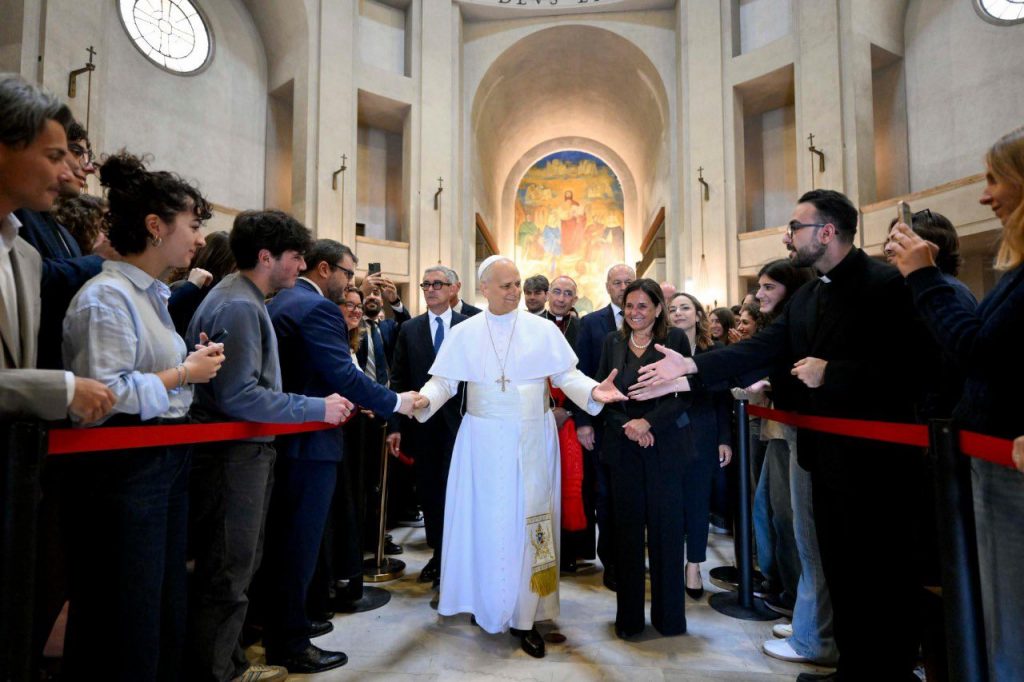
To you, young people, this unease asks: «Who are you?» Being ourselves, in fact, is the defining commitment of every man and woman’s life. «Who are you?» is the question we ask each other; the question we silently ask God; the question only we can answer on our own. We are our relationships, our language, our culture: all the more so, it is vital that the University years be a time of great encounters.
Therefore, to those who are older, the unease of youth asks: «What kind of world are we leaving behind?» A world, unfortunately, disfigured by wars and words of war. It is a contamination of reason, which, from a geopolitical perspective, pervades all social relations. The simplification that creates enemies must be corrected, therefore, above all in the University, with an awareness of the complexity and the wise exercise of memory. In particular, the tragedy of the 20th century must not be forgotten. The cry «Never again war!» of my predecessors, so in keeping with the rejection of war enshrined in the Italian Constitution, impels us toward a spiritual alliance with the wellspring of justice that dwells in the hearts of young people, with their vocation not to be confined by ideologies and national borders.
For example, in the last year, the increase in military spending worldwide, and particularly in Europe, has been enormous: we cannot call «defense» a rearmament that increases tensions and insecurity, impoverishes investments in education and health, undermines trust in diplomacy, and enriches elites who care nothing for the common good. Furthermore, it is necessary to monitor the development and application of artificial intelligence in the military and civilian spheres, so that it does not absolve human decisions of responsibility and exacerbate the tragedy of conflicts.
What is happening in Ukraine, in Gaza and the Palestinian Territories, in Lebanon and Iran illustrates the inhumane evolution of the relationship between war and new technologies in a spiral of annihilation. Let study, research, and investment go in the opposite direction: Let them be a radical «yes» to life! Yes to innocent life, yes to young life, yes to the lives of peoples who cry out for peace and justice!
A second area of shared commitment concerns ecology. As Pope Francis told us in the encyclical Laudato Si’, «there is a very solid scientific consensus indicating that we are facing a worrying warming of the climate system» (n. 23). More than a decade has passed since then and, beyond good intentions and some efforts directed in that direction, the situation does not appear to have improved.
In this scenario, I especially encourage you, dear young people, not to give in to resignation, but instead transform anxiety into prophecy. Especially those who believe know that history does not inevitably fall into the hands of death, but is always protected, whatever happens, by a God who creates life from nothing, Who gives without taking, Who shares without consuming. Today, precisely the implosion of a possessive and consumerist paradigm opens the way to the new that is already sprouting: study, cultivate, and safeguard justice! Together with me and so many brothers and sisters, be architects of true peace: a peace that is both disarmed and disarming, humble and persevering, working for harmony among peoples and the care of the Earth.
All your intelligence and audacity are needed. You, in fact, can help those who have come before you to re-establish a true horizon of meaning, so as not to get stuck in the umpteenth fleeting snapshot of the situation we find ourselves in. It is necessary to move from hermeneutics to action: so little considered by a society with fewer and fewer children, bear witness that humanity is capable of a future, when it builds it with wisdom.
Your University, which bears a divine name, is a place of study and a center for experimentation, which for centuries has shaped critical thinking. In particular, you, the professors, can cultivate a fruitful connection with the minds and hearts of young people: it is a demanding responsibility, undoubtedly, but also a fascinating one. It is of utmost importance to believe in your students. Therefore, ask yourselves often: Do I have confidence in them?
Teaching is a form of charity, just as helping a migrant at sea, a poor person on the street, or a troubled conscience is. It is about loving human life always and in every case, valuing its potential, so as to speak to the hearts of young people, without focusing solely on their knowledge. Teaching then becomes bearing witness to values through one’s life: it is caring for reality, it is welcoming what is not yet understood, that is, the truth. What sense would it make, on the other hand, to train a researcher or a professional who, nevertheless, does not cultivate their own conscience, their sense of justice, and respect for what cannot and should not be controlled? Knowledge, in fact, is not only useful for achieving professional goals, but also for discerning who we are. Through classes, practices, interaction with the city, theses, and doctorates, each student can always find new motivations, bringing order between study and life, between means and ends.
Dear friends, while I encourage you to this daily practice, my visit is meant to be a sign of a new educational alliance between the Church in Rome and your prestigious University, which was born and grew precisely within the Church. I assure you all of my prayers, and I wholeheartedly impart the Lord’s blessing upon the entire community of La Sapienza. Thank you!
_________________
Final, improvised greeting before the Rector’s Office
Thank you, thank you all! In this final greeting, after this morning’s visit, I would like to extend a kind of invitation to all of you: let us collaborate together, let us all be builders of peace in the world, let us work, let us study, let us do everything possible, from our relationships with friends, our words, our way of thinking, to build peace in the world. Always have hope in the possibility of building a new world! Thank you for being here, and see you soon!

Publicaciones relacionadas:
 This is the first YouTube video message from Pope Leo XIV to USA
 Pope Leo at the canonization of Acutis and Frassati: an invitation not to waste life and to look upward
 PHOTO GALLERY: Pope Leo XIV revives childhood tradition: mass blessing of “baby Jesus” figures at the Vatican
 The authentic experience of sports, team spirit, and its temptations, according to Pope Leo XIV
