

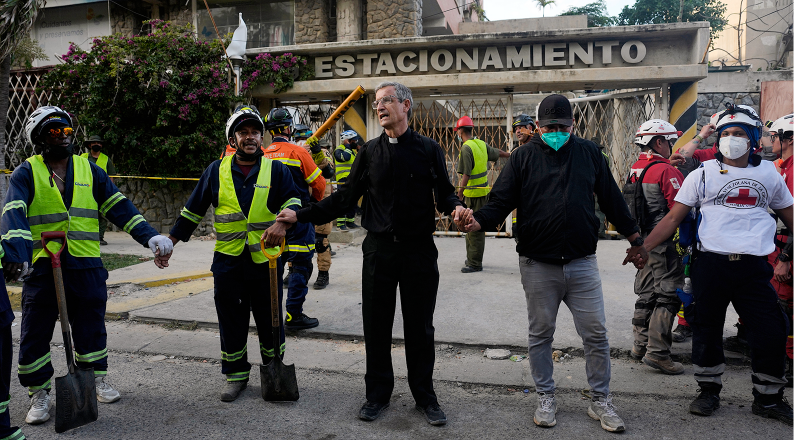
ZENIT News / Caracas, 07.12.2026).- As Venezuela begins the long and painful journey from emergency relief to reconstruction following the twin earthquakes that struck the country’s northern coast on June 24, the Catholic Church has emerged as one of the principal pillars sustaining devastated communities. While many survivors continue struggling to rebuild shattered lives, an extensive network of parishes, volunteers and international Catholic organizations has transformed compassion into one of the largest humanitarian responses the country has witnessed in recent years.
The first official emergency report released by Caritas Venezuela, titled “After the Tremor, Love”, offers a detailed account of relief efforts carried out between June 25 and July 6 following the magnitude 7.2 and 7.5 earthquakes that ravaged La Guaira, Caracas and several regions across central and western Venezuela. More than a statistical summary, the report documents a carefully coordinated operation designed to ensure that every shipment of aid can be fully traced from donor to recipient.
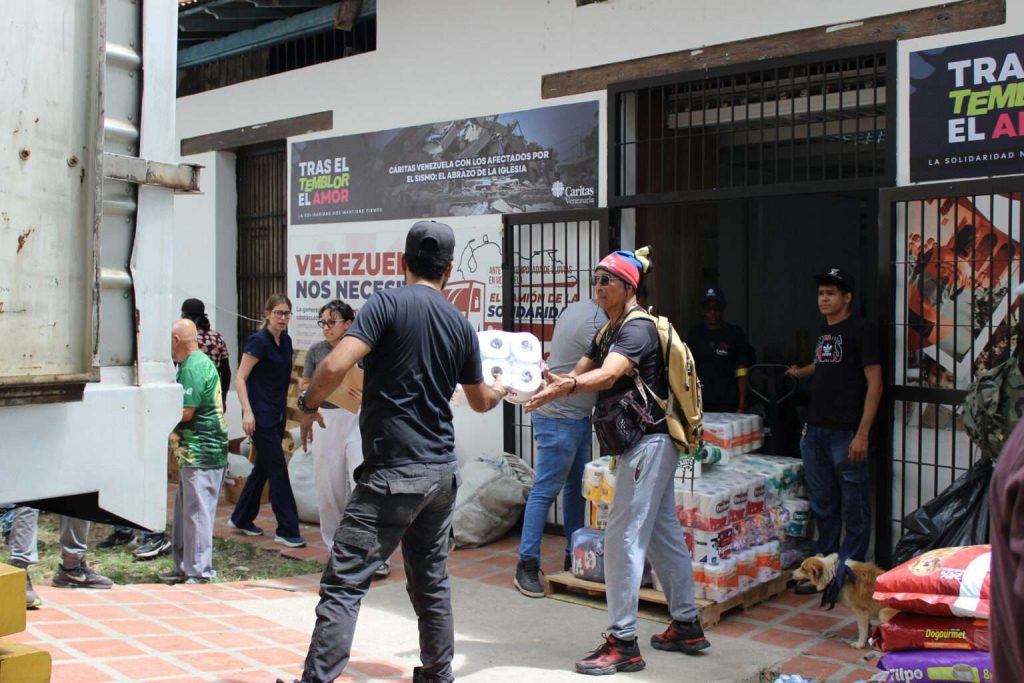
According to the report, Caritas Venezuela has received approximately 14,700 tons of humanitarian assistance. Of that amount, 9,000 tons—61 percent of the total—have already reached affected communities, while another 5,700 tons remain available for the next stages of relief. Water has represented the largest share of distributed supplies, totaling 4,031 tons, followed by 3,247 tons of food.
The scale of direct assistance has also been remarkable. Volunteers assembled and delivered 8,000 complete relief packages, including 5,000 food kits, 3,000 hygiene kits and 1,000 emergency kits for rescue personnel. Those distributions have benefited more than 8,000 families—an estimated 32,000 to 40,000 people—and have provided roughly 730,000 family food rations.
Medical assistance has formed another critical component of the operation. Caritas has delivered 73,356 units of medicines and medical supplies through 26 distribution points serving Greater Caracas and La Guaira. Nearly two-thirds of those supplies—61.3 percent—were sent directly to hospitals and healthcare facilities treating earthquake victims.
Behind these impressive figures stands an extraordinary volunteer effort. Caritas describes its volunteers as «the heart of the response.» More than 3,360 registered volunteers have participated in the operation, with an average of 280 serving each day in shifts lasting approximately seven and a half hours, contributing around 2,100 hours of humanitarian service daily.
The local Church has not worked alone. Specialists from the worldwide Caritas confederation—including Catholic Relief Services, Caritas Spain, Caritas Germany, Caritas Latin America and the Caribbean, Caritas Puerto Rico, and volunteers from Chile—have joined Venezuelan teams in areas ranging from water and sanitation to nutrition, emergency shelter and disaster-risk management. Caritas Italiana also launched a fundraising campaign, while the Italian Bishops’ Conference committed an initial €500,000 to support urgent relief operations.
The emergency response has extended beyond material assistance. The report also records the deployment of 27 Starlink communication kits and 878 rescue tools to facilitate operations in damaged areas, while emphasizing the pastoral presence maintained by the Venezuelan Bishops’ Conference and local clergy among grieving families.
For Father Antonio Rella, pastor of Immaculate Heart of Mary Parish in La Guaira, however, statistics only tell part of the story.
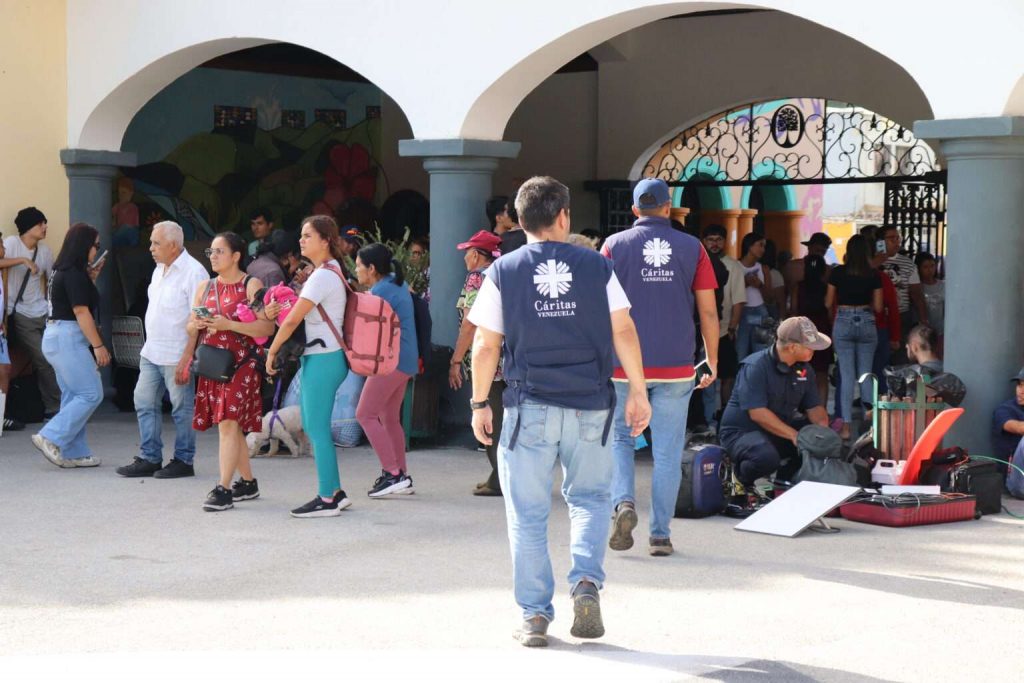
He describes neighborhoods reduced to scenes resembling battlefields, with entire buildings collapsed and communities still living between hope and heartbreak. More than two weeks after the disaster, many families continue waiting for news of missing loved ones, encouraged by occasional rescues such as that of two sisters found alive beneath the rubble. Others have experienced the anguish of recovering only the remains of relatives.
«The destruction was monumental,» the priest explains, noting that uncertainty now extends well beyond the immediate tragedy. Many residents have lost not only their homes but also their livelihoods. Businesses connected to Maiquetía International Airport, the port of La Guaira and local commerce remain closed or destroyed, leaving thousands without income even if their homes survived.
Although Father Rella’s own parish suffered relatively limited structural damage, allowing it to remain open, many neighboring churches were far less fortunate. La Guaira Cathedral sustained severe damage, while several parish churches will have to be demolished.
Because his church remained standing, it quickly became both a pastoral refuge and a logistical hub for relief distribution. Priests gathered there to coordinate assistance while volunteers organized food, medicine and emergency supplies for surrounding communities.
The priest acknowledges that the first days of relief were inevitably marked by confusion as numerous organizations converged simultaneously on the disaster zone. Yet he credits Caritas Venezuela’s parish-based structure with enabling a rapid and increasingly coordinated response.
Even so, Father Rella believes the greatest challenge now is not logistical but spiritual.
Celebrating funerals for earthquake victims—including a one-year-old child—and accompanying grandparents searching desperately for missing grandchildren have tested every priest serving the affected dioceses. Finding words capable of illuminating such suffering through faith, he admits, is among the most difficult responsibilities of pastoral ministry.
The Church also sees reconstruction in broader terms than rebuilding damaged buildings. Parish churches are viewed as places where wounded communities gather to pray, mourn, find consolation and gradually recover their sense of hope. Alongside restoring these sacred spaces, local Church leaders emphasize the importance of psychological and spiritual support for survivors, clergy and lay volunteers alike.
Food and clean water remain among the most urgent material needs, despite generous donations of medicines that have even allowed some parishes to establish community pharmacies.
Caritas Venezuela stresses that every shipment is documented through signed delivery records and transfer documentation, underscoring its commitment to financial transparency. The organization continues urging donors to contribute only through its official channels and warns against fraudulent fundraising efforts.
Its latest bulletin also carries an important reminder: the resources mobilized so far address only the emergency phase. The far more demanding work of rebuilding homes, communities and livelihoods will require sustained international solidarity long after media attention fades.
That appeal echoes Father Rella’s final message. Thanking countless individuals and institutions that have supported Venezuela, he asks that generosity not diminish as headlines move elsewhere. Above all, he invites people around the world to continue praying for the country.
«Faith does not make things easy,» he says. «It simply makes them possible, because it gives us the strength of soul to keep moving forward.»
The extensive humanitarian mobilization led by the Church has drawn widespread gratitude from survivors, many of whom have contrasted the rapid, organized presence of Catholic relief agencies and volunteers with what they describe as insufficient assistance from the Venezuelan government during the critical first weeks after the disaster.
Thank you for reading our content. If you would like to receive ZENIT’s daily e-mail news, you can subscribe for free through this link.

Publicaciones relacionadas:
 President of the World Council of Churches Calls for Inter-Communion Between Catholics and Protestants
 Pope Decides to Ban the Sodalitium of Christian Life and Entrusts Its Execution to a Controversial Priest
 Trump new president: a telegram from the pope, an end to gender ideology and a Catholic priest at the ceremony
 Controversial Antwerp bishop expands on his idea of ordaining married men and shares his thoughts on women
