

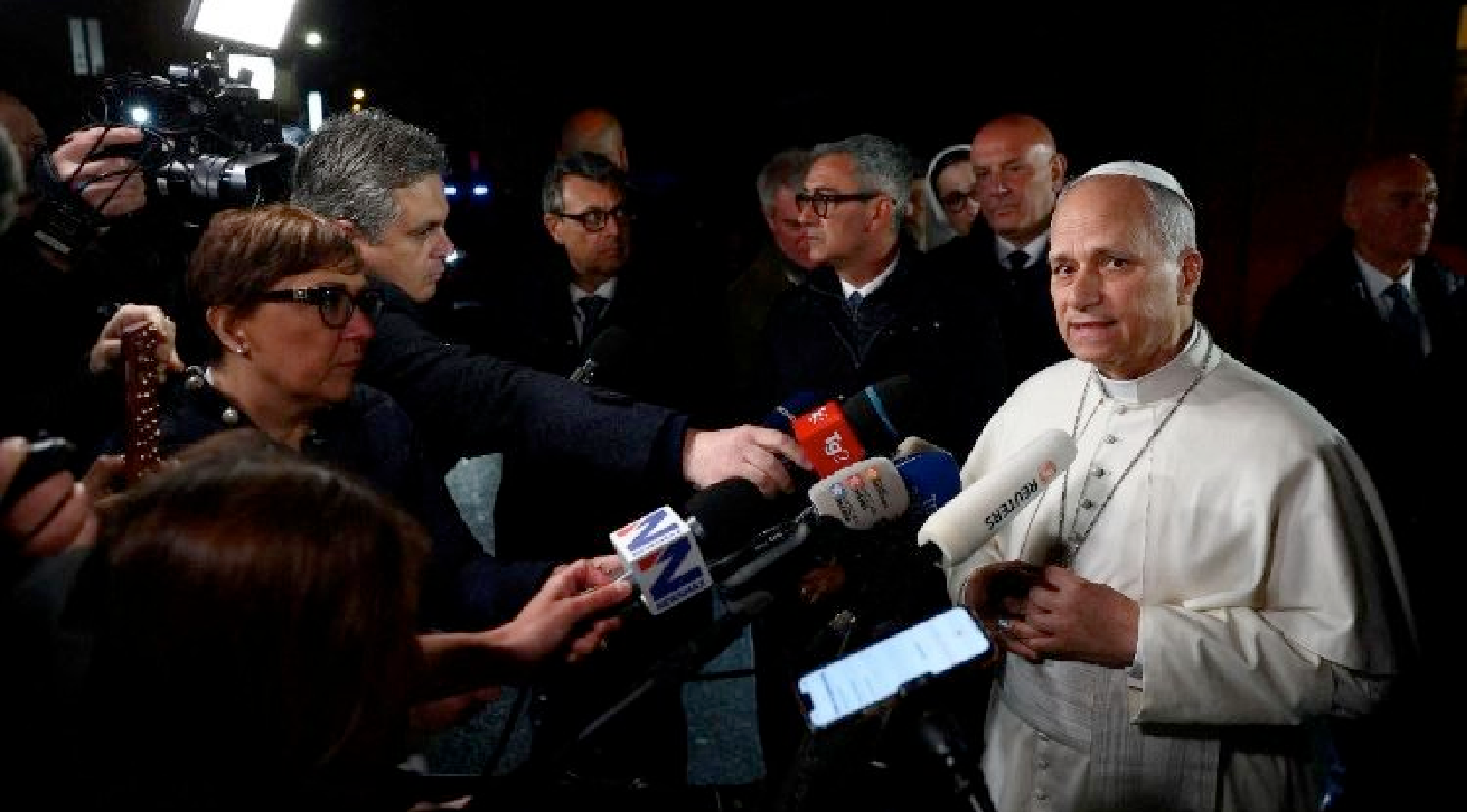
(ZENIT News / Castelgandolfo, 04.07.2026).- From the Castel Gandolfo, a place long associated with papal retreat and reflection, Pope Leo XIV delivered one of his most direct and politically charged appeals since the beginning of the latest international crisis. Speaking briefly to journalists on the evening of April 7, the pontiff framed the mounting tensions around Iran not merely as a geopolitical standoff, but as a test of humanity’s moral conscience.
His remarks came in response to the stark ultimatum issued by Donald Trump, who reportedly threatened devastating military action against Iran—including the possibility of annihilation “in one night”—should Tehran continue to reject conditions tied to the strategic Strait of Hormuz. Without naming Trump explicitly, the Pope left no ambiguity in his judgment: such threats, he said, are “simply unacceptable.”
The Pope’s intervention was notable not only for its clarity but for its dual framing. On one level, he acknowledged the legal dimensions of the crisis, pointing to violations of international law, particularly in relation to attacks on civilian infrastructure. Yet he insisted that the deeper issue transcends legal codes. “This is a moral question,” he stressed, one that must be evaluated in light of the common good and the protection of the most vulnerable.
Throughout his remarks, delivered first in Italian and then in English, Leo XIV returned insistently to the human cost of escalation. He urged listeners to “think in their hearts” of those who would bear the brunt of any further conflict: children, the elderly, the sick—figures he described as entirely innocent and yet inevitably exposed to the consequences of decisions made far from the battlefield.
The Pope also situated the crisis within a broader landscape of global instability. He pointed to a convergence of pressures—a fragile world economy, ongoing energy disruptions, and a Middle East marked by deepening volatility—that together risk amplifying the destructive potential of any single conflict. In his words, the region’s instability is not contained; it radiates outward, “provoking more hatred across the world.”
This linkage between local conflict and global repercussions reflects a consistent theme of his pontificate: the idea that modern crises are interconnected, and that war, far from resolving disputes, tends to multiply them. In this context, his rejection of military escalation was categorical. War, he argued, especially one widely regarded as unjust, “solves nothing” and instead entrenches cycles of violence and division.
Significantly, Leo XIV did not limit his appeal to political leaders. He called on ordinary citizens—across all nations involved—to make their voices heard. In a rare invocation of civic responsibility, he encouraged people to reach out to their representatives, including members of the U.S. Congress, urging them to prioritize negotiation over confrontation. “We are a people who love peace,” he said, framing public opinion as a potential counterweight to the logic of escalation.
The Pope’s remarks echoed and reinforced his Easter message delivered during the Urbi et Orbi on April 5, where he had already called on those with the power to wage war to lay down their arms and choose dialogue. Two days later, at Castel Gandolfo, that appeal took on a sharper urgency, shaped by rapidly unfolding events.
At the heart of his message lies a stark warning: that the normalization of threats against entire populations signals not only a failure of diplomacy, but a deeper erosion of ethical boundaries. Attacks on civilian infrastructure, he noted, are not just illegal—they are manifestations of a broader human capacity for destruction when dialogue breaks down.
In the end, Leo XIV’s intervention can be read as both a plea and a diagnosis. A plea for an immediate return to negotiation—“back to the table,” as he put it—and a diagnosis of a world drifting toward a dangerous threshold, where legal arguments risk obscuring the more fundamental question of what kind of humanity is being defended.
Thank you for reading our content. If you would like to receive ZENIT’s daily e-mail news, you can subscribe for free through this link.

Publicaciones relacionadas:
 Pape Leo Spoke On The Phone With Vladimir Putin: This Is What Their Conversation Was About
 US Congress: bill introduced to prevent revocation of Pope Leo XIV’s citizenship and tax issues
 [PHOTO GALLERY] This is how the first historic day of the King of England’s state visit to Pope Leo XIV unfolded
 Pope Leo XIV, the US-Iran war, and a forceful call in a Middle East on the brink of the abyss
