

(ZENIT News / Washington, 10.03.2026).- The U.S. military is giving its chaplains a more direct line to the Pentagon’s leadership, in a move welcomed by the Catholic archdiocese responsible for the spiritual care of American service members and their families.
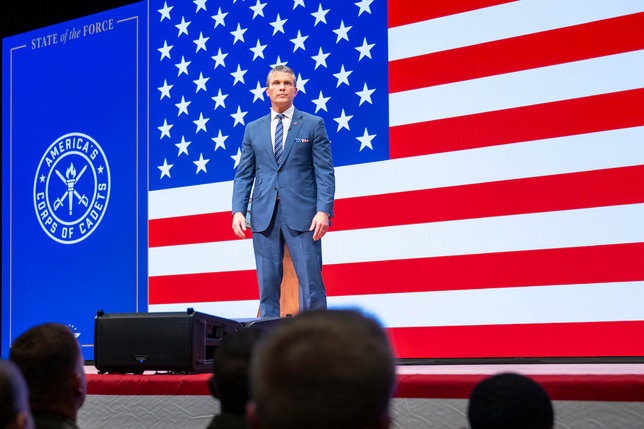
Defense Secretary Pete Hegseth announced the creation of a new Office of Religious Affairs on September 30 during his State of the Force address at Marine Corps Base Quantico, Virginia. The event was attended by about 600 military officers and service members. The new office, Hegseth said, will report directly to him and to future secretaries of defense, removing what he described as layers of secular bureaucracy between chaplains and senior decision-makers.
“This will not be a bureaucratic exercise,” Hegseth said. He promised the office real authority to protect budgets, secure infrastructure and strengthen religious support, giving chaplains an advocate at the highest level of the Defense Department.
For the Archdiocese for the Military Services, the significance of the announcement lies less in administrative restructuring than in what it could mean for the men and women who serve far from home.
The archdiocese said it hopes the new office will strengthen religious support for service members and their families while improving the conditions in which chaplains accompany soldiers, sailors and airmen. Giving greater priority to spiritual readiness and shortening the distance between needs identified in the field and decisions made at the top, it argued, could help overcome longstanding limitations affecting military chaplaincy.
The dispute behind the reform is partly about who gets to define the role of religion inside an institution whose primary mission is military. Hegseth argued that, under the previous system, decisions affecting religious life were too often made by secular officials and lawyers with little understanding of faith. Chaplains, he said, were left waiting for authorization while budgets, staffing and chapel resources suffered.
The secretary presented that situation as particularly difficult to justify because, according to his figures, only 5 percent of the armed forces profess no religion. Whatever the precise implications of that statistic for religious practice, his broader argument is that spiritual care should not be treated as an optional service in a force whose members routinely confront danger, separation from their families and the moral consequences of military action.
“Our department therefore has a sacred duty,” Hegseth said, “to provide first-class religious support wherever we send our warriors.”
The initiative also continues a series of changes affecting the military chaplaincy that have received support from Archbishop Timothy Broglio, head of the military archdiocese. Broglio welcomed Hegseth’s decision to withdraw official spiritual-fitness guidance that the secretary had criticized as promoting secular humanism and reducing chaplains to something resembling emotional-support officers. For Broglio, the change restores the distinctive purpose of chaplaincy: spiritual ministry should come before the additional functions that military life may require of chaplains.
The archbishop has likewise supported changing chaplain insignia on uniforms so that it emphasizes religious affiliation rather than military rank. His reasoning was practical as well as symbolic: if removing conventional rank insignia makes chaplains easier for service members to approach, the archdiocese considers the change worthwhile.
These reforms, however, have unfolded against a more complicated relationship between the military archdiocese and the Defense Department. In 2025, the archdiocese objected to the Army’s cancellation of religious contracts, after which the Defense Department worked to restore them. The episode illustrated the very problem that the new office is intended to address: religious ministry can depend heavily on administrative decisions made far from the people actually providing it.
Broglio’s support for strengthening chaplaincy should therefore not be mistaken for blanket approval of the administration’s military policies. The archbishop has been an outspoken critic when he believes those policies conflict with Catholic teaching. In April, he echoed Pope Leo XIV’s concerns about the war in Iran, arguing that it was difficult to reconcile that conflict with the Catholic tradition of just war. He has also criticized earlier proposals to annex Greenland and expressed concern over attacks on suspected drug-trafficking boats off Venezuela that reportedly killed more than 100 people.
That distinction is important. A military chaplain is not simply another representative of the chain of command, and Catholic chaplaincy in particular carries an obligation that cannot be reduced to morale-building. Its purpose is to serve the religious and spiritual needs of those in uniform, including when that ministry requires moral discernment about the use of force itself.
The Pentagon’s new office will ultimately be judged less by its organizational chart than by what changes on military bases: whether chapels receive adequate resources, whether service members can find a chaplain when they need one, whether religious practice is genuinely protected across different faith traditions, and whether chaplains can exercise their ministry without unnecessary bureaucratic interference.
Thank you for reading our content. If you would like to receive ZENIT’s daily e-mail news, you can subscribe for free through this link.

Publicaciones relacionadas:
 Discalced Carmelites leave Nicaragua amid government persecution
 United Kingdom joins countries attacking full sacramental stealth
 U.S. Army Decision to End Chapel Contracts Sparks Outcry from Military Catholics
 The Catholic Church in Poland Takes a Stand on Surrogacy and Faces a Battle to Defend Religious Education Classes
