

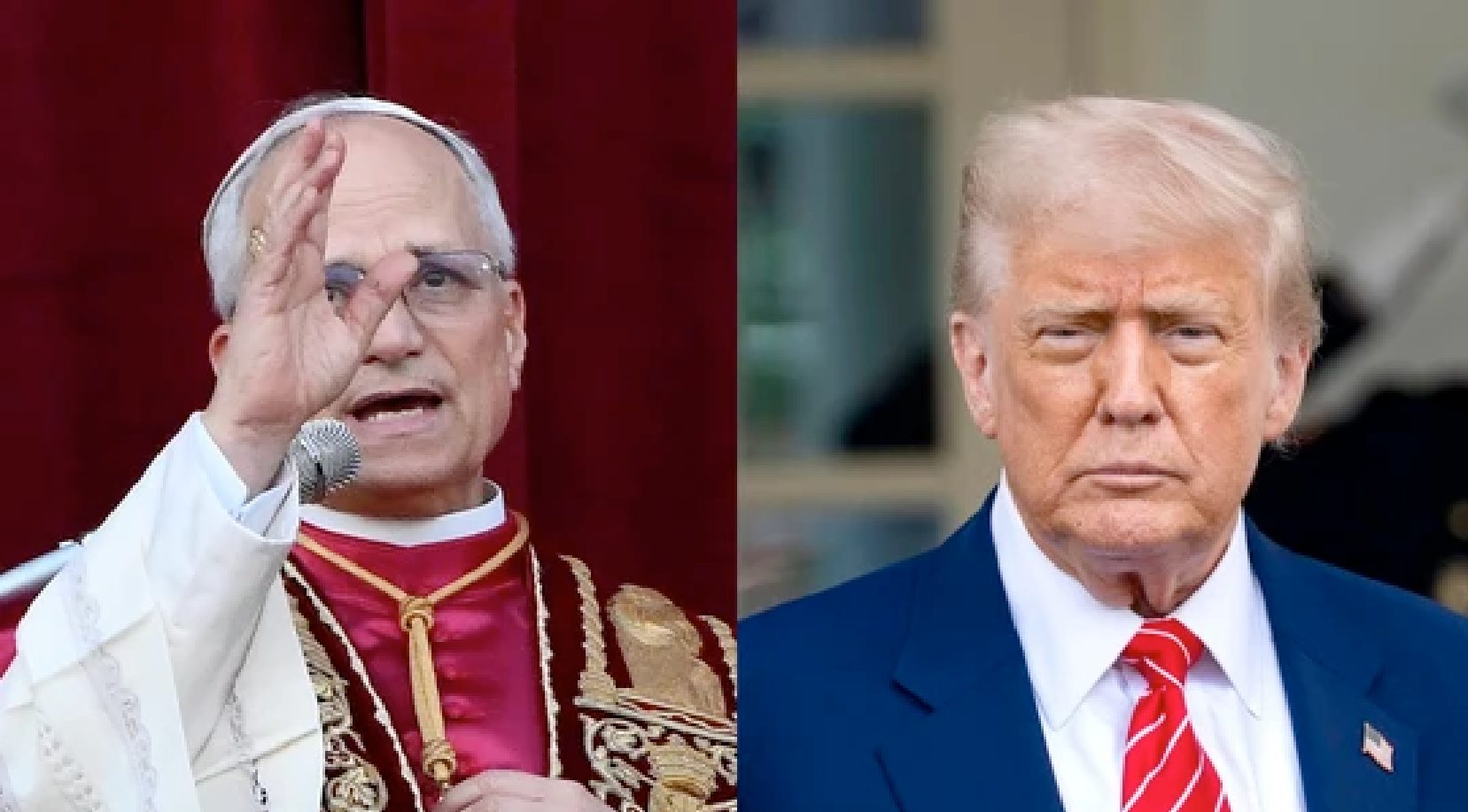
(ZENIT News / Rome, 05.08.2026).- A new national survey suggests that Pope Leo XIV’s appeals for peace amid escalating tensions with Iran have resonated strongly with the American public, while President Donald Trump’s increasingly confrontational rhetoric toward the pontiff has generated widespread disapproval across the United States.
The poll, conducted jointly by The Washington Post, ABC News, and Ipsos between April 24 and April 28 among 2,560 American adults, paints a striking picture of diverging public perceptions surrounding the conflict with Iran, nuclear tensions in the Middle East, and the moral language being used by political and religious leaders. The survey carries a margin of error of plus or minus two percentage points.
At the center of the controversy are comments made by Pope Leo XIV on April 7 after Trump warned that “the entire civilization” of Iran could be destroyed if Tehran failed to reach an agreement with Washington. The Pope responded sharply, calling such rhetoric a sign of the hatred, division, and destruction of which the human being is capable, and describing the language as “unacceptable.”
According to the survey, most Americans appear to agree with him.
Sixty-six percent of respondents said they viewed Leo XIV’s call for Americans to contact members of Congress in support of peace efforts positively, while only 30% reacted negatively. The Pope’s intervention was notable not only because of its directness, but because it placed the Holy See once again at the center of debates over war, diplomacy, and nuclear escalation.
The Vatican has consistently opposed the proliferation of nuclear weapons, a position maintained under successive pontificates and repeatedly reaffirmed by Leo XIV since the outbreak of the Israel-Iran confrontation in 2025. Although Trump accused the Pope of implicitly tolerating an Iranian nuclear arsenal, Leo never suggested that Iran should possess such weapons. Rather, he reiterated the Holy See’s longstanding insistence that nuclear deterrence itself poses grave moral and humanitarian risks.
That distinction appears to have mattered little to the political battle unfolding in Washington.
Trump responded publicly by declaring, “I don’t want a pope who thinks it’s okay for Iran to have a nuclear weapon.” Yet the survey indicates that most Americans rejected the president’s framing. Only 38% viewed Trump’s criticism positively, while 57% regarded it negatively.
Even more damaging politically was public reaction to an AI-generated image posted by Trump that appeared to depict him in a Christ-like form during the height of his dispute with the Pope. Only 9% of Americans reacted favorably to the image, while an overwhelming 87% viewed it negatively.
Trump later deleted the image and insisted he believed it portrayed him dressed as a doctor rather than as Jesus Christ. Nevertheless, the episode intensified criticism that the president was trivializing religious imagery at a moment of international crisis.
The survey also measured reactions to comments made by Defense Secretary Pete Hegseth, who publicly prayed for “decisive action against those who deserve no mercy” in connection with American strikes against Iran. Those remarks were viewed positively by just 27% of respondents and negatively by 69%.
Beyond the immediate dispute with the Vatican, the poll reveals broader political damage for the administration as the Iran conflict continues to affect domestic concerns such as inflation, fuel prices, and the rising cost of living.
Trump’s overall disapproval rating reached 62%, compared to only 37% approval. On specific issues, the numbers were even worse for the president: 66% disapproved of his handling of Iran, 72% disapproved of his management of inflation, and 76% criticized his handling of the cost of living.
The public also appears deeply divided over the military campaign itself. While 36% of Americans believe the strikes against Iran were the correct decision, 61% consider them a mistake. Nearly half of respondents — 46% — said the attacks contradicted Trump’s campaign promise to avoid foreign wars, while only 22% believed the military action remained consistent with that pledge.
Among Catholics, the numbers may be especially troubling for the White House.
Only 38% of Catholics approve of Trump’s performance, while 61% disapprove. The internal divisions within the Catholic electorate are also revealing. Among white Catholics, approval stands at 49%, with 51% disapproving. Hispanic Catholics, however, reject the president by a far wider margin: only 25% approve, while 72% disapprove.
By contrast, Pope Leo XIV currently enjoys relatively favorable perceptions, although a significant portion of Americans — especially non-Catholics — are still forming opinions about the first American pope in history.
Overall, 41% of Americans view Leo positively, 16% negatively, while 43% say they have no opinion yet. Among Catholics specifically, 61% hold a favorable view of the Pope, compared with only 14% unfavorable.
The partisan divide among Catholics remains visible but less dramatic than in broader American politics. Among Democratic or Democratic-leaning Catholics, 76% view Leo positively. Among Republican or Republican-leaning Catholics, favorable views still reach 48%, although 23% view him negatively.
Notably, Hispanic and white Catholics express almost identical levels of support for the pontiff. Sixty percent of white Catholics and 59% of Hispanic Catholics report favorable opinions of Leo XIV.
The timing of the survey is politically significant.
Its publication coincides with a second wave of public criticism from Trump directed toward the Pope and came only days before Secretary of State Marco Rubio met with Leo XIV at the Vatican on May 7. Rubio insisted the meeting had already been planned and was unrelated to the escalating rhetoric between the White House and the Holy See.
Meanwhile, Leo XIV has shown little sign of retreating from public engagement on the issue. Speaking on May 5, the Pope stated that he has no difficulty being criticized, provided criticism is rooted in truth.
That response reflects a broader pattern emerging in Leo XIV’s pontificate: a willingness to intervene forcefully in geopolitical debates while avoiding personal escalation. Unlike many political leaders, the Pope has framed the crisis primarily through moral and humanitarian categories rather than strategic or ideological ones.
The survey results suggest that Americans — including substantial numbers of Catholics across political lines — may be more receptive to appeals for restraint, diplomacy, and moral clarity than to rhetoric centered on destruction and confrontation.
Thank you for reading our content. If you would like to receive ZENIT’s daily e-mail news, you can subscribe for free through this link.

Publicaciones relacionadas:
 Leo XIV: a digital phenomenon and the first Pope influencer. Almost 13 million followers in 72 hours
 Trump Opens Another War Front: The Pope and the Vatican, Leo XIV Responds: «I Am Not Afraid of the Trump Administration»
 Trump Attacks the Pope for the Second Day, and Meloni Defends Him. The World Reacts While the Catholic Vice-President of the USA Supports Him
 Trump and Vance prolong the conflict with Leon XIV as Russia and Brazil join the controversy
