

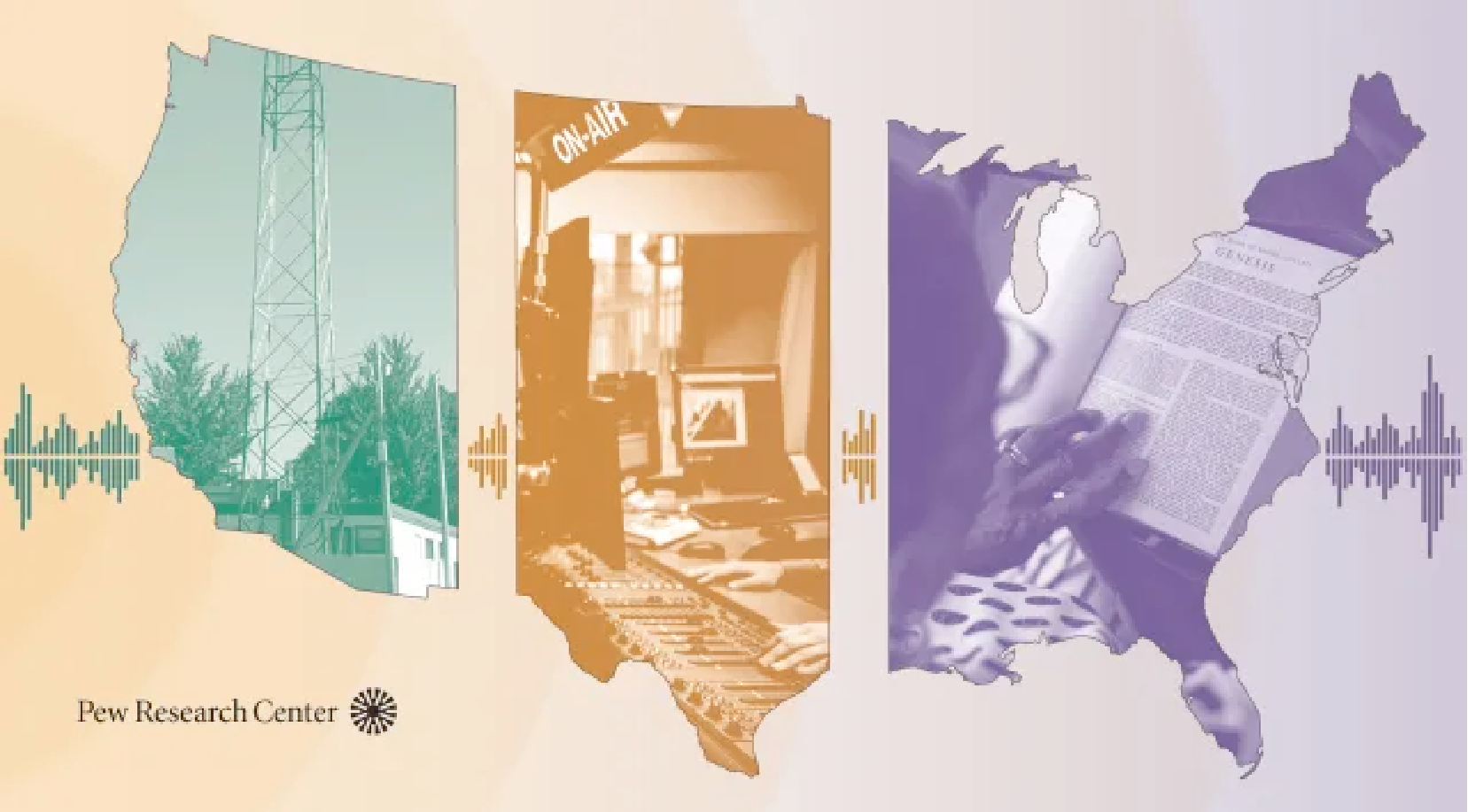
(ZENIT News / Washington, 04.12.2026).- In an era dominated by digital platforms and fragmented media consumption, one of the most pervasive and least examined forces in the United States remains firmly rooted: religious radio. Far from being a relic of the early twentieth century—when Sunday services were first broadcast to scattered congregations—this form of communication has evolved into a vast and structured ecosystem that continues to reach nearly the entire population.
According to a comprehensive analysis conducted by the Pew Research Center, more than 4,000 terrestrial religious radio stations are currently operating across the United States. This figure represents roughly one quarter of the approximately 17,000 AM and FM stations licensed by federal authorities. Coverage is so extensive that 98 percent of American adults live within range of at least one such station, and most can access several from their homes.
This ubiquity reflects not only institutional strength but also a deeply rooted cultural habit. Around 45 percent of adults report that they listen to religious audio programming in some form. Among these listeners, approximately three quarters still turn to traditional radio, even as seven in ten also access similar content via podcasts or streaming platforms. Rather than being displaced by digital media, religious broadcasting has effectively expanded into it, with nearly all major radio programs now available on demand.
The structure of this broadcasting universe is strikingly consistent in some respects and highly varied in others. Christianity overwhelmingly dominates the landscape. The majority of stations identify broadly as “Christian” without denominational specificity, accounting for 63 percent of the total. Another 10 percent align with particular Protestant traditions, while 8 percent identify as Catholic. Only a marginal number belong to other Christian communities or to non-Christian religions, and roughly one in five lacks sufficient public information to determine its affiliation.
Yet beyond labels, the mission articulated by these stations reveals a shared orientation. Approximately 77 percent explicitly describe evangelization—spreading the Gospel—as a central purpose. Their self-descriptions frequently emphasize being “inspirational” (36 percent), “family-friendly” (21 percent), or offering guidance for daily life (19 percent). These themes are not merely rhetorical; they correspond closely to the motivations cited by listeners, who often seek moral orientation, emotional support, or spiritual formation rather than strictly doctrinal instruction.
Programming reflects this hybrid function. On average, religious stations divide their airtime almost evenly between music and spoken content. Music—predominantly contemporary Christian and worship genres—occupies about half of the schedule, yet even here concentration is notable: just 1 percent of artists account for more than half of all song plays, and 16 percent of songs aired in July 2025 came from only ten performers.
The spoken component, meanwhile, constitutes a dense tapestry of sermons, talk shows, interviews, and call-in segments. Approximately 86 percent of this content contains explicit references to religion, amounting to more than ten hours of religious discussion per station each day. Male voices dominate the format, representing 81 percent of spoken airtime, a detail that underscores enduring gender imbalances within certain sectors of religious communication.
Beyond explicitly theological content, religious radio engages a broad array of everyday concerns. Stations routinely dedicate hours to topics such as family life, parenting, personal development, and health. This blending of spirituality with practical guidance helps explain the medium’s resilience: it does not confine itself to liturgical or doctrinal boundaries but extends into the lived experience of its audience.
The role of politics within this ecosystem is more complex and uneven. For many listeners, it is not a primary attraction—only 14 percent cite staying informed about current events as a major reason for tuning in, though 40 percent consider it at least a secondary factor. Nevertheless, the actual content tells a more nuanced story.
On average, stations devote around two hours per day to discussions of politics, social issues, and current events. However, this figure conceals sharp disparities. Roughly 30 percent of stations spend less than 30 minutes daily on such topics, while a nearly identical proportion exceeds two and a half hours. In some cases, political discourse dominates the schedule for ten hours or more each day.
Where politics is prominent, it tends to be presented not through neutral reporting but through opinion-driven formats. Discussions frequently take the form of host commentary or listener call-ins, and they often adopt clear positions on contentious issues. This pattern becomes particularly evident in coverage of cultural debates such as abortion and LGBTQ-related questions, where positions are overwhelmingly consistent and rarely neutral.
The same dynamic appears in the treatment of political figures and international issues. In stations with a strong political focus, references to Donald Trump alone average nearly two hours of airtime per day—significantly more than any other topic, including the economy. Mentions of the Democratic Party and President Joe Biden are predominantly negative, while references to Trump are more evenly distributed between neutral and favorable tones. Coverage of international matters, including Israel and the Palestinian territories, also reveals discernible patterns: roughly half of references are neutral, but favorable portrayals of Israel and negative portrayals of Palestinian actors are notably frequent.
Ownership structures further shape this landscape. While 28 percent of stations operate independently, the majority—72 percent—belong to larger networks that often broadcast identical content across multiple frequencies. This consolidation allows certain programs to achieve near-national reach. Some of the most prominent shows are aired by up to half of all religious stations, creating a shared auditory culture that transcends regional boundaries.
What emerges from this extensive mapping is not a monolithic phenomenon but a layered and adaptive system. Religious radio in the United States functions simultaneously as a tool of evangelization, a source of personal guidance, a platform for cultural commentary, and, in some cases, a vehicle for political expression. Its strength lies precisely in this flexibility: the ability to integrate faith with the rhythms and concerns of everyday life.
More than a century after its modest beginnings, religious broadcasting continues to occupy a central, if often overlooked, place in the American public sphere. It is a reminder that even in a fragmented media environment, certain voices—especially those that speak to meaning, identity, and transcendence—retain the capacity to reach almost everyone, almost everywhere.
Thank you for reading our content. If you would like to receive ZENIT’s daily e-mail news, you can subscribe for free through this link.

Publicaciones relacionadas:
 About the Scandal in New York’s Cathedral of Gay Irreverence During a Funeral and What This Has To Do with Fiducia Supplicans
 USA: Publication Shows That Progressive Clergy Is Extinguishing and Conservative Is Growing
 What is the religion of the people who migrate the most? Research answers and Mexico is part of the answer
 The health (physical, mental, and spiritual) of Australian clergy in 2025: What interesting research reveals
