

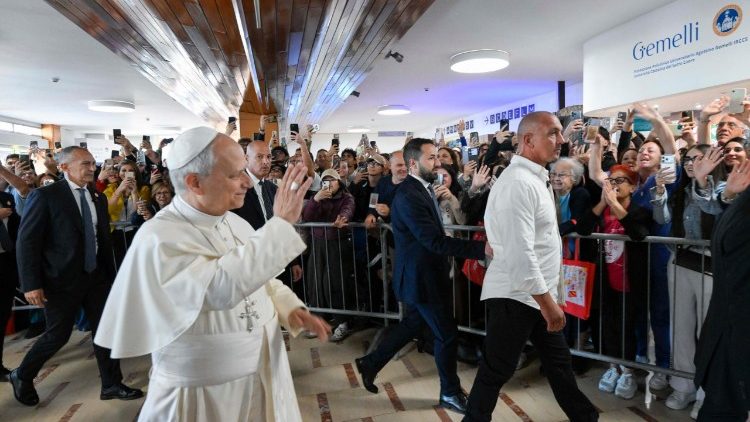
(ZENIT News / Rome, 10.13.2026).- Pope Leo XIV underwent successful surgery on Tuesday, October 13, at the Gemelli Polyclinic in Rome, to remove a lesion in his right lung that proved to be pulmonary adenocarcinoma, the Holy See confirmed in a medical bulletin released that same evening. The procedure, performed using video-assisted surgery, allowed for the removal of the lower lobe of the right lung. Although initial histological results confirmed the presence of a nodule, definitive analysis results are still required to ascertain the extent of the disease and determine whether additional treatment is needed.
A statement signed by doctors Luigi Carbone and Stefano Margaritora indicated that the operation proceeded as planned and without complications. The Pope spent approximately three hours in the operating room, although the surgery itself lasted about 90 minutes. After waking up without difficulty and undergoing a brief period of observation, he returned to his room on the hospital’s tenth floor.
Confirmation of the adenocarcinoma alters the scope of the news, which until now had been presented as the need to remove a localized pulmonary nodule, detected at an early stage. Pope Leo XIV had personally announced the issue at the conclusion of the Angelus prayer on Sunday, October 11, explaining that doctors had recommended surgery. The malignant nature of the lesion was revealed after the operation, thanks to a histological examination performed during the procedure.
Adenocarcinoma is one of the most common types of lung cancer. However, the diagnosis alone is insufficient to establish a prognosis; the tumor’s size and characteristics, potential involvement of other structures, and the results of additional tests are also significant factors. The available information does not allow for a definitive statement regarding whether the disease is confined solely to the excised tissue, nor does it indicate whether the Pope will require further treatment or be able to forgo it.
A More Extensive Procedure to Remove the Affected Tissue
The operation was led by Professor Stefano Margaritora, a specialist in thoracic surgery, with the participation of Professor Elisa Meacci and Doctors Maria Teresa Congedo and Leonardo Petracca Caravella. The anesthesiology team consisted of Professor Massimo Antonelli and Doctors Giovanni Lunzo and Giuseppe Bello.
The surgeons opted to remove the lower lobe of the right lung rather than simply removing the nodule. This procedure, known as a lobectomy, removes the affected section of the lung and is one of the surgical options used for certain lung tumors when clinical conditions permit.
The right lung has three lobes, so the removal of one of them reduces the available respiratory capacity. The actual impact will depend on, among other factors, Leo XIV’s lung function prior to the operation and how he progresses during recovery. Respiratory rehabilitation and the gradual resumption of physical activity may prove important in the weeks that follow.
The absence of complications during surgery is a positive initial development, but it should not be mistaken for the conclusion of the medical process. The definitive histological examination and subsequent evaluations will provide a clearer picture of the situation.
One Week of Hospitalization and a Suspended Schedule
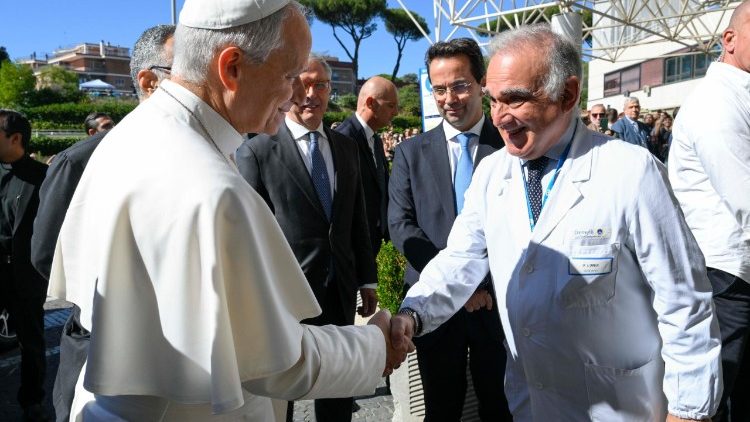
Leo XIV was admitted to the Gemelli shortly after 1:00 p.m. on Tuesday, October 13, accompanied by his Secretaries. Upon arrival, he greeted the people gathered outside the hospital, while an extensive security operation protected the Pontiff, the patients, and the medical staff.
Authorities had stepped up security measures in the days leading up to the event, implementing access controls, a visible presence by the Vatican Gendarmerie and Italian Security Forces, airspace restrictions to guard against unauthorized drone flights, and special protocols to protect clinical information. The Pope’s data, biological samples, and medical results are subject to strict confidentiality measures, given the growing risk of cyberattacks targeting sensitive institutions.
The Pontiff is expected to remain hospitalized for approximately one week. The Prefecture of the Papal Household has cancelled all scheduled audiences and activities through Tuesday, October 20, prioritizing his immediate recovery over public engagements.
The Pope is staying in a reserved area on the tenth floor of the hospital, but is not occupying the traditional papal suite, which is currently undergoing renovation. This alternative location allows for necessary isolation and security, though it also differs from previous hospitalizations of Pontiffs at the Gemelli.
The Church of Rome Accompanies the Pope in Prayer
As news of the procedure’s outcome emerged, Cardinal Baldassare Reina, the Pope’s Vicar for the Diocese of Rome, led the recitation of the Rosary in the hospital’s chapel dedicated to Saint John Paul II. The prayer gathering was organized to express the Roman Church’s closeness to its Bishop.
Elena Beccalli, Rector of the Catholic University of the Sacred Heart, also conveyed the university community’s solidarity. She highlighted the bond between the institution and the Gemelli Polyclinic, as well as the Pope’s commitment to human dignity, dialogue, and peace.
The choice of hospital holds historical significance. John Paul II received care there on numerous occasions and famously referred to it as «Vatican III.» Francis was also treated at the facility during his own health issues, including the prolonged hospitalization prior to his death, in May 2025. Now, the Center once again becomes the setting for a delicate moment for the Catholic Church, although the clinical circumstances regarding Leo XIV are different and must be assessed based on their own specific details.
For the moment, the technical success of the operation and the absence of immediate complications are the main positive developments. The next step will be to determine, based on the definitive results and the Pontiff’s progress, whether the excision was sufficient or if specialists deem it necessary to take further measures. Until then, any conclusion regarding the ultimate severity of the condition or the prospects for recovery would be premature.

Publicaciones relacionadas:
 In what sense is the Bible the Word of God in human words? Pope Leo XIV responds
 Opus Dei before the Pope: what was said about the new statutes and some controversies in Argentina
 Pope Leo XIV summons bishops to Rome to discuss the reimplementation of the controversial Amoris Laetitia
 Two interpretations of the empty tomb, only one to choose: Pope Leo XIV’s reflection
