

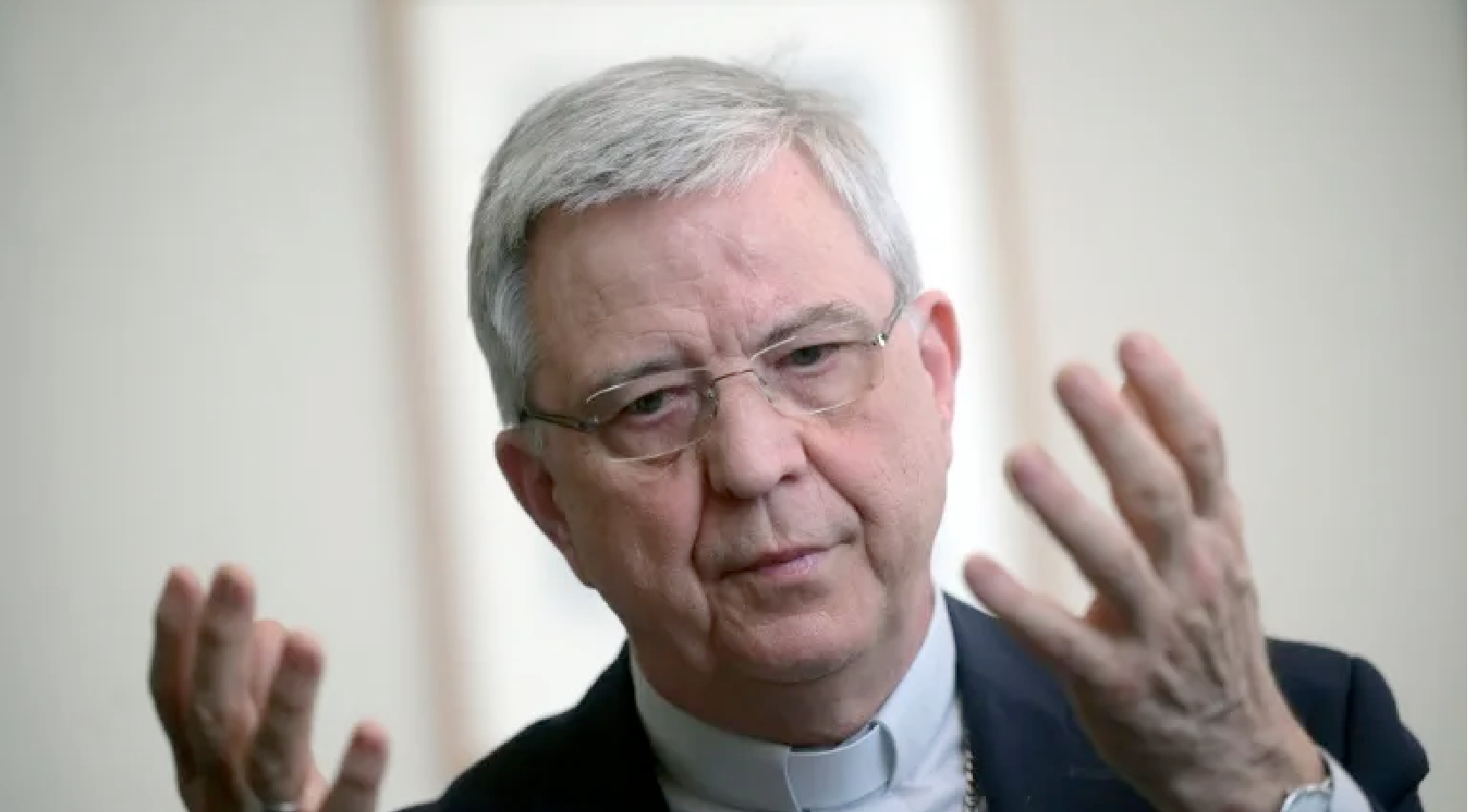
(ZENIT News / Antwerp, 04.03.2026).- In a Church accustomed to gradual reform and carefully calibrated language, the timetable proposed by Johan Bonny has landed with unusual force. By 2028, he says, his diocese should be ready to ordain married men as priests—a step that, if carried out, would test the limits of current Catholic discipline in the Latin rite and reopen one of the most persistent debates in modern ecclesial life.
The bishop’s intervention, set out in a pastoral letter and expanded in subsequent interviews, is framed as a pastoral necessity. In Antwerp, the numbers are stark. Where once there were nearly 1,500 active priests until the 1960s—supplemented by several hundred retirees—today fewer than 100 remain in ministry. About half are foreign-born, and in some regions of the diocese there is not a single priest under the age of 75.
The consequence, Bonny argues, is a structural distortion of priestly life. Clergy are increasingly absorbed by administrative tasks and internal meetings, with sacramental and pastoral presence reduced to a minimum—often limited to Sunday Eucharist. “There is no time to accompany people,” he has observed in substance, shifting the debate from abstract doctrine to operational reality. The issue, in his formulation, is no longer whether married men could be ordained, but when and under what conditions.
The proposal situates itself within the broader implementation phase of the recent global synodal process, an initiative strongly associated with Pope Francis. Bonny acknowledges that he himself was initially skeptical of the synodal exercise, but says a closer reading of its final document led him to a different conclusion: either the text is merely aspirational, or it demands concrete action. His pastoral letter, he suggests, is an attempt to take the second option seriously.
In doing so, the Belgian bishop is not operating in a vacuum. The idea of ordaining so-called “viri probati”—married men of proven faith and stability—has circulated for decades, particularly in regions facing acute priest shortages. Bonny claims that many bishops, especially in Western Europe, privately support such a move, even if few have articulated it with comparable clarity or urgency. His own experience in Rome, where he worked for over a decade at the Pontifical Council for Promoting Christian Unity, informs his belief that the issue is understood within Vatican circles, even if no consensus has yet emerged.
Canon law in the Latin Church currently requires priestly celibacy, though this is a discipline rather than a dogma. Married priests already exist within Catholicism, particularly in Eastern Catholic Churches and in specific cases of former Anglican clergy received into full communion. Bonny’s argument rests in part on this precedent: the existence of multiple traditions within the universal Church suggests that a broader application, at least regionally, would not constitute a doctrinal rupture.
Still, the bishop is aware of the institutional constraints. He does not present his plan as an act of defiance, nor does he dismiss the authority of Rome. The final decision, he acknowledges, rests with the Pope. Yet his insistence on a timeline introduces a new variable into a debate often characterized by postponement. Waiting, he argues, is no longer compatible with a “missionary and synodal Church.”
The urgency is underscored by demographic and cultural trends. Secularization has reduced Mass attendance across much of Western Europe, but Bonny rejects the idea that fewer faithful should lead to fewer priests. On the contrary, he contends, a Church seeking renewed missionary dynamism requires sacramental availability and visible pastoral leadership—both of which depend on an adequate number of ordained ministers.
His vision extends beyond the question of married clergy. In the same pastoral framework, Bonny proposes exploring new forms of ecclesial ministry for both men and women, particularly in light of unresolved debates about the role of women in ordained ministry. While he distinguishes this issue from that of married priests, he suggests that the Church could develop structured, liturgically recognized roles—drawing on existing models such as the blessing of abbots and abbesses—that confer mission and visibility without altering sacramental theology.
Such proposals reflect a broader effort to rethink ministry in functional as well as symbolic terms. The bishop envisions public rites in which candidates would profess their vocation, receive liturgical symbols such as the Bible and vestments, and be entrusted with defined responsibilities through the invocation of the Holy Spirit. These would not replace ordination but could respond to pastoral needs that currently remain unmet.
Whether any of this will be realized remains uncertain. The Vatican has previously intervened to halt or redirect national or regional initiatives perceived as exceeding doctrinal or disciplinary boundaries. Bonny himself acknowledges that a prohibition from Rome would change the landscape, though he declines to speculate on how he would respond if that scenario materializes.
For now, his intervention functions less as a unilateral decision than as a strategic provocation—one that forces the question of how long the current model can sustain itself in parts of the Church where the clergy base has all but collapsed. By attaching a date to a long-discussed reform, Bonny has effectively transformed a theoretical debate into a test case.
In Antwerp, at least, the clock is now running.
Thank you for reading our content. If you would like to receive ZENIT’s daily e-mail news, you can subscribe for free through this link.

Publicaciones relacionadas:
 U.S. Bishops Vote for USCCB Treasurer-elect and Committee Chairmen-elect at Fall Plenary Assembly
 Catholic, Orthodox, and Protestant leaders in the Holy Land unite against “Christian Zionism”
 “We cannot vote on the Resurrection”: Cardinal of Cologne absent from German Synodal Path meeting and considers it over
 The (unusual) reshuffling of bishops in Pakistan: a (strange) episcopal exchange orchestrated by Leo XIV
