

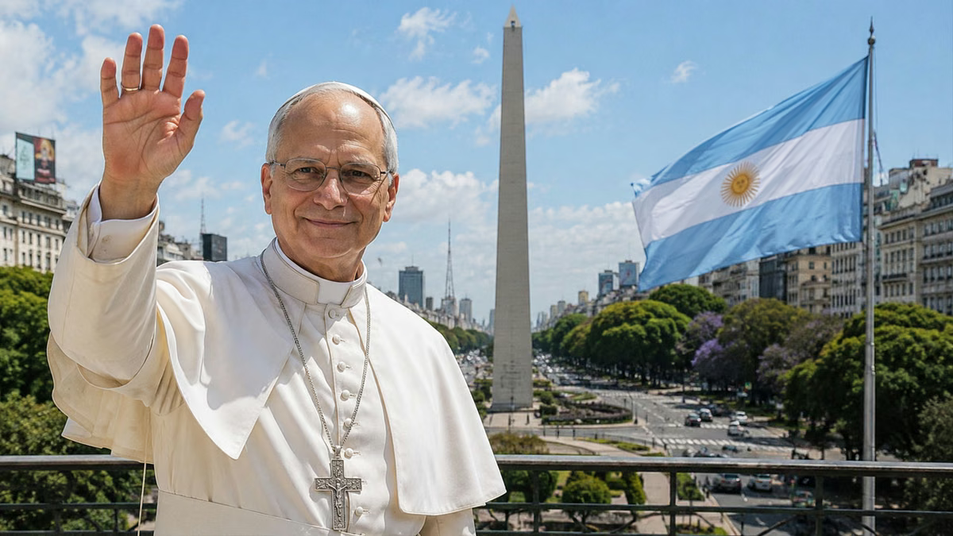
(ZENIT News / Buenos Aires, 10.30.2026).- A new survey suggests that the country’s expectations (Argentina) of the pontiff are focused less on the internal life of the Catholic Church than on its ability to address urgent social and international challenges. Poverty stands well ahead of every other issue respondents want him to discuss, while the importance attached to the visit itself varies sharply according to age, gender and place of residence.
The study, conducted by the Barometer of Religions and Beliefs in Argentina, part of the University of Buenos Aires’ Observatory of Beliefs in Argentina, found that 43.2% of those surveyed want Leo XIV to make the fight against poverty the central theme of his visit. International peace comes second, at 20.6%. Together, the two issues account for nearly two-thirds of the priorities identified by respondents.
The figures point to a society looking to the Pope primarily for a public voice on human suffering and global instability. Church transparency ranks a distant third, with 9.7%, followed by migration at 6.9% and the environment at 5.1%. Doctrinal questions receive 4.6%, while sexual abuse within the Church registers 4.2%. Family issues attract just 2.9%. Artificial intelligence and interreligious dialogue bring up the rear, with 1.7% and 1%, respectively.
Yet the survey also exposes a striking gap between the prominence of the papal office in public life and the place of religion in the personal outlook of many Argentines. Asked whether Leo XIV’s visit was important, 49.3% described it as very or somewhat important, while 50.7% considered it of little or no importance. The near-even split conceals substantial differences between social groups.
Among people aged 50 and over, 58.3% attach importance to the visit. The figure falls to 39.8% among those aged 16 to 29. Women are also more likely than men to regard the event positively: 53.7%, compared with 44.5%. The sharpest divide, however, is geographical. In the greater Buenos Aires metropolitan area, only 35.5% consider the visit important, against 56.2% in the rest of the country — a difference of 20.7 percentage points.
The pattern is not simply one of religious commitment fading among younger generations. The survey found that young people are the least likely to expect the Pope’s presence to bring them closer to religion or spirituality: only 27.6% believe this could happen to a great or considerable extent, compared with 39% among those aged 30 to 49 and 38.4% among people aged 50 and over. Nevertheless, poverty is an especially strong concern among the young. Nearly half of respondents aged 16 to 29, or 49.2%, want Leo XIV to prioritize it.
This combination is perhaps the study’s most revealing finding. A generation less inclined to see a papal visit as personally or spiritually significant can still expect the Pope to speak forcefully about economic hardship. Distance from religious institutions, in other words, does not necessarily mean indifference to the social responsibilities associated with the Church.
The emphasis on poverty is also particularly pronounced among respondents with lower levels of education, at 45%, and among residents of the Buenos Aires metropolitan area, where it reaches 50.9%. Peace, meanwhile, becomes a more prominent concern with age: 12% of the youngest respondents selected it, compared with 24.8% of those aged 30 to 49 and 23.6% of those aged 50 and over.
Gender differences extend beyond the perceived importance of the visit. Women are considerably more likely than men to believe that the Pope’s presence could encourage a renewed interest in religion or spirituality: 42.2% express that expectation, against 28% of men.
For Juan Cruz Esquivel, director of the Barometer, the findings suggest that the Pope retains a favorable public standing, even when that regard does not translate into greater personal religious involvement. Marcos Carbonelli, director of the Observatory, similarly observes that expectations are concentrated on Leo XIV’s capacity to address major social and global challenges rather than doctrinal debates or the Church’s internal affairs.
The figures offer the Vatican a portrait of a country whose relationship with Catholicism is not easily captured by conventional measures of religious attachment. The Pope may not command universal enthusiasm, particularly in the capital’s metropolitan area or among younger people, but many Argentines still look to the papacy as an institution capable of giving moral weight to questions that transcend ecclesiastical boundaries.
For Leo XIV, the challenge will be to meet those expectations without reducing the Church’s mission to a programme of social intervention. Poverty and peace are central concerns of Catholic social teaching, rooted in the dignity of every human person and the demands of solidarity. The visit will therefore test not only the Pope’s ability to speak to Argentina’s immediate anxieties, but also whether his message can connect those concerns with a broader vision of human dignity, family life and the common good.
Thank you for reading our content. If you would like to receive ZENIT’s daily e-mail news, you can subscribe for free through this link.

Publicaciones relacionadas:
 7 out of 10 Spanish citizens believe that Leo XIV’s papacy will be good or better than that of Pope Francis
 Pope Leo XIV won’t be visiting the U.S. in 2026, but his popemobile will: here’s what we know
 The Pope to Young Iraqi Christians: Your Mission Is to Be Light in the Darkness
 In the wake of the earthquake, the Colombian Catholic Church has become a haven of hope. Pope Leo XIV has sent emergency financial aid
