

(ZENIT News / Rome, 05.01.2026).- A vehicle associated with papal appearances in St. Peter’s Square is about to take on a markedly different mission. Transformed from a symbol of proximity between the Pope and the faithful into a moving appeal for solidarity, a papal car will cross the United States in the summer of 2026 to draw attention to one of the most urgent yet often distant humanitarian crises: children affected by war.
The initiative, titled “American Catholic Heroes: The Road Trip for Hope,” has been entrusted to the charitable organization Cross Catholic Outreach, with the support of the Vatican’s Dicastery for the Service of Charity. The project will cover approximately 3,700 miles—around 6,000 kilometers—from New York to California, passing through 13 cities and key Catholic institutions, including stops in Washington, St. Louis, and the University of Notre Dame.
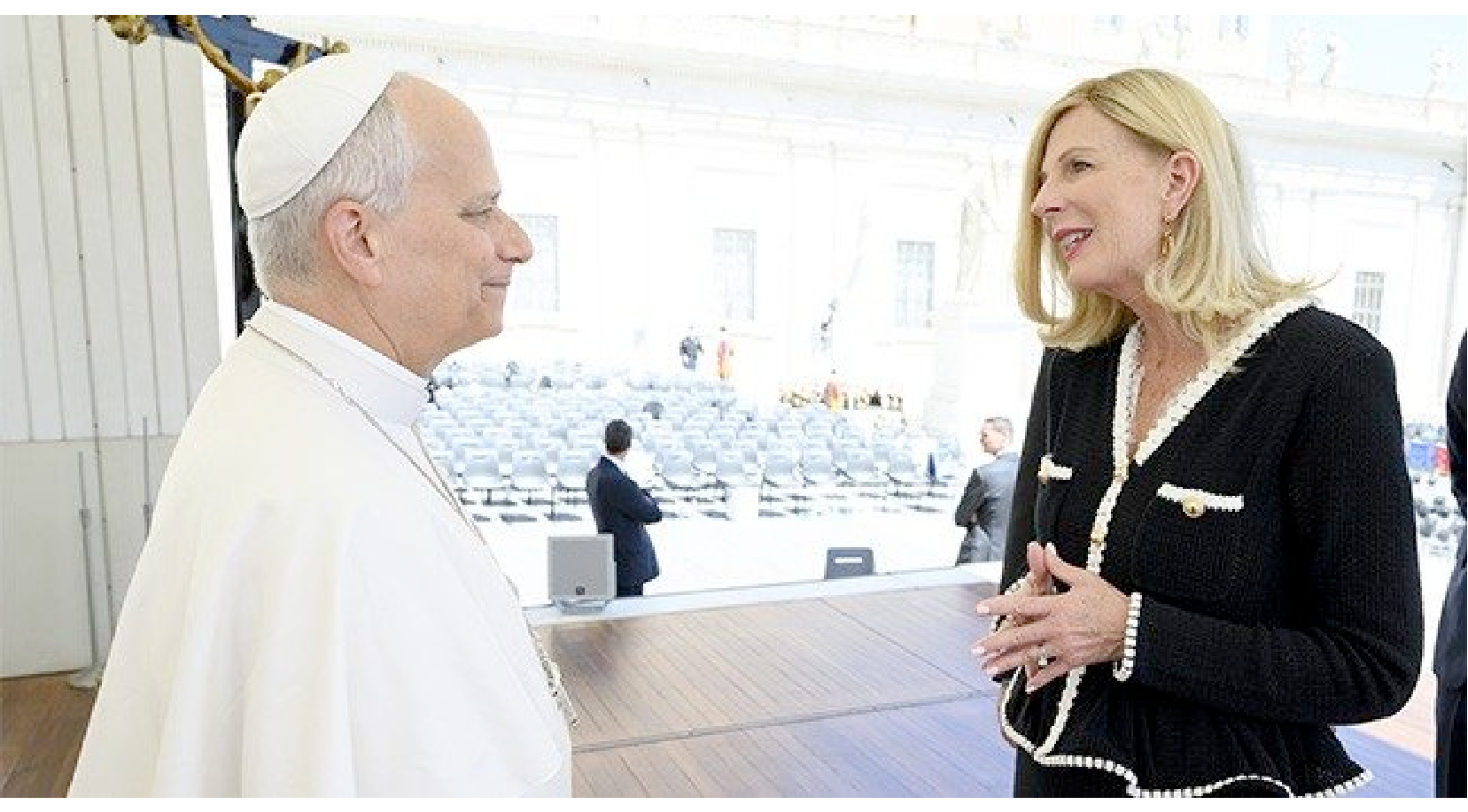
The symbolic starting point of the initiative was marked in Rome at the end of April, when the prefect of the dicastery, Monsignor Luis Marín de San Martín, handed over the keys of the vehicle to Michele Sagarino, president of the organization. Shortly thereafter, she greeted Pope Leo XIV following a general audience, formally launching a journey that blends fundraising, awareness, and spiritual engagement.
The papal vehicle, now rebranded as the “Hopemobile,” will not simply travel as a static exhibit. Organizers intend it to become a focal point for public encounters, prayer gatherings, and moments of reflection along the route. The objective is twofold: to raise funds for humanitarian programs and to bring the reality of war’s victims—particularly children—closer to a society often geographically removed from such suffering.
The proceeds from the initiative will be directed entirely to the charitable works overseen by the Vatican dicastery, with a particular emphasis on projects supporting vulnerable populations in regions affected by conflict. Cross Catholic Outreach, which has been active for nearly 25 years, reported that in 2024 alone it operated in 32 countries, including Malawi, Zambia, and Haiti, supporting 279 projects focused on healthcare, agriculture, food security, access to clean water, education, and spiritual assistance.
The scale of these operations underscores the broader context in which the “Hopemobile” initiative is situated. The Dicastery for the Service of Charity, acting on the direct mandate of the Pope, has long sought to translate the Church’s teaching on charity into concrete action. As Monsignor Marín de San Martín emphasized, charity cannot remain an abstract principle; it must take the form of service, particularly toward those most in need.
The timing of the journey adds further layers of meaning. Scheduled for June and July 2026, it coincides with the 250th anniversary of the United States Declaration of Independence, signed in 1776, as well as the first anniversary of the pontificate of Leo XIV, the first American Pope in history. The convergence of these milestones invites reflection on the relationship between freedom and responsibility, particularly in a global context marked by inequality and conflict.
The initiative also carries forward a decision originally authorized by Pope Francis, who envisioned the use of such symbolic assets to support the poor, especially children suffering the consequences of war. Pope Leo XIV has reaffirmed this direction, notably in his recent apostolic exhortation Dilexi te, where he places the “most forgotten and wounded of humanity” at the center of the Church’s concern.
By bringing a recognizable papal symbol into public spaces across the United States, the project seeks to bridge the gap between global crises and local awareness. In societies where media saturation can dull the impact of distant tragedies, physical presence—an object that draws attention, invites curiosity, and fosters encounter—can serve as a catalyst for renewed engagement.
The planned charitable auction at the conclusion of the journey will provide a tangible measure of its success. In a cultural environment often marked by fragmentation and individualism, the initiative proposes a different narrative: one in which solidarity is not an abstract ideal but a shared responsibility.
If the papamobile once represented the Church’s effort to be close to the faithful, its transformation into the “Hopemobile” suggests an extension of that logic. It is no longer only about proximity to those who gather in celebration, but also about reaching those who suffer in silence—especially children whose lives have been shaped by violence they did not choose.
Thank you for reading our content. If you would like to receive ZENIT’s daily e-mail news, you can subscribe for free through this link.

Publicaciones relacionadas:
 7 out of 10 Spanish citizens believe that Leo XIV’s papacy will be good or better than that of Pope Francis
 Leo XIV surpasses Francis in popularity according to first published survey: these are the percentages
 Monaco will be the second destination for a trip by Pope Leo XIV at the end of March 2026: here is what is known
 Pope Leo XIV to Equatorial Guinea: video captures the Holy Father’s travel coordinator visiting the country ahead of a papal trip
