(ZENIT News / Rome, 03.20.2026).- Beneath the surface of headline-grabbing secularization trends lies a more nuanced reality: while more than a third of American adults have left the religion of their upbringing, most have not. The latest data suggest that continuity still outweighs rupture—but the reasons behind both are increasingly complex, personal, and revealing of deeper cultural shifts.
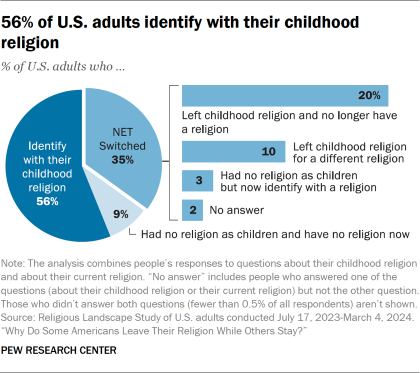
According to a comprehensive analysis by the Pew Research Center, drawing on a large-scale Religious Landscape Study conducted between 2023 and 2024 with 36,908 respondents, as well as a follow-up survey of 8,937 adults in May 2025, 56% of Americans continue to identify with the religion in which they were raised. A further 9% report no religious upbringing and maintain no affiliation today. In contrast, 35% have moved away from their childhood faith—either embracing another religion (10%) or abandoning religious identification altogether (20%).
At first glance, these figures might suggest a straightforward narrative of decline. Yet a closer examination reveals that the dynamics of religious change in America are less about institutional collapse and more about individualized belief systems, shifting authority, and evolving cultural priorities.
For those who remain within their childhood religion, the decisive factors are overwhelmingly internal rather than social. Nearly two-thirds (64%) say they continue to believe in the teachings of their faith, while 61% affirm that it meets their spiritual needs and 56% say it gives meaning to their lives. These are not marginal motivations: they point to a deeply personal adhesion rooted in conviction rather than habit.
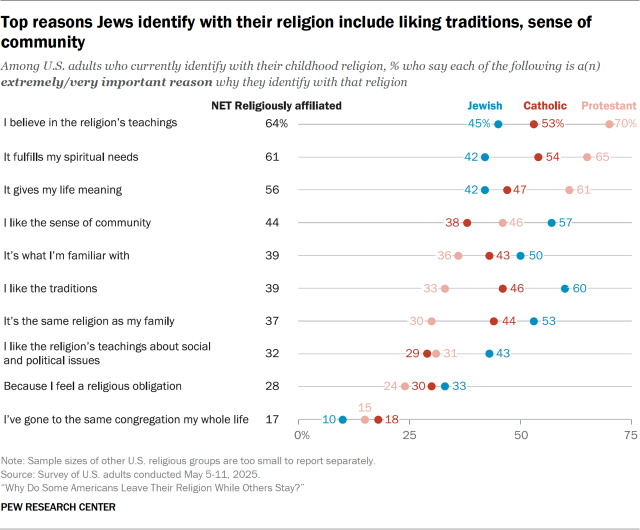
External factors—often assumed to be central—play a secondary role. Only 44% cite community as a major reason to stay, while familiarity and tradition each register at 39%. Even fewer (32%) point to alignment with social or political teachings. In other words, continuity in religious identity appears less driven by cultural inheritance than by perceived existential relevance.
This pattern holds across major Christian groups, though with some variation. Among lifelong Protestants, belief in doctrine is especially prominent, cited by 70% as a key reason for remaining. Catholics, by contrast, display a more balanced profile: 54% emphasize spiritual fulfillment, 53% belief in teachings, and 47% the sense of meaning provided by their faith.
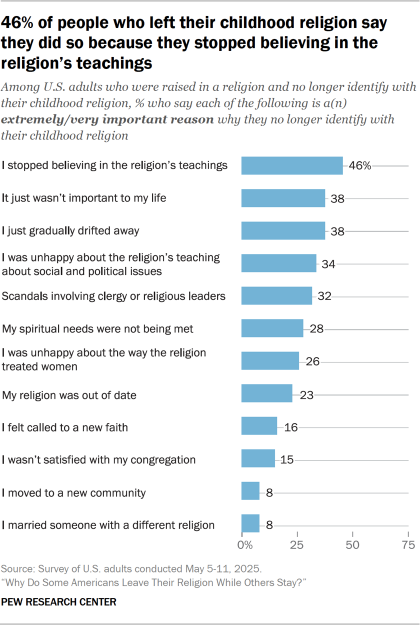
Jewish respondents, however, illustrate a different model of religious continuity—one less centered on doctrinal assent and more on communal and cultural belonging. Among those raised Jewish who remain so, 60% point to the value of traditions and 57% to community. Roughly half cite family heritage or familiarity. This suggests that in some traditions, identity persists even when belief is less central, highlighting the multifaceted nature of religious affiliation.
If the reasons for staying are largely internal, the reasons for leaving are equally revealing—and often mirror the inverse. Among those who have abandoned their childhood religion, the most commonly cited factor is a loss of belief: 46% say they no longer accept its teachings. A similar proportion describe a gradual disengagement, with 38% saying religion simply faded from importance in their lives, and another 38% reporting a slow drift away.
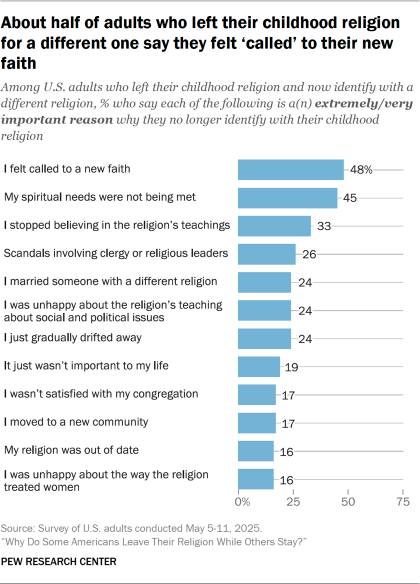
Institutional factors also play a role, though less decisively. About one-third point to disagreements with religious teachings on social or political issues (34%) or to scandals involving clergy and leaders (32%). These findings suggest that while controversies may accelerate disaffiliation, they are rarely the primary cause; rather, they reinforce pre-existing doubts or disengagement.
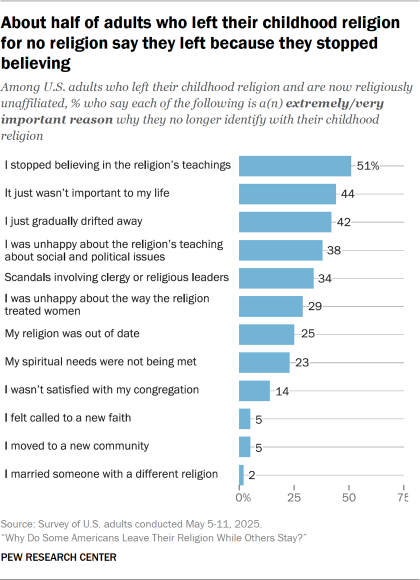
Not all departures follow the same trajectory. Those who convert to another religion often describe their shift in terms of attraction rather than rejection. Nearly half (48%) say they felt called to a new faith, while 45% report that their previous religion failed to meet their spiritual needs. By contrast, those who become religiously unaffiliated tend to frame their decision more negatively: 51% cite disbelief, and large numbers emphasize indifference or gradual detachment.
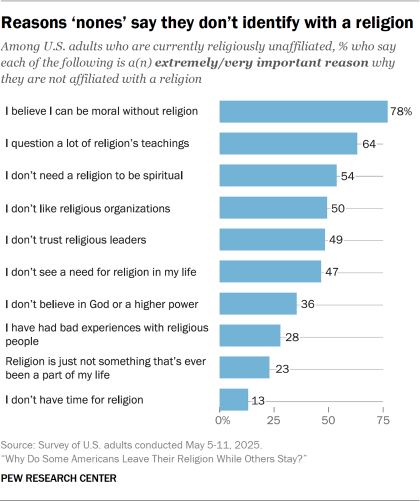
The rise of the religiously unaffiliated—now representing 29% of U.S. adults—marks one of the most significant developments in the American religious landscape. Yet even here, the picture is more layered than simple secularization. A striking 78% of unaffiliated individuals say they believe it is possible to be moral without religion, while 64% express skepticism toward religious teachings and 54% say they do not need religion to be spiritual.
Distrust also emerges as a key factor: half report negative views of religious institutions, and 49% cite lack of confidence in religious leaders. Still, a minority within this group maintains some openness to belief: about 6% say they believe in God or scripture but see no need for formal affiliation, suggesting that institutional disengagement does not always equate to personal disbelief.
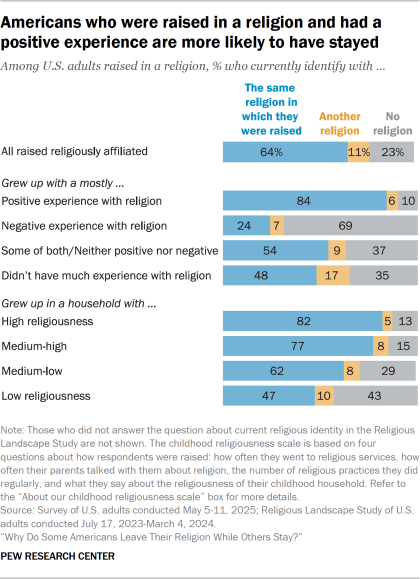
Beyond individual motivations, the data highlight the enduring influence of early formation. Religious upbringing proves to be one of the strongest predictors of adult identity. Among those who recall a positive religious childhood experience, 84% remain in their original faith. Conversely, among those with negative experiences, 69% now identify with no religion.
The intensity of childhood religiosity also matters. Retention rates reach 82% among those raised in highly religious households, but fall sharply to 47% among those from minimally religious environments. These findings underscore a well-established sociological principle: religious identity is not only taught but embodied through practice, family dynamics, and emotional experience.
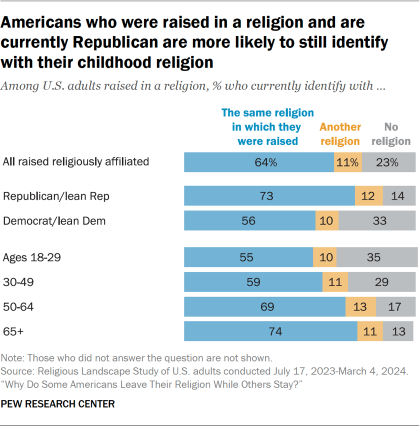
Demographic and political factors further complicate the picture. Political affiliation correlates strongly with religious retention: 73% of Republicans and Republican-leaning independents still identify with their childhood religion, compared to 56% of Democrats and Democratic-leaning individuals. Age also plays a decisive role. Among Americans aged 65 and older, 74% retain their childhood religion, while only 55% of those under 30 do so. Younger adults are nearly three times as likely as seniors to be religiously unaffiliated (35% versus 13%).
Retention rates also vary significantly across religious traditions. Those raised in Hinduism (82%), Islam (77%), and Judaism (76%) show the highest levels of continuity, while Protestants retain 70% of adherents. Catholics, however, retain only 57%, a figure that has drawn particular attention given the Church’s historical centrality in American religious life. Retention is even lower among Mormons (54%) and Buddhists (45%).
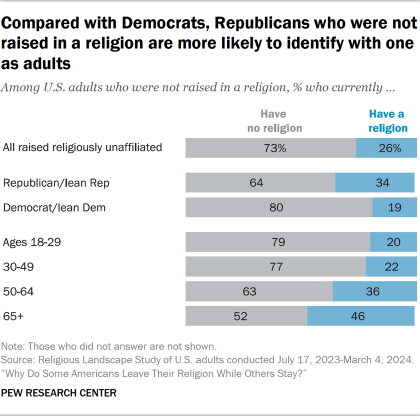
At the same time, religious change is not a one-way process. A small but notable 3% of Americans who were not raised in any religion have adopted one in adulthood. Overall, 26% of those raised without religion now identify with a faith—suggesting that, even in a secularizing context, religious affiliation remains a viable and sometimes attractive option.
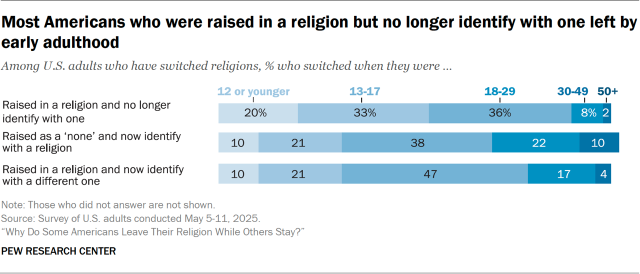
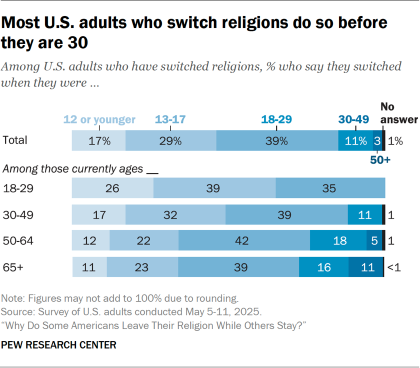
Timing also matters. Religious change tends to occur early in life: 85% of those who switch do so before age 30, and nearly half (46%) make the transition during childhood or adolescence. Those who abandon religion entirely tend to do so earlier than those who convert to another faith, indicating that disaffiliation may be more closely tied to formative experiences.
Taken together, these findings point to a religious landscape defined less by abrupt rupture than by gradual reconfiguration. Belief, belonging, and identity are no longer inherited in a straightforward way; they are negotiated, reassessed, and often reshaped over time.
For religious institutions—particularly those like the Catholic Church that place strong emphasis on doctrinal continuity—the implications are significant. The data suggest that credibility, personal relevance, and early formation are more decisive than cultural legacy alone. In a society where individuals increasingly see themselves as authors of their own spiritual journeys, the challenge is not merely to retain members, but to persuade them that faith remains intellectually credible, spiritually meaningful, and existentially necessary.
The American case, often seen as a bellwether for broader Western trends, thus offers a paradox: religion is both weakening as a social structure and persisting as a personal choice. Understanding that tension may be the key to interpreting the future of faith—not only in the United States, but far beyond it.
Thank you for reading our content. If you would like to receive ZENIT’s daily e-mail news, you can subscribe for free through this link.