

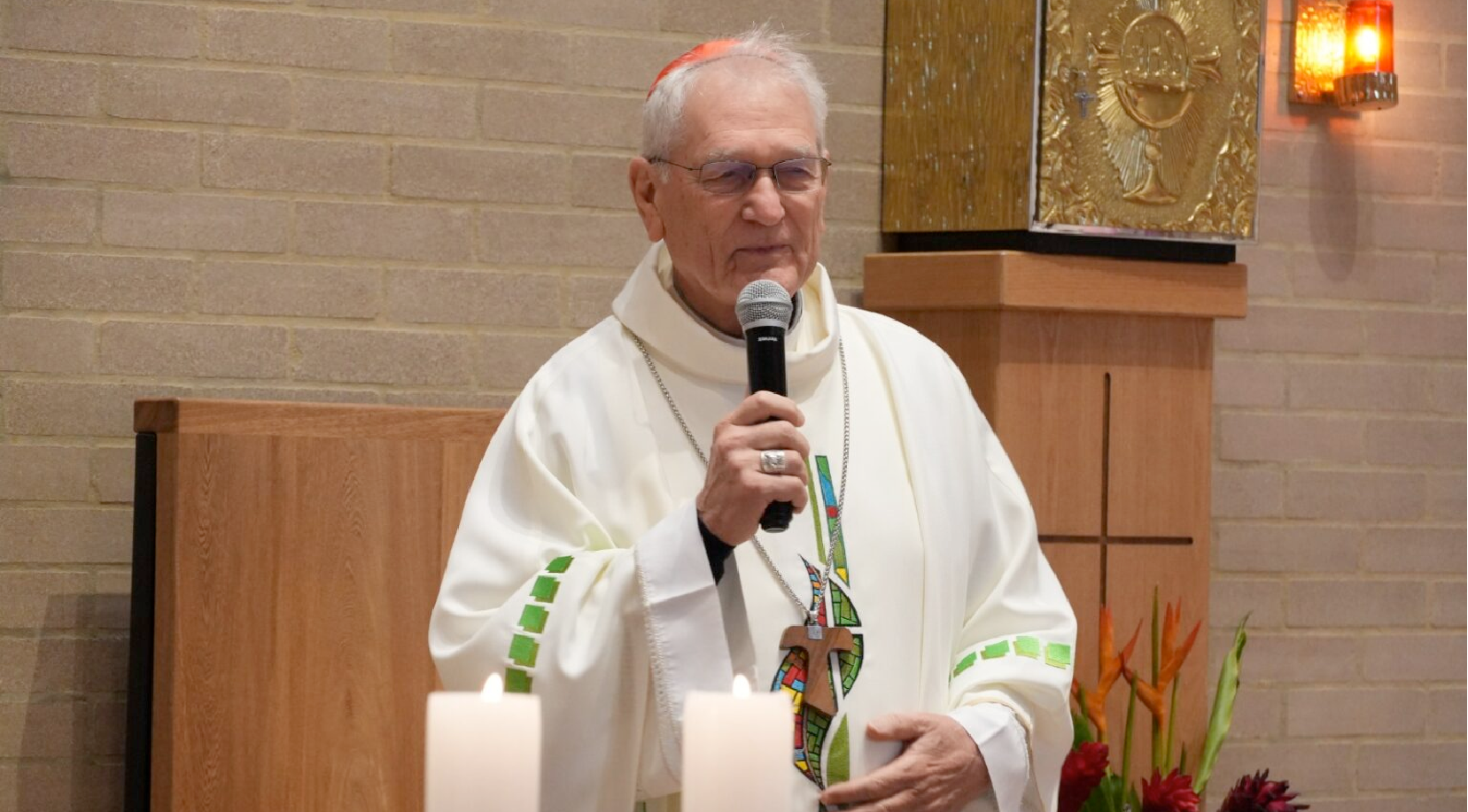
(ZENIT News / Rome, 03.20.2026).- The Ecclesial Conference of the Amazon (CEAMA) has chosen a figure deeply rooted in both territory and theology to guide its next period. The election of Cardinal Leonardo Ulrich Steiner as president for the 2026–2030 term marks not simply a change in leadership, but a consolidation of a distinctly “Amazonian” model of Catholic governance that has been taking shape since the Synod of 2019.
The decision, taken on March 18 during CEAMA’s sixth General Assembly in Bogotá, reflects a deliberate continuity. Steiner, currently Archbishop of Manaus, embodies several of the key trajectories that Rome has encouraged in the region: proximity to indigenous peoples, pastoral decentralization, and a synodal style of discernment. His Franciscan identity, repeatedly highlighted in the official communiqué, is not incidental—it signals a preference for a Church that privileges presence over structure, and listening over institutional reflex.
Born in southern Brazil but ministering in the heart of the Amazon, Steiner represents a bridge between the broader Latin American ecclesial tradition and the specific challenges of the rainforest. Ordained in 1978 and formed intellectually at the Pontifical Antonianum in Rome—where he later served as Secretary General—he combines academic formation with extensive pastoral experience. His appointment as Archbishop of Manaus in 2019 and elevation to the cardinalate in 2022 were widely interpreted as signals of Pope Francis’ strategic prioritization of the Amazon, not only as an ecological concern but as a theological frontier.
That frontier remains complex. The Amazon basin spans nine countries and is home to hundreds of indigenous groups, many of whom face ongoing threats linked to deforestation, extractive industries, and social marginalization. Within this context, CEAMA has emerged as an experimental structure: neither a traditional episcopal conference nor a purely consultative body, but a hybrid organism designed to embody synodality in practice. Its composition—bringing together bishops, clergy, religious, laity, and indigenous representatives—reflects an ecclesiology that seeks to move beyond clerical centralization.
Steiner’s election must be read against this institutional backdrop. According to CEAMA, his leadership is expected to “strengthen the path of a Church with an Amazonian face,” a phrase that has become shorthand for a model of inculturation that goes beyond symbolic gestures. In practical terms, this includes promoting indigenous leadership within ecclesial structures, defending territorial rights, and integrating local cosmologies into pastoral life without diluting doctrinal coherence.
The choice of Jesús Huamán Conisilla as vice president reinforces this direction. A priest from the Apostolic Vicariate of Puerto Maldonado in Peru, Huamán brings firsthand experience from one of the most socially fragile areas of the Amazon. His pastoral work has focused on accompaniment—an approach that, in the region, often involves navigating tensions between state absence, economic exploitation, and cultural resilience. His role within CEAMA suggests a continued emphasis on grassroots engagement rather than top-down governance.
The broader leadership structure, still being completed during the assembly, is designed to ensure representational diversity. Members of the vice presidency will include voices from religious life, lay communities, and indigenous populations, in line with CEAMA’s founding vision. This plural composition is not merely symbolic; it is intended to function as a corrective to historical imbalances in ecclesial decision-making.
For observers of Vatican dynamics, the significance of CEAMA lies precisely in this experimental character. It operationalizes synodality not as a slogan but as a governance model, testing whether a more participatory Church can respond effectively to complex regional realities. In this sense, the Amazon has become a laboratory whose outcomes may influence ecclesial structures far beyond Latin America.
Steiner inherits both the promise and the tension of this experiment. The expectations are considerable: to maintain unity while fostering diversity, to defend vulnerable populations without politicizing the Church, and to translate the theological intuitions of recent pontificates into sustainable pastoral practice.
If the Amazon is, as many in Rome now suggest, one of the decisive frontiers for Catholicism in the 21st century, then CEAMA’s new leadership will play a role that extends well beyond the rainforest. It will test whether the Church can truly become, in structure as well as in rhetoric, what it claims to be: a community that listens before it speaks, and that walks with those on the margins rather than ahead of them.
Thank you for reading our content. If you would like to receive ZENIT’s daily e-mail news, you can subscribe for free through this link.

Publicaciones relacionadas:
 USA: Court stays trial of former Cardinal McCarrick due to cognitive impairment
 Cardinal Dolan reveals that the US Vice President apologized to him for a false and defamatory comment
 Jerusalem: Holy Week Behind Closed Doors. A Statement from the Catholic Patriarch
 Cardinal Pham Minh Mǎn, the Face of Catholic Resistance in Vietnam, Dies
