

(ZENIT News / Rome, 04.09.2026).- The announcement of a two-week ceasefire between the United States and Iran has momentarily interrupted a conflict that, until hours before, seemed on the verge of a dramatic escalation with global consequences. Yet beyond the fragile military pause lies a deeper confrontation—one not only between states, but between competing moral visions of war, peace, and the role of religion in both.
The truce, reached late on April 7 after intense diplomatic pressure led primarily by Pakistan and supported by last-minute interventions from China, came against a backdrop of extraordinary tension. Just hours earlier, U.S. President Donald Trump had issued a stark ultimatum threatening to annihilate Iran’s “entire civilization” if Tehran did not reopen the Strait of Hormuz, a strategic artery through which a significant portion of the world and transit of gas supplies.
The deadline passed not with bombardment, but with an agreement: Iran would guarantee safe maritime passage, while Washington and its allies would suspend military operations.
The immediate economic reverberations underscored the stakes. Oil prices fell sharply, with Brent crude dropping to around 93 dollars per barrel, while major Asian stock indices posted gains of between 4 and 5 percent. Markets, often the first barometer of geopolitical anxiety, signaled cautious relief. On the ground, however, the situation remained volatile, with reports of missile and drone activity in parts of the Gulf even after the ceasefire was declared, raising doubts about command and control across the various actors involved.
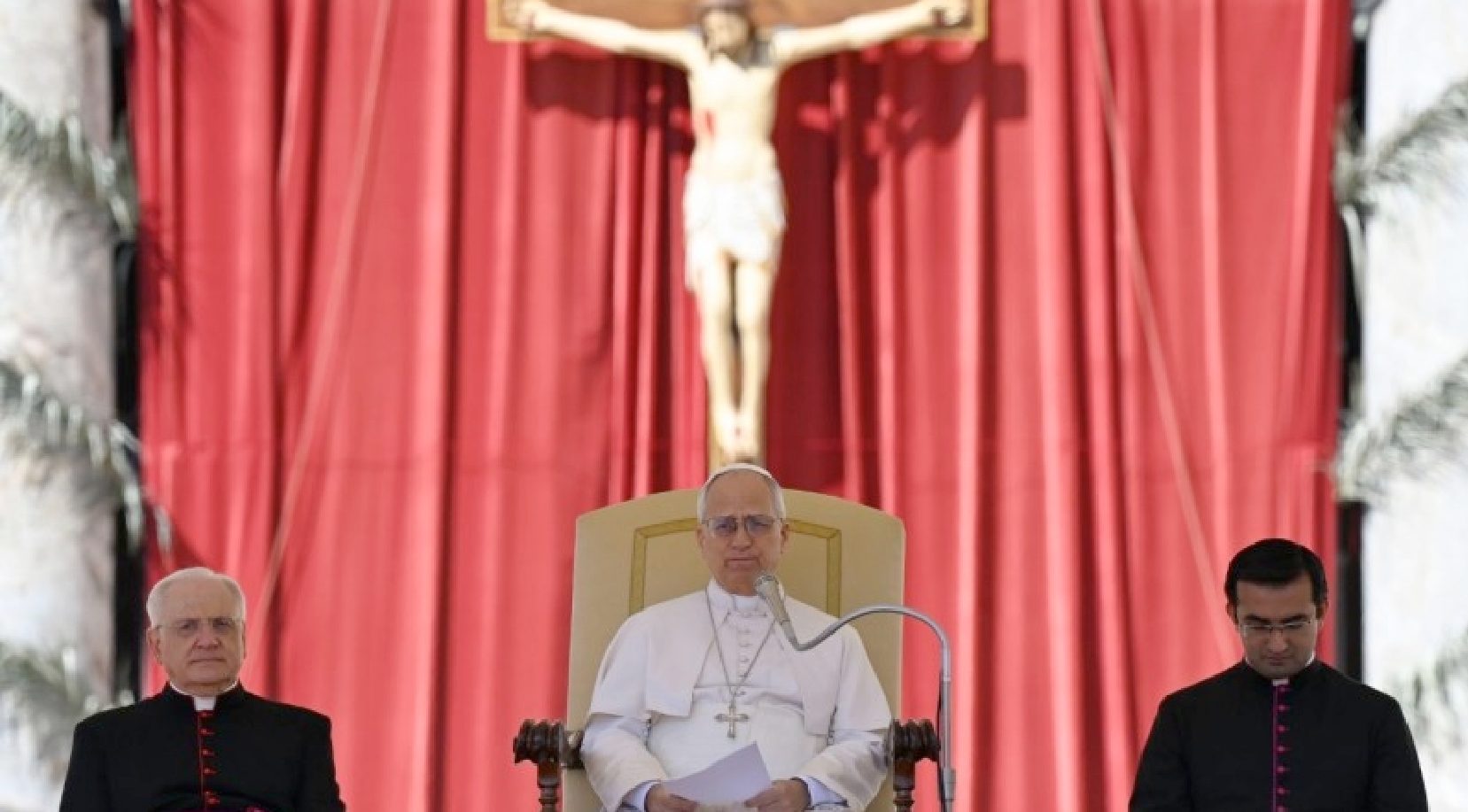
It was into this atmosphere that Pope Leo XIV intervened with unusual immediacy and clarity. Speaking at the end of his general audience on April 8 in St. Peter’s Square, he described the ceasefire as a “sign of genuine hope,” while insisting that only a return to negotiations could bring a definitive end to the war. His remarks carried added weight because they followed his explicit condemnation, just hours earlier, of threats against an entire people as “unacceptable,” framing the issue not merely in strategic or legal terms, but as a moral boundary that must not be crossed.
The Pope’s appeal extended beyond diplomatic actors to the global faithful, whom he urged to accompany the negotiations with prayer, culminating in a vigil for peace scheduled for April 11 in St. Peter’s Basilica. Yet his message also hinted at a broader concern: that the mechanisms of diplomacy themselves are weakening under the pressure of military logic intensifies.
This diagnosis was articulated more fully by Pietro Parolin, the Vatican’s Secretary of State, who has emerged as one of the Holy See’s principal interpreters of the current geopolitical crisis. In a wide-ranging reflection, published in “Dialoghi,” the quarterly cultural magazine of Italian Catholic Action, he warned that the international system risks sliding from the “force of law” to the “law of force,” as states increasingly rely on military solutions while diplomatic channels fall silent. His critique extended to what he described as double standards in the application of international law, pointing to differing global reactions to civilian suffering in conflicts such as Ukraine and Gaza.
Parolin’s intervention is not merely analytical; it reflects a longstanding Vatican concern about the erosion of multilateralism. The Holy See continues to place its hopes in international institutions, including the United Nations, even as it acknowledges their limitations—particularly the paralysis induced by veto powers. Against this backdrop, the cardinal’s insistence that peace cannot be secured through rearmament alone represents a direct challenge to prevailing strategic doctrines in several capitals.
The tension between these perspectives has been sharpened by the increasingly explicit use of religious language within political and military discourse in Washington. Senior officials, including Defense Secretary Pete Hegseth, have publicly attributed military developments to divine providence, while President Trump himself has suggested that God supports American actions. Such rhetoric has drawn criticism from a broad spectrum of religious leaders, who see in it a troubling fusion of faith and warfare.
Among them, Timothy Broglio, archbishop for the U.S. military services, offered a more cautious endorsement of the ceasefire. While welcoming any step toward peace, he warned that excluding key theaters such as Lebanon from the agreement risks undermining its effectiveness. His remarks reflect a concern widely shared among Church leaders: that partial solutions may fail to address the interconnected nature of conflicts in the region.
More forceful still has been the opposition from other Catholic voices. John Michael Botean, a Byzantine Catholic bishop in the United States, went so far as to declare the war against Iran unjust, arguing that participation in it would constitute moral complicity in wrongdoing. His language, rooted in the Church’s just war tradition, underscores a growing unease within parts of the Catholic hierarchy about the ethical foundations of the conflict.
These debates unfold against a stark human toll. According to available figures, at least 1,665 civilians have been killed in Iran, including 244 children, while in Lebanon the death toll has surpassed 1,500. Additional casualties have been reported across the Gulf and in Israel, alongside American military losses. Such numbers, while provisional, provide a sobering counterpoint to the strategic calculations dominating political discourse.
The ceasefire itself remains precarious. Reports of continued hostilities, disagreements over its scope—particularly regarding Lebanon—and mutual accusations of violations suggest that the current pause may be less a turning point than a brief interlude. Even the Strait of Hormuz, whose reopening was central to the agreement, has already become a point of contention amid renewed tensions.
What distinguishes the present moment is not only the danger of renewed escalation, but the convergence of multiple crises: military, economic, diplomatic and moral. The Vatican’s insistence on dialogue, echoed by a range of religious leaders across denominations, stands in contrast to a geopolitical environment increasingly shaped by deterrence, coercion and the language of force.
In this sense, the two-week ceasefire is more than a tactical pause. It is a test—of whether diplomacy can still function under extreme pressure, of whether moral arguments retain any influence in the conduct of war, and of whether religious voices, often dismissed as peripheral, can still shape the conscience of nations.
Thank you for reading our content. If you would like to receive ZENIT’s daily e-mail news, you can subscribe for free through this link.

Publicaciones relacionadas:
 The Middle East, the spread of war, and the position of the Pope and the Catholic Church
 A Church Against the Logic of War: Vatican Voices, Middle East Realities, and the Risk of a Vanishing Christianity
 German president visits the Pope: invitation to the country, role of the Holy See in the current situation, and ecclesial life in Germany are the topics
 Nicolás Maduro asks the Pope for diplomatic mediation in conflict with Trump and the United States
