

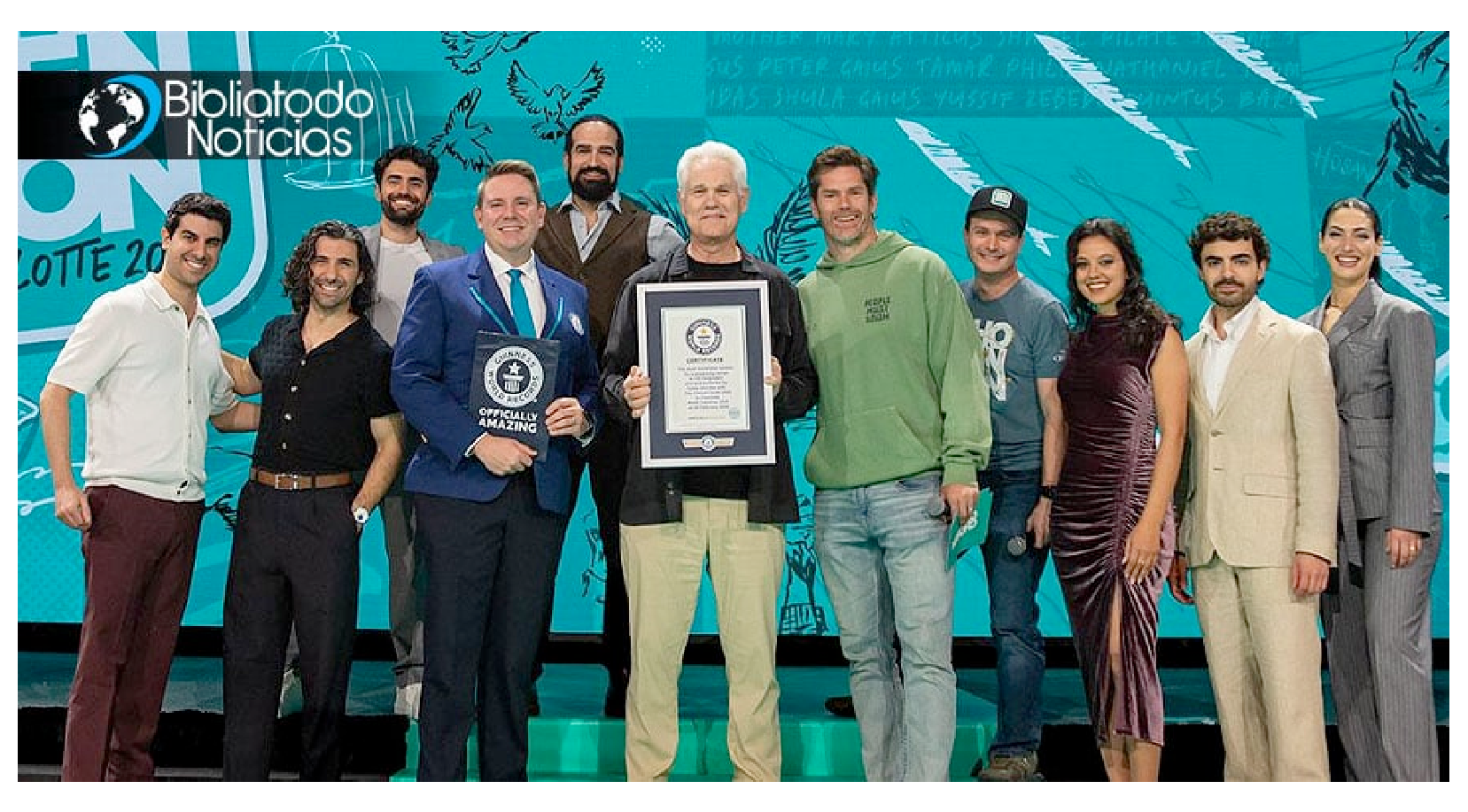
(ZENIT News / Rome, 03.01.2026).- On February 23, 2026, an unlikely television project rooted in crowdfunding and faith-based storytelling reached a milestone few global media giants can rival. The Chosen, the American series that dramatizes the life of Jesus and his first followers, was officially recognized for the second time by Guinness World Records as the most translated television series in history. Its first season alone is now available in 125 languages, a figure that places it far beyond the reach of conventional international distribution models.
The announcement was made during ChosenCon, an international gathering held from February 19 to 21 that brought together thousands of fans, cast members, and creators to reflect on the series’ expanding global footprint. More than a fan event, the convention functioned as a snapshot of a cultural phenomenon that has reshaped how religious content circulates across borders. Attendees were offered exclusive previews, in-depth panel discussions, and behind-the-scenes access to the production process that has sustained the series for nearly a decade.
At the center of the celebration was The Chosen itself, widely regarded as the first multi-season television series devoted entirely to the life of Jesus and his apostles. Since its debut in 2017, the show has reached audiences in 175 countries and surpassed 280 million viewers worldwide through streaming platforms and broadcast partners. Its international reach is not the byproduct of a major studio’s marketing machine, but of a deliberate strategy to remove linguistic barriers as a primary obstacle to access.
“This is not the last translation record we will break,” said Dallas Jenkins, the series’ creator and director, speaking at the event. Jenkins attributed the achievement to the global network supporting the project and to the sustained work of its translation partners, suggesting that the series’ linguistic expansion is far from complete.
That ambition is most clearly articulated by Come and See, the nonprofit organization responsible for overseeing the production and global distribution of the series. Its chief executive, James Barnett, used the occasion to underline a goal that would have seemed implausible just a few years ago: translating and dubbing the series into 600 languages. The rationale, he explained, is not simply numerical reach, but intimacy. People, he said, need to encounter the story of Jesus in the language in which they think, dream, and pray.
What distinguishes this effort from standard localization practices is its scale and its method. More than 200 specialists—linguists, local theologians, pastors, and biblical scholars—are involved in adapting the series for diverse cultural and ecclesial contexts. Their task goes beyond literal translation. It involves theological precision, sensitivity to local idioms, and an awareness of how biblical narratives are received in communities where Christianity may be a minority faith or a newly encountered tradition.
The new Guinness recognition surpasses a previous record set in September 2025, when the first season was available in 86 languages. In just a matter of months, that number increased by nearly 40 languages, illustrating an acceleration that mirrors the growing demand for localized religious content in the digital age. Unlike traditional missionary models, which often depended on print or institutional structures, The Chosen’s expansion relies on digital platforms, volunteer networks, and partnerships that allow rapid dissemination without centralized control.
For observers of global Christianity, the significance of the record lies not only in the numbers, but in what they reveal about contemporary religious communication. A series produced outside the traditional studio system has become one of the most linguistically accessible audiovisual narratives in history. In doing so, it has demonstrated that faith-based storytelling, when combined with new distribution models and sustained grassroots support, can achieve a reach once reserved for the largest entertainment franchises.
Thank you for reading our content. If you would like to receive ZENIT’s daily e-mail news, you can subscribe for free through this link.

Publicaciones relacionadas:
 Kyra: the young American Jewish girl who converted to Catholicism thanks to two friends (one of them Our Lady)
 Record-Breaking Financial Success at World Youth Day 2023 in Portugal
 England: Vatican’s Cricket Team Plays Against King’s Royal Household Team: The Score
 80,000 People Attend Mass Every Sunday… in the Same Church. Of Which Country Are We Talking About?
