

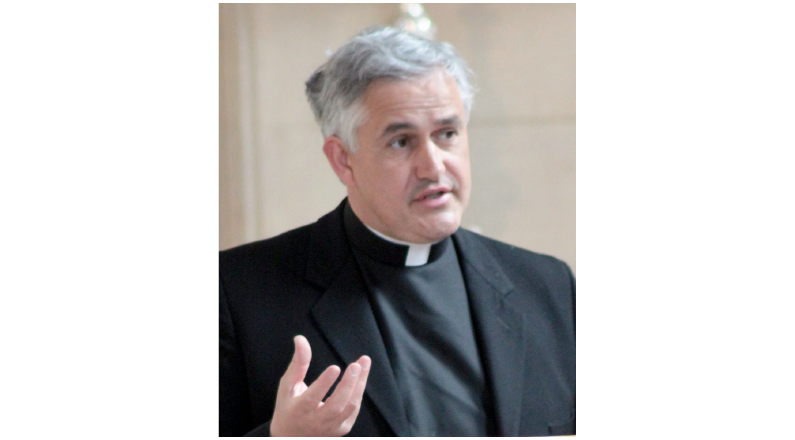
(ZENIT News / Rome, 03.05. 2026) – Robin Ward, a prominent theologian and former Director of the prestigious Anglican St. Stephen’s House seminary in Oxford, has been officially received into the Catholic Church. The reception took place on February 14, 2026, at the Benedictine Abbey of St. Michael in Farnborough, England, where he was Confirmed by Abbot Dom Cuthbert Brogan as part of a spiritual process that, according to Ward, has lasted nearly four decades.
Robin Ward, born on January 22, 1966, is a British academic specializing in Patristics and Church History, with a long background in Anglican clerical formation. He studied Medieval English at Magdalen College, Oxford, and between 1988 and 1991 trained for the ministry at St. Stephen’s House, the historic college that represents the Anglo-Catholic tradition within the Church of England. He later earned his Doctorate from King’s College London with a dissertation on the Antiochian schism in the 4th century.
Ward was ordained a priest in the Church of England in 1992 and carried out his ministry in various parishes, serving as a vicar, chaplain, and, since 2004, as an Honorary Canon of Rochester Cathedral. In 2006, he was appointed Principal of St. Stephen’s House, a position he held until 2025, training generations of future Anglican leaders and teaching a liturgy that recalls the legacy of the Oxford Movement.
This seminary, founded in 1876 and colloquially known as «Staggers,» has played a central role in the Anglo-Catholic Movement within the Church of England, a Movement influenced by the Oxford Movement of the 19th century, which sought to recover Catholic elements of pre-Reformation Christianity. Historical figures such as John Henry Newman (who later converted to Catholicism, was canonized and is a Doctor of the Roman Catholic Church) emerged from this context.
Although Ward was educated in what he described as a form of «Low Church» Anglicanism, characterized by the use of the Book of Common Prayer, austere liturgy, and a Protestant approach to the sacraments, his experience at Oxford and his encounter with the Anglo-Catholic tradition ignited in him a deeper search for the identity of the Church. Over the years, this search took a certain course in the face of what he perceived as growing internal tensions within the Church of England. His seminary work can be summarized in three questions: «Who is Christ?», «What is a priest?», and «What is the Church?» However, the answer to this last question seemed increasingly difficult to find satisfactory, both for himself and for his students, past and present.
Key influences on his journey included continuous contact with Catholic communities in Oxford — including the Dominicans of Blackfriars, the Jesuits of Campion Hall, and the Oratorians of Saint Aloysius — and, above all, the figure of Saint John Henry Newman, whose theological thought Ward described as decisive. In fact, upon receiving Confirmation in the Catholic Church, he chose «John Henry» as his Confirmation name, in honour of Newman.
After being received into the Catholic Church, Ward said he feels deeply grateful to those who prayed for him for years, and that he faces this new stage without «regret or hesitation.» The priest also acknowledged that the process of full integration into the life of the Catholic Church involves not only familiarity with the liturgy and practices, but a deeper reorientation of faith in communion with the Apostolic Tradition.
Robin Ward’s reception into the Catholic Church fits into a broader context of conversion movements from the Church of England to Rome, especially in recent decades. Since 1992, it is estimated that around 700 Anglican clergy and religious in Britain have been received into the Catholic Church, a phenomenon that includes prominent figures such as Anglican Bishops Michael Nazir-Ali, Jonathan Goodall, John Goddard, Peter Forster, Richard Pain, and John Ford.
Furthermore, some data report an increase in conversions of laypeople and entire communities, such as those observed in the Oratorian Community of Oxford, which in the first two months of 2026 received more members into the Church than in the entire previous year. According to some observers, these trends reflect a search for doctrinal, liturgical, and communal stability, which many find more fully articulated within the Catholic Church.
As Robin Ward considers how to follow his vocation within this new stage of his life of faith, possibly under the jurisdiction of special ecclesial structures such as the key Ordinariates established by the Catholic Church to welcome Anglican groups, his conversion leaves a significant mark on the dialogue between Christian traditions and underscores how fundamental questions about the identity and authority of the Church continue to shape religious life in the 21st century.

Publicaciones relacionadas:
 Requiem Requested by San Francisco’s Archbishop Salvatore Cordileone Reaches Top of Billboard List
 Sydney: photos of the impressive Corpus Christi procession, the largest since the pandemic
 World’s Highest IQ Holder Publicly Professes Christian Faith, Citing Quantum Physics and the Mystery of Consciousness
 Asteroid Dedicated to Catholic Priest: Who He Is and Why?
