

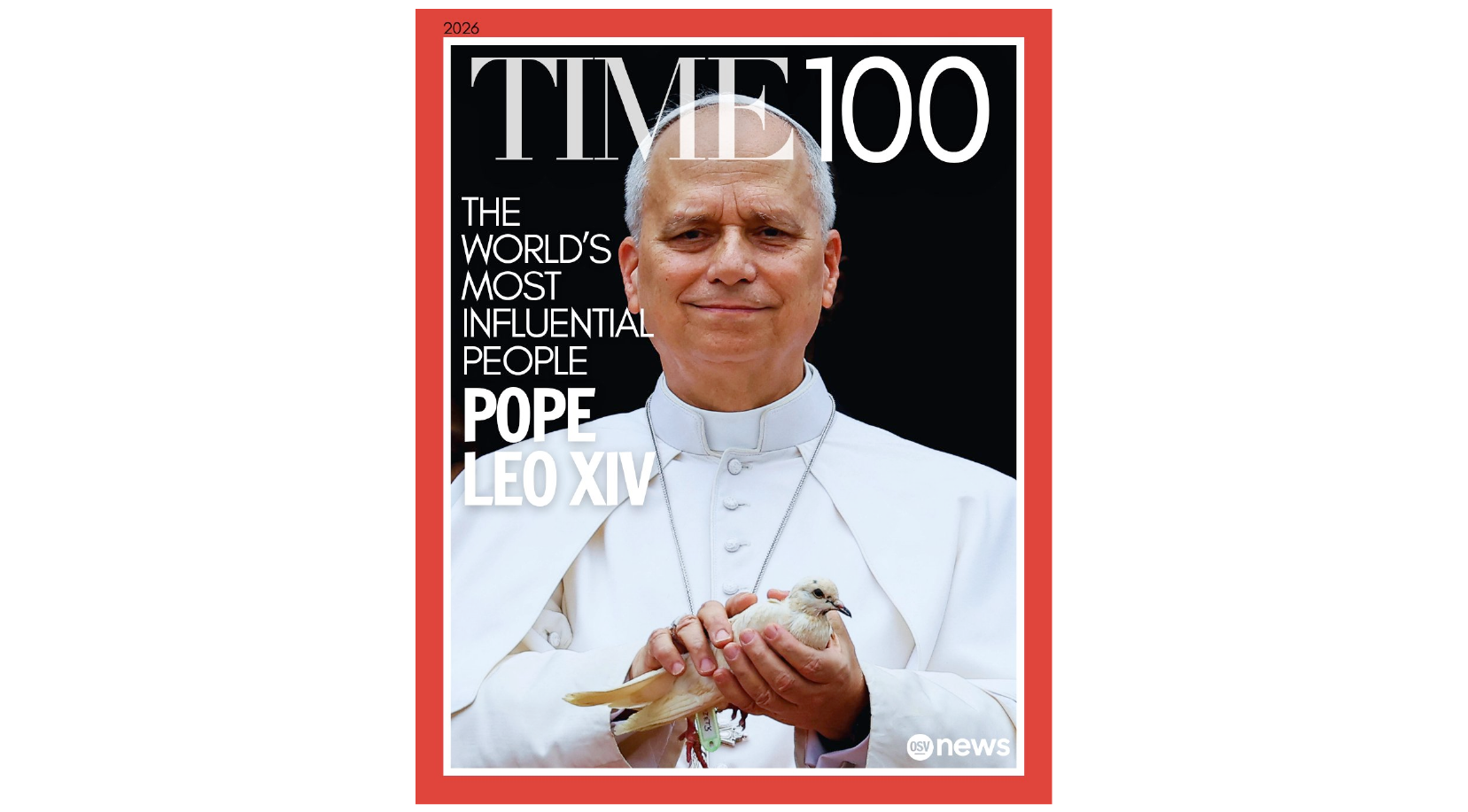
(ZENIT News / Rome, 04.16.2026).- The inclusion of Pope Leo XIV in TIME magazine’s 2026 list of the world’s 100 most influential people offers more than a symbolic accolade. It captures a moment in which the Catholic Church, often described as navigating a prolonged crisis of credibility, finds itself once again at the center of global cultural and moral debate—this time under a pontiff whose profile blends institutional continuity with an unmistakable personal imprint.
Placed in the “Leaders” category, Leo XIV appears alongside figures such as Claudia Sheinbaum, Donald Trump, Marco Rubio and Mark Carney, an alignment that underscores the Vatican’s enduring role not merely as a religious institution but as a participant in the shaping of global narratives. The list itself spans a wide spectrum—from Xi Jinping to Dakota Johnson and Victoria Beckham—but the Pope’s presence stands out precisely because his influence operates on a different register, less measurable in conventional metrics of power.
The accompanying tribute, written by filmmaker Martin Scorsese, provides a revealing lens through which to interpret this recognition. Scorsese situates Leo XIV within a broader historical arc that began with Pope Francis, whose election marked a decisive shift away from a Eurocentric papacy and toward a more globally representative Church. In Leo XIV, Scorsese sees both continuity and rupture: the first pope born in North America, shaped by a distinctly American cultural background, and the first member of the Augustinian tradition to occupy the See of Peter.
This dual identity—rooted in both the intellectual heritage of Augustine and the social realities of contemporary America—helps explain the particular tone of Leo’s pontificate. It is a leadership style marked less by doctrinal innovation than by a recalibration of emphasis. The Church, in this vision, is not primarily an institution defending its boundaries, but a community seeking to recover its moral credibility in a secularized and often skeptical world.
That credibility, as Scorsese notes, has been deeply eroded in recent decades by recurring scandals, including revelations of sexual abuse and financial misconduct. These crises have not only damaged the Church’s public standing but have also accelerated broader trends of secularization, particularly in Western societies. Against this backdrop, the Pope’s insistence on reform is not an abstract aspiration but a structural necessity.
One of the more distinctive elements highlighted in the TIME profile is Leo XIV’s apparent commitment to re-centering Christian life beyond institutional frameworks. His recent contribution to a new edition of “The Practice of the Presence of God,” a seventeenth-century spiritual classic by the Carmelite friar known as Brother Lawrence, points in that direction. The text proposes a form of spirituality grounded in the ordinary rhythms of daily life, suggesting that the experience of God is not confined to liturgical spaces but can permeate every dimension of existence.
Leo XIV’s own reflection—summarizing Christian ethics as a continual awareness of divine presence—resonates with this approach. It signals a pastoral strategy that seeks to reconnect doctrine with lived experience, an effort to bridge the gap between institutional religion and personal faith that has widened in many parts of the world.
This emphasis also aligns with another priority associated with both Leo XIV and his predecessor: the expanded role of the laity. By encouraging greater participation of Catholics in leadership and charitable action, the Pope appears to be responding to a long-standing tension within the Church between hierarchical authority and the sensus fidelium, the lived faith of ordinary believers.
The historical precedent for papal inclusion in TIME’s list further contextualizes this moment. Pope Benedict XVI appeared three times, while Francis was featured on six occasions, reflecting different phases in the Church’s engagement with global issues. Leo XIV’s first appearance, early in his pontificate, suggests that his leadership is already being interpreted as consequential beyond ecclesial boundaries.
Yet the recognition also raises a more complex question: what kind of influence does a pope exercise in an age where traditional forms of authority are increasingly contested? Unlike political leaders, whose power is tied to state structures, or cultural figures, whose impact is mediated through markets and media, the Pope’s influence depends on persuasion, moral coherence, and the ability to articulate a vision that resonates across ideological divides.
In that sense, Leo XIV’s inclusion in the 2026 list may be less a reflection of consolidated authority than of contested relevance. His voice enters a global conversation marked by polarization, where appeals to peace, reform, and spiritual depth must compete with more immediate and often more forceful narratives.
Thank you for reading our content. If you would like to receive ZENIT’s daily e-mail news, you can subscribe for free through this link.

Publicaciones relacionadas:
 What did Leo XIV do the first night as Pope and what is his agenda for the next few days?
 Leo XIV’s First Homily: Who Do the People Say Jesus Is? Two Answers and a Task
 Leo XIV: A Pope Who Ordains Priests Again (And Other Masses During May 2025)
 Zelensky calls Leo XIV: Ukrainian President invited Pope to visit the country
