

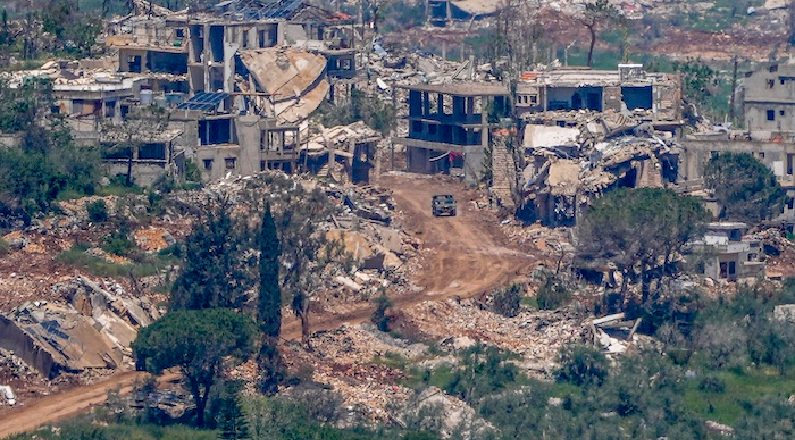
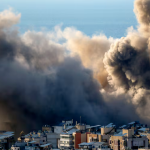
(ZENIT News – TerraSantaNet / Beirut, 05.25.2026) – The motivation is always the same: to eliminate Hezbollah structures and weapons located near Lebanon’s southern border, used to threaten northern Israel, especially Galilee. Thus, in early May, the Israeli Armed Forces attacked the village of Yaroun, less than two kilometers from the Blue Line (the Israeli-Lebanese border), where a few Christian and Muslim families remained, destroying the Catholic school of the Salvatorian Sisters of the Annunciation, a small Greek-Catholic Religious Order. The school had existed for more than half a century and was a landmark for the local community. The convent was also damaged.
Ten days earlier, the Israeli army had outlined the parameters of an «advanced security zone» it intends to establish in southern Lebanon in anticipation of a final assault. According to data collected by the Lebanese newspaper L’Orient-Le Jour, the area covers slightly more than 600 square kilometers, equivalent to almost 6 percent of all the Lebanese territory, and includes dozens of towns and villages. There are 68 villages controlled by the Israeli Army, as declared on May 11 by Lebanese Prime Minister Nawaf Salam: before the war resumed on March 2, there were only five. The occupation encompasses approximately half of the territory south of the Litani River, about 30 kilometers from the Israeli border. The Israel’s IDF’s strategy is to completely prohibit access to these villages for their inhabitants. An occupation that replicates the one Israel has imposed in the Golan Heights for almost sixty years, and in half of the Gaza Strip since October 2025.
In the absence of a reliable census — which has not been conducted in Lebanon for decades — estimates of the population forced to abandon their villages are based on the 2022 electoral rolls and indicate that at least 200,000 adults have been forced to leave their homes (residents under 21 are excluded, as they are not included in these rolls).
This new war has already caused almost three thousand deaths. Numerous civilians, rescue personnel, and journalists have been killed. The Israeli Army’s use of phosphorus bombs, which render territories permanently uninhabitable and impossible to cultivate, has been denounced by multiple parties.
A Franciscan Among the Displaced
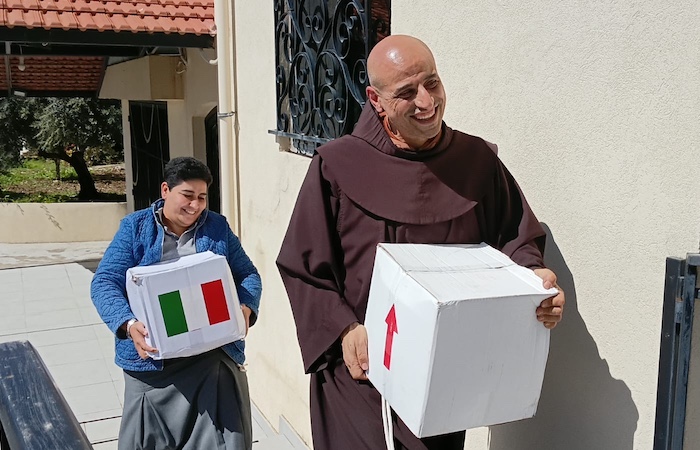
Friar Minor Toufic Mehri of the Custody of the Holy Land is parish priest to the Latin Catholics in a vast territory of southern Lebanon, between Tyre on the coast, where the monastery is located, the inland villages, and the Blue Line. He recounts how people have had to abandon their homes and their memories, forced to live in a suspended present without being able to think about the future.
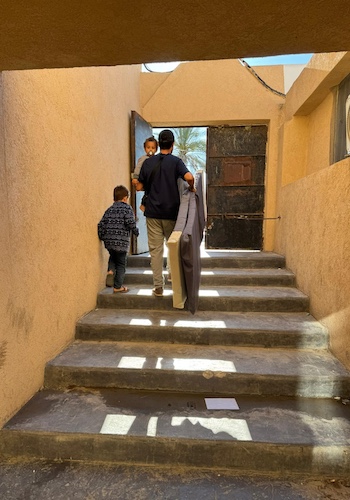
«The parish community of Deir Mimass, in the mountains, just four kilometers from the border with Israel, has been cut off,» he tells us. «I can’t get there. I can’t reach my parishioners who are stranded. Right now, they have an Orthodox priest and a Melkite priest with them.» Father Toufic continues: «In our convent in Tyre, we have taken in nearly two hundred displaced people from the nearby villages. All we have been able to offer them is a little warmth and a roof over their heads. In the first few days, we were not prepared to receive such a large number of people. They settled in the classrooms we used for catechism, and they used the large hall where lessons or mosaic workshops were being held. The fabric that was supposed to serve as the base for the mosaic was the children’s blanket. This is a memory I will never forget … We tried to give them a little dignity because they felt truly uncomfortable.»
It is a mountainous area that Israel is occupying, called Jabal Amil, where historically a Shia Muslim majority was formed, although over the centuries many Christians found refuge there. A territory that remained on the margins during the Ottoman Empire; more linked in its rural economy to the port of Haifa, now in Israel, than to that of Beirut. In the region, after the Nakba of 1948, a resistance against Israel was organized, fueled by Palestinian refugees. Over the decades, Israel has always tried to control it to reduce the threat that came from there. It occupied the territories south of the Litani River between 1978 and 2000, sowing it with mines; it fought a month of war in 2006
UNIFIL, the UN intervention force that has existed since 1978 and began its latest mandate in 2006, is nearing the end of half a century of presence. The mission to create a buffer zone containing Hezbollah forces — effectively an army within the Lebanese State — has ultimately failed, while international diplomacy debates about the forces and ways with which to replace them.
«Lebanon: A Space for Open and Permanent Dialogue»
The Maronite Catholic Bishops, representatives of the largest Eastern Church in the country, meeting in assembly on May 6, wished to emphasize that «Lebanon is not simply a contingent and transitory political entity, but a message of human and civil presence based on freedom, plurality, and coexistence.»
Therefore, they urged the country’s institutions to assume their responsibilities to uphold the Constitution and the rule of law and to avoid «all forms of intervention in other people’s conflicts.»
Lebanon remains in a precarious balance: «Neither Israel nor Hezbollah» could be the slogan capable of uniting the largest number of people and offering a third way, because the institutions have not yet had the strength to put it into practice.
That is why the Bishops are calling for a stronger State — which tensions between Hezbollah and other factions in the country are hindering — and a peace process that will lead Lebanon to neutrality, removed from the conflicts of the Middle East, so it can recover from the economic and social devastation that has plagued it since 2019.
«The vast majority of Lebanese,» they conclude, «do not want an endless war, a war fought on behalf of others at the cost of their own lives and security.» Friar Toufic observes how Lebanon, though small, harbors enormous disparities: «In the same country, there are young people who go out at night to nightclubs in Beirut and the North. And there are children who live in fear in the South, while their churches and schools remain closed.» The Franciscan friar continued: «Some have told me: ‘Father, we are not a number for the statistics and we are not merchandise to be sold to obtain a little support and help. We are people who ask to live, and ask to live with dignity.'» (f.p.)

Publicaciones relacionadas:
 Sister Nabila: Trump’s (and Netanyahu’s) plan for Gaza is ‘unimaginable’
 American Catholic Church Commends President Trump for Acknowledging Starvation in Gaza and Urges Administration to Expand Humanitarian Access
 Vatican questions “preventive” war in Iran as Leo XIV intensifies diplomatic calls for peace
 Ceasefire brings no peace to Lebanon as Israel continues its attacks
