

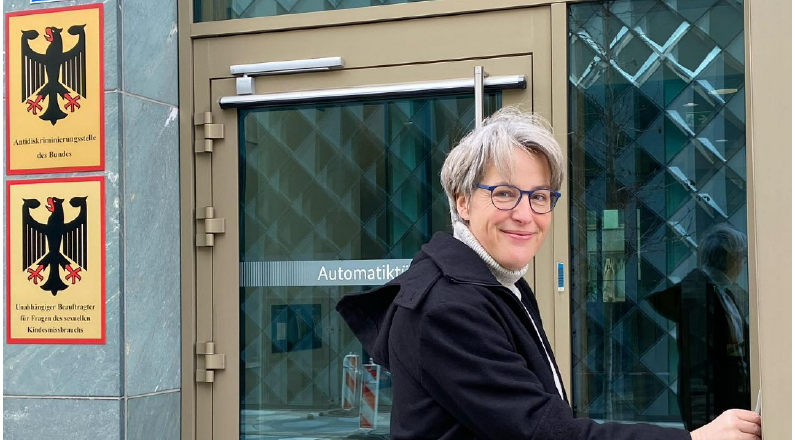
(ZENIT News / Berlin, 05.25.2026).- For decades, few subjects have shaken the credibility of the Catholic Church more deeply than the sexual abuse crisis. Revelations from many countries exposed institutional failures, devastated victims and families, and forced the Church into a painful process of self-examination. Precisely because of that history, recent comments from Germany carry particular significance: not as a declaration that the problem has been solved, but as recognition that major structural changes have taken place.
Kerstin Claus, Germany’s Independent Federal Commissioner for Child and Youth Sexual Abuse Issues, has publicly stated that Catholic institutions have developed what she describes as a high level of expertise and a “culture of vigilance” in the field of prevention. Claus, who herself was abused by a Protestant pastor in 1984 and now leads the federal office responsible for combating abuse of minors, argues that important advances have emerged particularly in Catholic schools, childcare centers, parish youth programs and local church structures.
Her remarks are noteworthy because they come not from Church authorities defending their own record, but from a senior government official whose work focuses specifically on protecting children and supporting victims.
According to Claus, mandatory training programs and comprehensive protection policies have become central elements of Catholic prevention efforts. In many communities, she said, these structures do more than simply attempt to stop abuse before it occurs. They also create environments where children suffering violence, stress or neglect at home may find adults capable of recognizing warning signs and offering support.
One of her strongest observations concerns the local level, where child protection often succeeds or fails. She suggested that some Catholic communities have developed prevention mechanisms that, in practice, exceed standards found in municipal structures. She believes this experience could benefit broader society, encouraging stronger cooperation between Church institutions, local authorities, civic organizations and youth programs.
The proposal reflects an important reality often overlooked in public debate: protecting children depends not on isolated institutions but on interconnected systems. A child does not live exclusively within one environment. Home, school, parish, sports clubs and social networks all intersect. Weakness in one area can undermine safety everywhere.
The discussion surrounding abuse has also generated debate in other European countries. In Spain, organizations focused on child protection have warned against what they call a disproportionate concentration of media attention on Church cases alone while minimizing the broader social dimension of abuse. Data cited by Spain’s ANAR Foundation, which analyzed cases reported between 2008 and 2019, indicated that only 0.2% of reported abuse cases involved priests, while most occurred within family or social environments. The same report suggested that parishes and Catholic institutions ranked among statistically safer and more monitored environments.
None of this changes a fundamental truth: even a single case of abuse by a religious figure represents a profound moral failure. The spiritual trust invested in clergy makes such betrayals uniquely damaging. The Church itself has repeatedly acknowledged that numbers alone cannot erase suffering.
Yet there is another truth emerging from the current debate. Institutions are often judged not only by their failures but also by their willingness to confront them. In Europe, civil authorities increasingly appear to recognize that the Catholic Church — under the pressure of scandal, public scrutiny and the testimony of victims — has invested heavily in prevention structures that may now offer lessons extending beyond ecclesial life.
Perhaps the most uncomfortable conclusion is also the most important one: child abuse was never exclusively a Church problem. It was, and remains, a societal problem. The challenge now is ensuring that hard-earned lessons born from tragedy do not remain confined within church walls, but become part of a wider culture of protection capable of reaching every child, everywhere.
Thank you for reading our content. If you would like to receive ZENIT’s daily e-mail news, you can subscribe for free through this link.

Publicaciones relacionadas:
 Peru: What Does the Sodality of Christian Life Think About Archbishop Charles Scicluna’s Visit to Peru to Investigate Them?
 Australian bishops’ president speaks out on abuse allegation against bishop emeritus of Broome
 Church calls on legislature to investigate child sexual abuse in state-run facilities and to treat all victims of abuse equally
 Declining trend of abuse in U.S. church continues, according to new report
