

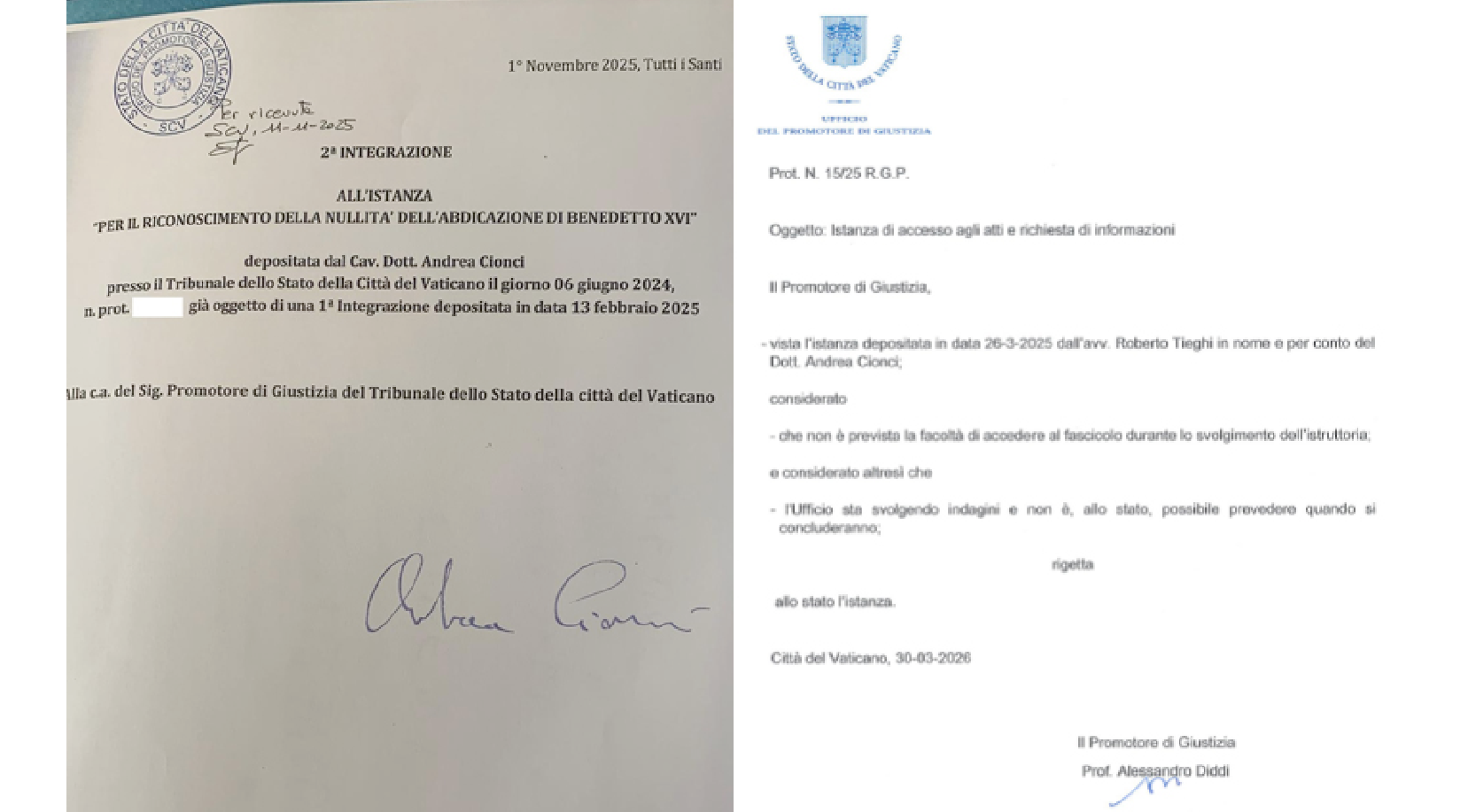
(ZENIT News / Rome, 04.20.2026).- The confirmation that a Vatican judicial office has opened a file concerning the resignation of Benedict XVI has circulated widely in recent days, often presented as a potential turning point in one of the most persistent fringe theories of the past decade. A closer look at the procedural reality, however, reveals a far more prosaic picture—one that says more about how justice functions in the Holy See than about any supposed uncertainty over the 2013 renunciation.
The case originates from a formal petition submitted on 6 June 2024 by Andrea Cionci, supported by lawyer Roberto Tieghi and accompanied by numerous signatures. The request asked the Vatican Tribunal to examine the validity of Benedict XVI’s decision to resign the Petrine ministry. At the heart of the initiative lies a theory that has circulated for years in certain circles: the claim that Benedict never truly abdicated and that his successor, Pope Francis, would therefore be an illegitimate occupant of the See of Peter.
This hypothesis has often been framed in quasi-literary terms, suggesting that the German pontiff left behind a trail of coded messages—hidden in speeches and documents—intended to reveal a secret plan to attentive interpreters. In practice, such claims have been consistently dismissed by theologians and canon lawyers as lacking any credible foundation.
The recent development stems from a letter dated 30 March 2026, in which the Vatican’s Promoter of Justice, Alessandro Diddi, denied a request by Tieghi to access the case documents. The reason given was straightforward: the matter is under preliminary investigation, and its duration cannot yet be determined. Some commentators have attempted to portray this procedural response as indirect validation of the petition’s seriousness. That interpretation does not withstand even a basic understanding of judicial procedure.
In Vatican law, as in most legal systems, the filing of a formal complaint—especially one supported by multiple signatories—automatically triggers the opening of a dossier. This step does not imply endorsement of the claims; it merely initiates a preliminary assessment. During this phase, access to the acts is routinely restricted, precisely to safeguard the integrity of the inquiry. The Promoter of Justice, functionally equivalent to a public prosecutor, is tasked with evaluating whether the submission meets the minimum threshold to proceed further. In the overwhelming majority of cases lacking substantive merit, the outcome is dismissal.
On the substance of the matter, the consensus among qualified canonists remains unequivocal. Benedict XVI’s Declaratio of 11 February 2013 fulfilled the essential juridical requirements established by canon law: the act was made freely and was properly manifested. No recognized authority in the field has argued otherwise. Moreover, Benedict himself, until his death in 2022, repeatedly affirmed both the validity of his resignation and the legitimacy of his successor.
The persistence of alternative narratives is therefore less a question of legal ambiguity than of interpretative insistence. Scholars who have examined the claims have done so with notable clarity. Geraldina Boni, professor of canon law at the University of Bologna, described the arguments as improvised and devoid of credibility. Theologian Silvio Barbaglia demonstrated that their premises collapse under scrutiny. Canonist Rosario Priore has gone further, calling them entirely unfounded from both theological and juridical perspectives. Even Archbishop Georg Gänswein, Benedict’s longtime personal secretary, dismissed the theory as a personal elaboration reminiscent of fictional conspiracy plots.
What emerges from the current episode is not a crisis of legitimacy, but a familiar dynamic in contemporary ecclesial debate: the transformation of technical or procedural developments into symbolic battlegrounds. The mere existence of a file—an administrative necessity—has been recast as evidence of hidden truths, reflecting a broader tendency to conflate legal process with doctrinal substance.
From a Vatican perspective, the episode ultimately reinforces the normal functioning of its judicial system. The opening of a dossier demonstrates that petitions are received, recorded, and examined according to established norms. It does not signal that every claim carries equal weight, nor that long-settled questions are suddenly reopened.
Nearly thirteen years after Benedict XVI’s historic resignation—the first papal renunciation in centuries—the Church continues to live with the consequences of that unprecedented gesture. Yet on the central question of its validity, there is no institutional doubt. What persists instead is a narrative sustained at the margins, periodically revived but consistently answered by the same convergence of law, theology, and historical fact.
Thank you for reading our content. If you would like to receive ZENIT’s daily e-mail news, you can subscribe for free through this link.

Publicaciones relacionadas:
 Pope Asks Neo-Catechumenal Way to Preach Jesus Christ with the Strength of the Spirit in the Church and with the Church”
 Pope Francis participated in the closing of the International Meeting of Meaning and launched the University of Meaning
 Pope Leo XIV inaugurates Borgo Laudato si’: Francis’ encyclical that became a reality in one place
 A Delegation of the Vatican City State at the 28th Universal Postal Congress
