

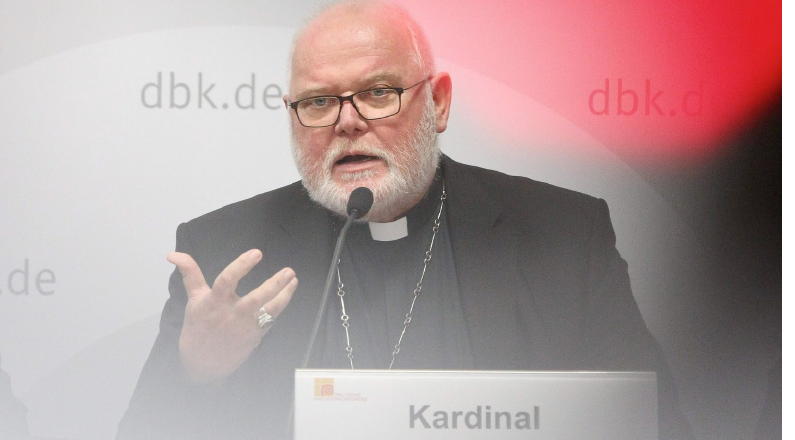
(ZENIT News / Munich, 04.21.2026).- One of the country’s most influential Catholic leaders has moved to institutionalize pastoral practices that continue to test the boundaries of ecclesial unity. In Munich and Freising, Cardinal Reinhard Marx has asked clergy and pastoral workers to adopt a set of guidelines that authorize blessings for couples who cannot, or do not wish to, enter into sacramental marriage. The decision places the archdiocese at the forefront of a broader tension within the Church: how to accompany complex personal situations without obscuring the theological meaning of marriage.
The guidelines in question, approved in 2025 by a joint body linking the German bishops’ conference and a major lay organization, propose structured ceremonies for a wide range of couples. These include divorced and civilly remarried Catholics, same-sex couples, and others whose unions fall outside canonical norms. While the text insists that such blessings are not equivalent to a sacramental marriage, it nonetheless envisions stable, repeatable rites—something that raises questions about their theological and liturgical implications.
Cardinal Marx has framed the initiative in explicitly pastoral terms. In his communication to clergy, he emphasizes that no couple should feel excluded from the Church’s life and that a blessing, understood in its most basic sense as invoking God’s good upon a person, can serve as a gesture of welcome and spiritual support. He has also called for a pedagogical effort within parishes, urging priests and lay ministers to explain the theological meaning of blessing to those who remain hesitant.
To ensure implementation, the archdiocese plans to offer training programs beginning in June 2026. Pastoral personnel unwilling to preside over such ceremonies are expected to refer couples to other ministers or to the local deanery, a provision that some critics interpret as reducing conscientious objection to a procedural formality rather than a substantive safeguard.
The German initiative draws partial inspiration from a 2023 Vatican declaration that opened the door to non-liturgical blessings for couples in “irregular” situations. That document, however, set clear conditions: such blessings should be spontaneous, brief, and carefully distinguished from any form resembling a marriage rite. The concern in Rome was to avoid precisely the kind of ritualization that could generate confusion among the faithful regarding the nature of marriage, which the Church continues to define as an exclusive, indissoluble union between a man and a woman ordered toward the good of the spouses and the transmission of life.
It is at this juncture that the German approach becomes controversial. By proposing structured ceremonies and embedding them within diocesan pastoral planning, the guidelines exceed the parameters outlined by the Holy See. This concern is not merely theoretical. The Archdiocese of Cologne, among others, has explicitly declined to adopt the guidelines, stating that they go beyond what the universal Church permits. Similar reservations have been expressed in other dioceses such as Augsburg, Eichstätt, Passau, and Regensburg, illustrating that the German episcopate itself is far from unified on the matter.
Behind the debate lies a deeper ecclesiological question: how far can local churches adapt pastoral practice without fracturing doctrinal coherence? The German “Synodal Path,” from which these proposals ultimately emerged, has sought to address issues of governance, morality, and participation in response to the country’s particular context. Yet its critics warn that a pastoral strategy detached from the universal framework risks creating parallel norms that, over time, erode the Church’s internal unity.
At the same time, proponents insist that the initiative responds to real human situations that cannot be ignored. In increasingly secularized societies, many couples seek some form of spiritual recognition even when they do not meet canonical requirements for marriage. The pastoral challenge, therefore, is not abstract: it involves accompanying individuals without diluting the Church’s teaching on life, family, and the sacramental order.
This tension is not new in Catholic history. The Church has long navigated the delicate balance between truth and mercy, doctrine and pastoral care. What is new, however, is the speed and visibility with which local decisions now reverberate globally, often amplified by media narratives that frame them as either breakthroughs or ruptures.
In Munich, the immediate effect will be practical: clergy will begin to implement a framework that formalizes what in some places had already been occurring informally. In the wider Church, the implications will be more complex.
Thank you for reading our content. If you would like to receive ZENIT’s daily e-mail news, you can subscribe for free through this link.

Publicaciones relacionadas:
 Germany: bishop responsible for queer ministry calls for changes in Church doctrine
 Woman Wins Lawsuit Against Two Bishops in Belgium for Refusing to Accept Her for Diaconal Formation
 Pro-LGBT+ bishop receives award in USA and criticizes “obsolete theological frameworks” of the Church
 Prefect of Dicastery for Doctrine of the Faith criticizes gender ideology in speech to German theologians
