

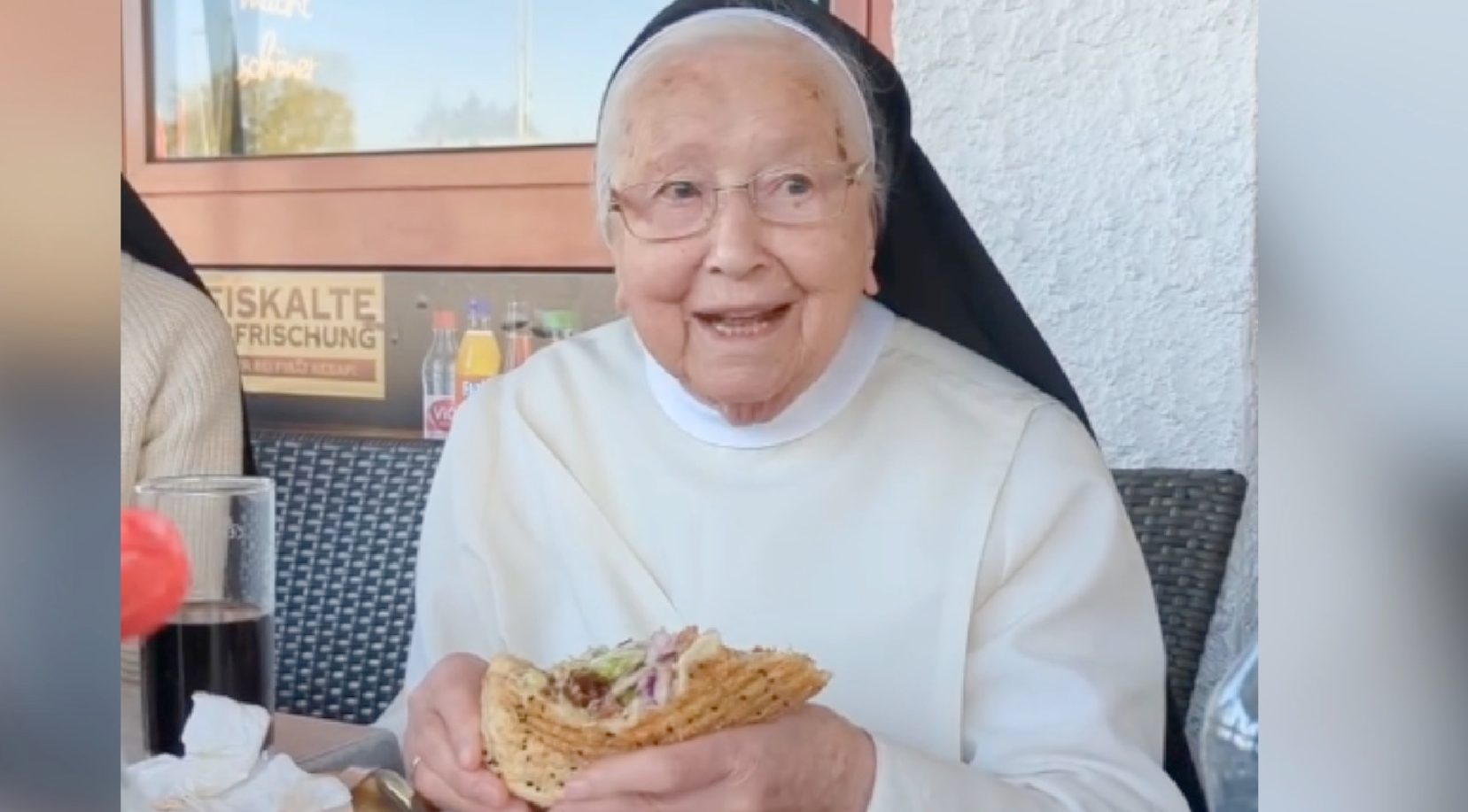
(ZENIT News / Arenberg, 04.29.2026).- A brief, almost improvised scene recorded on a mobile phone has unexpectedly opened a window into a reality often hidden behind centuries-old walls. In a fast-food shop in western Germany, a 92-year-old Dominican nun takes her first bite of a kebab, smiles with disarming spontaneity, and declares herself “absolutely delighted.” Within days, more than eight million people had watched the moment.
What might have remained a simple anecdote from a day trip has instead become a small cultural event, revealing not only the enduring human appeal of authenticity but also the evolving ways in which religious life is being communicated in the digital age.
The video was filmed by Sister Clarita, a 28-year-old nun from the Arenberg Abbey in Rhineland-Palatinate. The community had traveled with seven other sisters on a pilgrimage to Trier, where the Holy Robe Days had just concluded. On their return, they stopped for a meal, eventually arriving—somewhat by chance—at a kebab shop in an industrial area of Mülheim-Kärlich, chosen in part for its accessible parking, as several of the older sisters had difficulty walking.
Ver esta publicación en Instagram
Inside the establishment, identified as Firat Kebap Haus, the group was welcomed warmly. For at least two of them—Sister Irmingard, 92, and Sister Hildegunde, 89—it was an entirely new culinary experience. The scene that followed, marked by laughter and a certain initial uncertainty about how to approach the unfamiliar dish, was captured on camera with a simplicity that would later resonate widely online.
In the video, Sister Clarita asks Irmingard how she finds her first kebab. The reply is immediate and enthusiastic. In a humorous moment, the elderly nun, visibly energized, claims to be 82 years old, prompting a gentle correction from her companion: she is, in fact, 92. The exchange, at once playful and tender, appears to have struck a chord far beyond the confines of the convent.
The figures associated with the clip illustrate the scale of its reach. By April 29, 2026, it had surpassed eight million views, accumulated more than 324,000 likes, and generated nearly 3,200 comments. In an earlier phase, the sisters themselves had already expressed astonishment when the video reached 1.2 million views in a single night. “We are euphoric,” one of them remarked on social media, while Sister Irmingard reacted with characteristic irony, wondering how many viewers even knew who she was.
Yet the viral success is not accidental. It forms part of a broader and deliberate effort by the community to engage with contemporary culture. Sister Clarita, who entered the convent in 2022 and has around 16,000 followers on Instagram, has been particularly active in this regard. Her motivation, as she has explained, stems from a personal experience: before choosing religious life, she found little accessible or realistic information about it online.
In her view, persistent stereotypes continue to shape public perception—images of nuns as isolated, perpetually silent, or detached from ordinary human experience. Through social media, she seeks to offer a different narrative, one grounded in daily life, shared joy, and community.
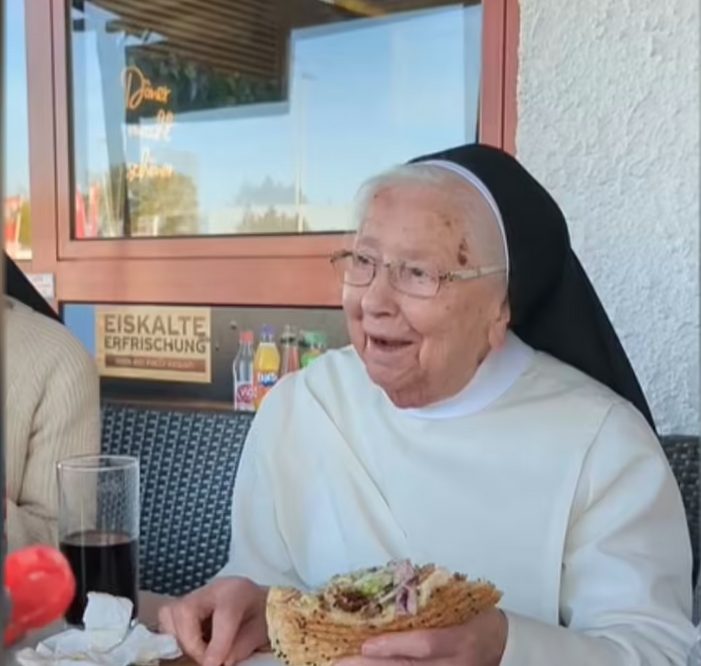
The kebab episode, in this sense, functions as more than a humorous interlude. It illustrates a form of witness that does not rely on formal discourse but on lived experience. The sisters are seen not as abstract symbols but as individuals capable of curiosity, humor, and openness to the unfamiliar—even in their ninth decade of life.
At the same time, the story retains its rootedness in traditional religious practice. The outing was not a leisure trip in the ordinary sense, but part of a pilgrimage—a journey with spiritual meaning in Christian tradition, often associated with prayer, penance, and communal reflection. That such a journey could include a spontaneous stop at a fast-food restaurant may appear incongruous, yet it reflects the integration of faith into the ordinary rhythms of life.
The broader significance of the episode lies in its timing. In many parts of Europe, religious vocations are declining, and monastic life is often perceived as distant or obsolete. Against this backdrop, moments like these—unplanned, unscripted, and widely shared—offer a different perspective. They suggest that the appeal of consecrated life may still be communicated, not primarily through argument, but through the visibility of a life lived with coherence and joy.
In the end, the enduring image is a simple one: an elderly nun, momentarily surprised by a taste she had never encountered, responding with gratitude and delight: even within structures shaped by discipline and tradition, there remains space for discovery—and that this very humanity may be one of the most persuasive forms of testimony.
Thank you for reading our content. If you would like to receive ZENIT’s daily e-mail news, you can subscribe for free through this link.

Publicaciones relacionadas:
 INTERVIEW: Cardinal Guixot Discusses Fruits of Pope & Grand Imam’s Abu Dhabi Document on Human Fraternity
 FEATURE : ‘An Economy Which Excludes No One’ — Cardinal Turkson Explains to ZENIT Importance of Pope’s Assisi Encounter
 INTERVIEW: New York COVID Task Force–in ‘Mission of Faith’– Sets Out to Annihilate Virus, Starting From Diocese of Brooklyn
 Pope Francis Will Be 85 on Saturday and This Is the Person with Whom He Will Celebrate His Birthday
