

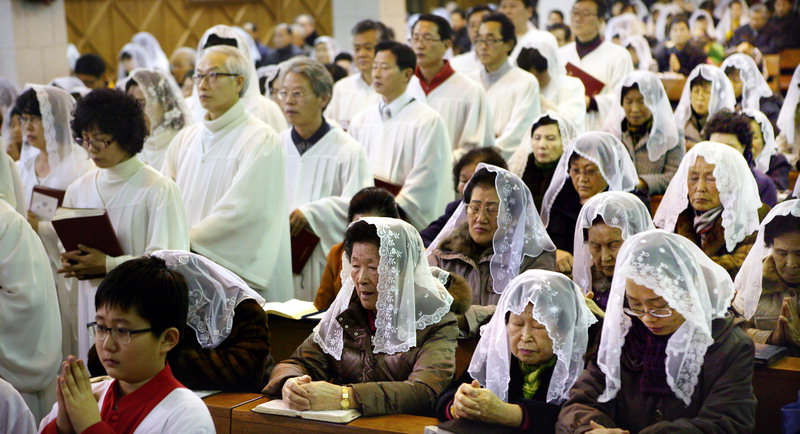
(ZENIT News / Seoul, 05.05.2026).- The Catholic Church in South Korea has crossed a symbolic threshold that would have seemed extraordinary half a century ago. From just one million faithful in 1975, the community has grown sixfold to 6,006,832 Catholics by the end of 2025. Yet this numerical success, confirmed in the latest statistics released on April 22 by the Korean Bishops’ Conference, conceals a far more complex ecclesial reality—one marked by demographic fragility, declining participation, and a contraction in vocations that is beginning to reshape the Church’s future.
The headline figure—six million Catholics—has been described by the bishops themselves not as a culmination, but as a starting point for confronting what they openly acknowledge as a new phase of pastoral urgency. Growth, while still positive, has slowed dramatically: a modest 0.2 percent increase in 2025, down from 0.5 percent the previous year. The trajectory suggests that the Church’s expansion, once fueled by conversions and social dynamism, is entering a plateau phase.
More revealing than total membership is the age profile of the faithful. Nearly one in three Korean Catholics—28.9 percent—is now aged 65 or older, making the elderly the largest demographic group within the Church. This mirrors a broader national trend. South Korea, despite its economic strength, is grappling with one of the most severe demographic crises in the world. Its fertility rate, at 0.80 in 2025 (up slightly from a historic low of 0.72 in 2023), remains far below the 2.1 replacement level. The implications for the Church are direct: fewer baptisms, fewer young families, and a steadily aging parish base.
Even more concerning for ecclesial life is the sharp decline in sacramental practice. Sunday Mass attendance has dropped to just 15 percent of registered Catholics, a significant fall from 20.7 percent in 2015. While major liturgical celebrations such as Easter and Christmas still draw larger crowds—around 25 percent participation—the contrast with pre-pandemic figures is stark. In 2019, nearly 80 percent of Catholics attended these key feasts, suggesting that the COVID-19 period accelerated a disengagement that has yet to be reversed.
One notable exception stands out: the Military Ordinariate, where attendance reaches 97 percent, largely due to the structured environment of military life. This contrast underscores a broader pastoral question: to what extent is participation sustained by conviction, and to what extent by context?
The decline in vocations adds another layer of urgency. In 2025, only 70 new priests were ordained nationwide, compared to 121 a decade earlier—a drop of over 42 percent. Four dioceses—Chuncheon, Wonju, Andong, and Jeju—did not ordain a single priest that year. The number of seminarians has also fallen to 854, with fewer than 100 new entrants annually since 2022. Religious life mirrors this downturn. The total number of men and women religious stands at 11,170, down by 187 from the previous year, continuing a downward trend that has persisted since 2022. Particularly striking is the collapse in new entrants: compared to 2015, female novices have decreased by 61.5 percent and male novices by 40.7 percent.
These figures point not merely to a vocational shortage, but to a deeper cultural and spiritual shift. South Korea’s rapid modernization, intense work culture, and evolving social values have contributed to a gradual distancing from institutional religion. For the Catholic Church, which once benefited from a reputation for moral clarity, educational excellence, and social engagement, the challenge is no longer visibility but credibility and relevance in a highly competitive and secularized environment.
In their accompanying analysis, the bishops identify the “recovery of inactive and non-practicing faithful” as an urgent priority. The language is notable for its candor. Reintegrating those who have drifted away from sacramental life is no longer framed as a secondary concern, but as a central pastoral imperative. The report explicitly acknowledges that the question of how to bring back those who have ceased practicing “can no longer be ignored.”
This diagnosis aligns with broader trends observed across many parts of the global Church, but it takes on particular intensity in the Korean context, where demographic collapse and religious disengagement are unfolding simultaneously. The convergence of these two dynamics—fewer people and fewer practicing believers—poses a structural challenge that cannot be addressed by pastoral strategies alone.
At the same time, the Korean Church retains significant assets. Its history of lay leadership, its strong educational institutions, and its witness during periods of political repression continue to offer a foundation for renewal. Moreover, in a society marked by isolation and low birth rates, the Church’s emphasis on family, community, and the dignity of life may yet resonate as a countercultural proposal.
The six-million mark, then, is less a triumph than a diagnostic moment. It reveals a Church that has grown in size but now faces the harder task of deepening commitment, fostering vocations, and rebuilding a culture of participation.
Thank you for reading our content. If you would like to receive ZENIT’s daily e-mail news, you can subscribe for free through this link.

Publicaciones relacionadas:
 The Holy See and Vietnam at a turning point that comes from afar
 USA: Bipartisan Collaboration on Immigration Reform is Still Possible, says Bishop Seitz
 Record year for fires targeting Catholic churches: justice system investigates new fire at iconic Parisian parish
 Brazilian Catholic priest takes Volkswagen to court for modern slavery
