

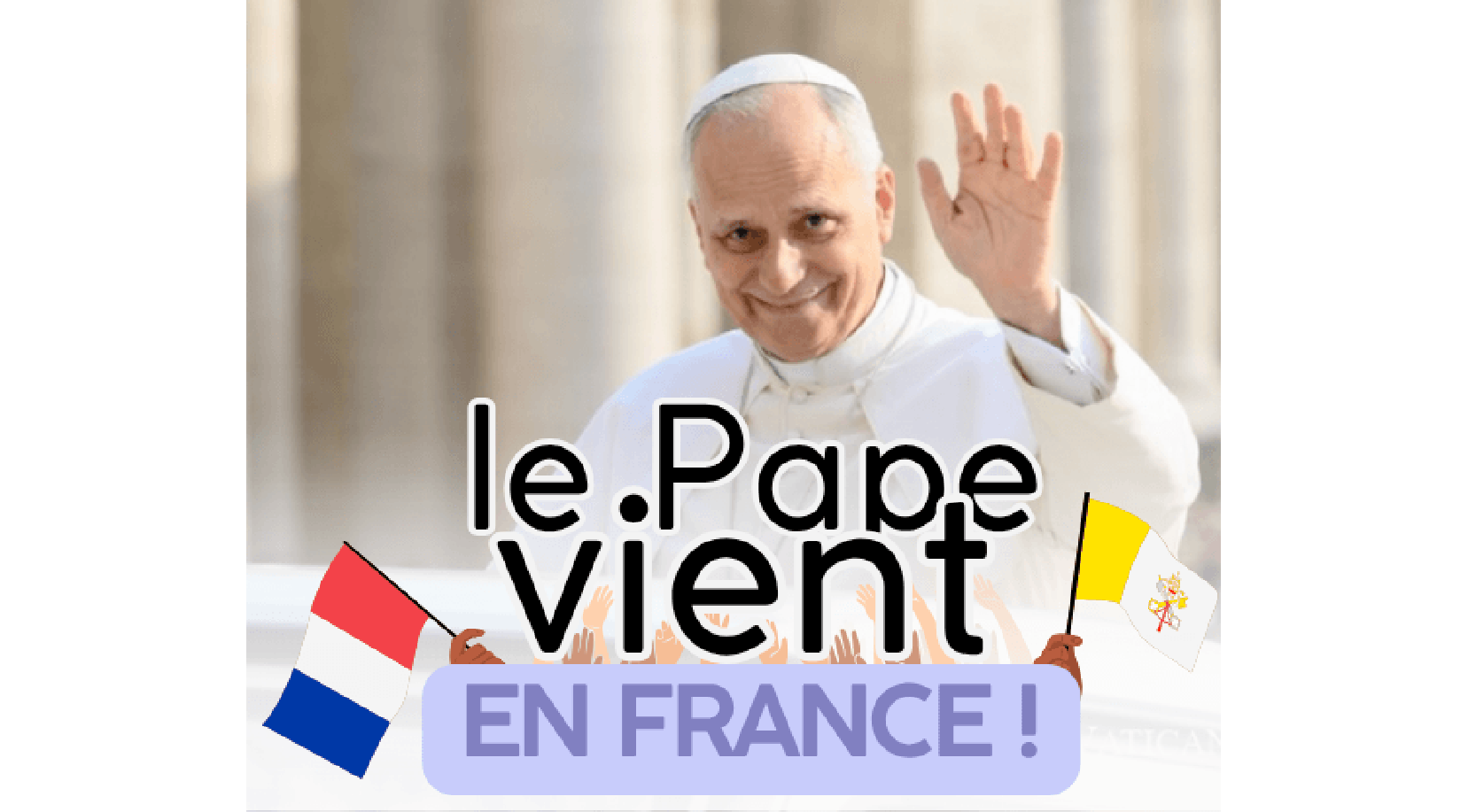
(ZENIT News / Paris, 05.16.2026).- The Vatican has officially confirmed that Pope Leo XIV will travel to France from September 25 to 28, 2026.
The Holy See announced that the Pope’s visit comes in response to invitations from French civil authorities, the country’s bishops, and the Director-General of UNESCO, whose Paris headquarters Leo XIV is expected to address during the trip.
Although the Vatican has not yet released the full itinerary, Church officials in France anticipate that the Pope will visit both Paris and the Marian shrine of Lourdes. Preparatory committees are now being established under the coordination of the French Bishops’ Conference, while logistical and pastoral details continue to be worked out jointly between Vatican officials and local dioceses.
For the French Church, however, this visit is being understood as far more than a state occasion. Many bishops see it as a pivotal spiritual moment for a Catholic community navigating simultaneously crisis, secularization, renewal, and unexpected missionary vitality.
A Pope Deeply Interested in France
Cardinal Jean-Marc Aveline, Archbishop of Marseille and president of the French Bishops’ Conference, has emerged as one of the principal architects of the trip.
Speaking after the Vatican announcement, Aveline described the Pope’s decision as “a great joy” and emphasized that Leo XIV had shown genuine personal interest in France almost immediately after his election.
According to the cardinal, the Pope is particularly attentive both to the missionary dynamism emerging within French Catholicism and to the complex challenges facing the Church in one of Europe’s most secularized societies.
That dual reality — decline in some sectors alongside striking signs of spiritual renewal — appears to have strongly attracted Leo XIV’s attention.
In recent years, France has witnessed a surprising increase in adult catechumens, especially among young adults seeking baptism or confirmation. Pilgrimages, particularly to Marian shrines such as Lourdes, have also experienced renewed popularity among younger generations searching for spiritual meaning in an increasingly fragmented cultural environment.
Cardinal Aveline noted that many of the young participants discovering Christianity today are encountering the faith for the first time in a serious way.
For Church leaders, this emerging spiritual curiosity represents both an opportunity and a challenge: how to accompany new believers in a society where Catholic culture can no longer be assumed or transmitted automatically through family and social structures.
A Church Carrying Wounds and Hopes
The French Church’s enthusiasm surrounding the papal visit is also shaped by recent painful history.
Like other Western countries, France has endured a profound crisis linked to clerical abuse scandals, which severely damaged public trust in ecclesiastical institutions. French bishops have repeatedly acknowledged that the work of justice, transparency, and support for victims remains unfinished.
Cardinal Aveline openly referred to those wounds while discussing the upcoming trip, stressing that Leo XIV is fully aware both of the suffering endured and of the continuing effort required for authentic renewal.
The Pope’s visit is therefore expected not only to encourage believers, but also to help orient the French Church for the years ahead.
According to Aveline, Leo XIV intends above all to listen: to understand the realities Catholics face in France, to hear their concerns, and then to offer guidance within the broader communion of the universal Church.
That listening dimension has already become one of the defining characteristics of Leo XIV’s pontificate, which has consistently combined doctrinal clarity with strong emphasis on pastoral proximity and missionary engagement.
Nous nous réjouissons que Sa Sainteté le Pape Léon XIV ait confirmé son voyage en France.
Cette visite en septembre prochain sera un honneur pour notre pays, une joie pour les catholiques et un grand moment d’espérance pour tous.
— Emmanuel Macron (@EmmanuelMacron) May 16, 2026
UNESCO and the Catholic Vision of Education
One of the most anticipated moments of the journey will likely be Leo XIV’s address at UNESCO headquarters in Paris.
The choice is highly significant.
Throughout his first year as Pope, Leo XIV has repeatedly emphasized the importance of education, culture, and the relationship between faith and reason. He has also warned about what he describes as a growing “educational fragmentation” affecting younger generations shaped by technological acceleration, social isolation, and ideological polarization.
For French bishops, the UNESCO stop fits naturally within the broader priorities of both the Pope and the French Church.
In recent years, the bishops of France launched a multiyear reflection dedicated specifically to education, involving Catholic schools, families, educators, and religious congregations long associated with teaching and youth formation.
The topic carries particular weight in France, where debates over secularism, religion in public life, family structures, and cultural identity remain especially intense.
Catholic educational institutions continue to play a major role in French society despite secularization, and many Church leaders see education as one of the decisive battlegrounds for the future of European civilization.
Cardinal Aveline explicitly linked this effort to the Church’s social doctrine and to the Christian conviction that education concerns not only academic formation but the integral development of the human person.
The reference to UNESCO also evokes a historical memory within the Church. During his 2008 visit to France, Pope Benedict XVI strongly emphasized the harmony between faith and reason, arguing that Christianity contributed decisively to the development of European intellectual culture rather than standing in opposition to it.
Leo XIV appears poised to revisit similar themes, though likely through the lens of contemporary challenges surrounding artificial intelligence, cultural fragmentation, and the moral foundations of democracy.
France, Europe, and the Question of Reconciliation
The visit also carries broader implications for Europe itself.
This will be Leo XIV’s fifth international journey and already his third within Europe, following earlier visits to Turkey, Lebanon, Monaco, Spain, and several African nations.
The frequency of European trips suggests that the Pope sees the continent as standing at a particularly fragile historical crossroads.
Cardinal Aveline pointed directly to Europe’s experience of war and reconciliation as a possible framework for Leo XIV’s message.
He recalled that the European project itself emerged after catastrophic conflicts largely through the efforts of Christian statesmen such as Alcide De Gasperi, Konrad Adenauer, and Robert Schuman, whose political vision was deeply shaped by Christian anthropology and the possibility of reconciliation between former enemies.
In a world increasingly marked by geopolitical fragmentation, war, and declining confidence in international institutions, the French cardinal suggested that Europe’s postwar reconciliation experience still offers an important witness for peace.
That perspective aligns closely with Leo XIV’s repeated appeals for dialogue, diplomacy, and renewed commitment to international law amid global instability.
Macron Welcomes the Pope
French President Emmanuel Macron also welcomed the announcement enthusiastically, calling the upcoming trip “an honor” for France, “a joy for Catholics,” and “a great moment of hope for everyone.”
Macron had already met Leo XIV at the Vatican on April 10, continuing the longstanding — and often delicate — relationship between the French Republic and the Holy See.
The interaction between a strongly secular state and one of Europe’s historically Catholic nations remains one of the defining tensions of modern France.
Yet the upcoming visit suggests that, despite ideological divisions and rapid secularization, the papacy continues to hold significant cultural, moral, and symbolic influence within French public life.
For the Catholic Church in France, meanwhile, the journey represents something even deeper: an opportunity to rediscover confidence after years of turmoil, and perhaps to discern whether the unexpected spiritual awakenings appearing among younger generations signal not merely isolated phenomena, but the beginning of a broader renewal.
Thank you for reading our content. If you would like to receive ZENIT’s daily e-mail news, you can subscribe for free through this link.

Publicaciones relacionadas:
 Pope Leo’s visit to Argentina unofficially confirmed after audience with President Milei
 Taiwan’s president writes to Pope Leo XIV: ‘Taipei wants peace, human rights, and democracy’
 The Middle East, the spread of war, and the position of the Pope and the Catholic Church
 An Italian: this is the Pope’s new ambassador “to” Donald Trump
