

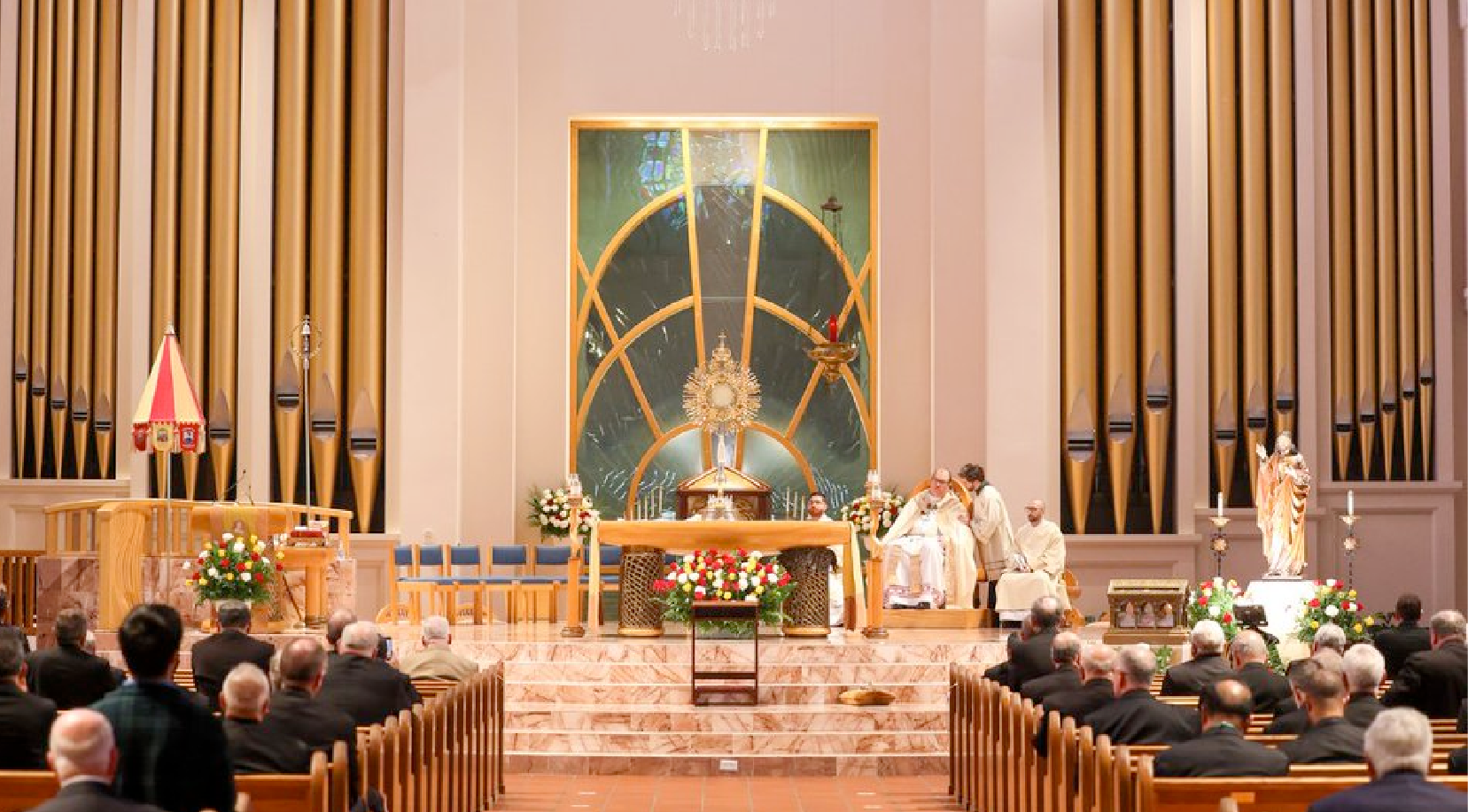
(ZENIT News / Orlando, 06.13.2026).- As the United States approaches the 250th anniversary of its founding, the country’s Catholic bishops have sought to place that milestone within a spiritual rather than merely historical framework. Gathering in Orlando on June 11, on the eve of the Solemnity of the Sacred Heart of Jesus, they participated in a national act entrusting the nation to the Heart of Christ, a gesture intended to unite prayer, repentance, and hope for the future of the country.
The ceremony, held during the spring assembly of the U.S. Conference of Catholic Bishops, crowned months of preparation and followed a nationwide novena conducted from June 3 to June 11. Throughout those nine days, Catholics were invited to reflect on the spiritual significance of the Sacred Heart through the teachings of saints and popes, drawing particularly on Pope Francis’ encyclical Dilexit Nos and Pope Leo XIV’s apostolic exhortation Dilexi Te, both of which emphasize that authentic Christian love must be expressed in service to others.
The Act of Consecration of the United States to the Most Sacred Heart of Jesus, prayed at the Mass on June 11, 2026.
On this Solemnity of the Most Sacred Heart of Jesus, our nation is entrusted to His love, mercy, and protection.@ArchbishopOKC @OrlandoDiocese pic.twitter.com/9VKBeE9Cjs— U.S. Conference of Catholic Bishops (@USCCB) June 12, 2026
The initiative enjoyed overwhelming episcopal support. In a vote conducted months earlier, 215 bishops backed the proposal, while eight opposed it and seven abstained. Yet the ceremony also revealed the complexity that sometimes accompanies symbolic religious acts in contemporary America. Some observers noted that the text used during the liturgy avoided the explicit verb “to consecrate,” despite the event being widely presented as a national consecration. Critics interpreted this as an effort to accommodate differing sensitivities among bishops while preserving broad consensus.
The setting itself underscored the solemnity of the occasion. At the Basilica of the National Shrine of Mary, Queen of the Universe, rows of bishops filled the sanctuary as clergy and lay faithful gathered beneath Florida’s intense summer light filtering through stained-glass windows. Before the liturgy, many knelt in prayer before relics of Saint Margaret Mary Alacoque, the seventeenth-century French Visitation nun whose reported visions played a decisive role in spreading devotion to the Sacred Heart throughout the Catholic world.
For many outside the Church, the devotion may appear merely devotional or sentimental. Historically, however, it has carried a deeper theological meaning. The Sacred Heart represents Christ’s self-giving love for humanity, symbolized by the wounded heart of the crucified Lord. The devotion gained particular prominence after the French saint’s revelations and was later embraced by successive popes as a remedy against indifference, secularism, and social fragmentation.
The American ceremony reflected that broader spiritual vision. While celebrating the nation’s achievements and recalling the Declaration of Independence’s affirmation of the rights to life, liberty, and the pursuit of happiness, the liturgy also acknowledged darker chapters of national history. Prayers referred explicitly to the country’s “original sins” of slavery and racism, emphasizing that gratitude for the nation’s blessings must be accompanied by honesty about its failures.
Archbishop Paul Coakley of Oklahoma City summarized this balance by noting that neither the nation nor the Church has always reflected the love symbolized by the Sacred Heart. In that sense, the act was presented not as a triumphal celebration of national identity but as an invitation to conversion.
The theme of conversion extended beyond society to the bishops themselves. Earlier that same day, Archbishop Shelton Fabre challenged his fellow bishops to confront divisions within the Church. Warning that internal conflicts weaken Catholic witness, he urged them to examine not only their actions but also their public statements, social media activity, and private conversations. His appeal came against the backdrop of recent disagreements among American bishops on several high-profile issues, highlighting concerns about polarization within ecclesial life.
Fabre’s message echoed the symbolism of the Sacred Heart itself. If the devotion points believers toward reconciliation through Christ’s love, then the bishops’ own unity becomes part of the credibility of their message. “We must resist the temptation to reduce one another to labels,” he told the assembly, calling instead for genuine fraternity among successors of the apostles.
The Orlando ceremony was the first event of its kind ever held at a national level in the United States, although similar consecrations have taken place in various countries since the nineteenth century. In 1899, Pope Leo XIII consecrated the entire world to the Sacred Heart, a decision he described as one of the most important acts of his pontificate.
More than a century later, America’s bishops have sought to renew that spiritual heritage in a nation marked by political polarization, cultural conflict, and growing religious disaffiliation. Whether described as a consecration, an entrustment, or an act of dedication, the message emerging from Orlando was clear: the bishops hope that the future of the United States will be shaped not only by its founding ideals, but also by a renewed encounter with the love symbolized by the Heart of Christ.
Thank you for reading our content. If you would like to receive ZENIT’s daily e-mail news, you can subscribe for free through this link.

Publicaciones relacionadas:
 Bishop Accepts and Backs First Transgender “Man” (Biologically a Woman) in Catholic Hermitic Life
 Four German Bishops Formally Disassociate Themselves from the German Synodal Path to Remain in the Catholic Church
 Pope Francis’ confessor dies in Argentina at age 98
 Chaldean Catholic Patriarch of Iraq: “Let us save the historic Christian cemeteries of Najaf”
