

(ZENIT News / Rome, 06.17.2026).- For much of the past quarter-century, the trajectory of American public opinion on LGBTQ issues appeared remarkably consistent. Support for same-sex marriage rose steadily, cultural acceptance broadened, and opposition seemed increasingly confined to smaller segments of society. New polling data, however, suggest that this long period of movement in one direction may be giving way to a more complicated and contested landscape.
According to Gallup’s 2026 Values and Beliefs survey, support for legal same-sex marriage remains the majority position in the United States, but it has declined noticeably from its recent peak. Today, 65% of Americans favor legal recognition of same-sex marriage, down from 71% in 2022 and 2023. While still dramatically higher than the 27% recorded in 1996, the trend points to a modest but sustained retreat over the past several years.
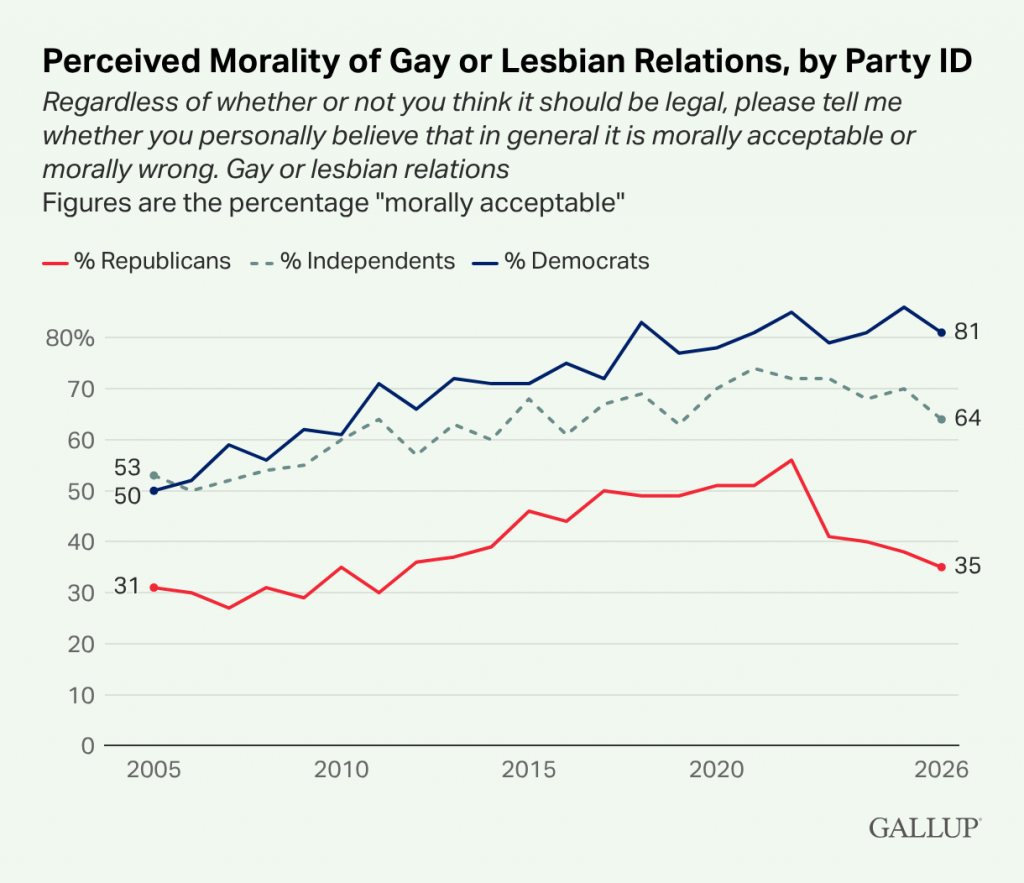
A similar pattern emerges regarding moral evaluations. Sixty-two percent of Americans now describe same-sex relationships as morally acceptable, the lowest figure recorded since 2016. Even more striking is the shift on gender transition issues. When Gallup first asked Americans about the moral acceptability of changing one’s gender in 2021, 46% considered it acceptable. That figure has now fallen to 38%, while 57% regard it as morally wrong.
The numbers reveal a country that is not abandoning support for LGBTQ rights but is reassessing some of the assumptions that dominated public discourse during the early 2020s. Rather than a wholesale reversal, the data suggest growing hesitation, particularly on questions involving gender identity.
The political divide behind this shift is impossible to ignore. Gallup’s findings indicate that most of the recent decline in support has occurred among Republicans. Just a few years ago, a majority of Republican voters supported same-sex marriage. In 2021 and 2022, support reached 55%; today it stands at 37%. Likewise, the percentage of Republicans who view same-sex relationships as morally acceptable has dropped from 56% to 35% since 2022.
Democrats, by contrast, have remained largely unchanged. Support for same-sex marriage among Democratic voters stands at 87%, while 81% consider same-sex relationships morally acceptable. Independents occupy a middle ground, though even among them support has softened somewhat in recent years.
The debate becomes even more polarized when gender transition is considered. Only 5% of Republicans now describe gender transition as morally acceptable, compared with 42% of independents and 60% of Democrats. Such figures illustrate how questions surrounding gender identity have become one of the sharpest fault lines in contemporary American culture.
Yet while attitudes toward certain LGBTQ issues have cooled, another trend continues in the opposite direction. Gallup estimates that 9% of American adults now identify as LGBTQ, more than double the 3.5% recorded in 2012. The figure has remained relatively stable over the past two years after a period of rapid growth.
The demographic story behind that increase is particularly revealing. Nearly one-quarter of Americans under the age of 30—23%—identify as LGBTQ, compared with 10% of those aged 30 to 49, 3% among those between 50 and 64, and only 2% among seniors. Women are also significantly more likely than men to identify as LGBTQ, with rates of 10.5% and 5.6%, respectively.
Most LGBTQ-identifying Americans do not identify as gay or lesbian. Instead, nearly six in ten identify as bisexual, making bisexuality by far the largest category within the LGBTQ population. Approximately 1.1% of Americans identify as transgender.
These apparently contradictory developments—a growing LGBTQ population alongside declining support for some LGBTQ-related positions—highlight a reality often lost in political rhetoric. Identity and public policy are not the same thing. Americans may increasingly know family members, friends, colleagues, or neighbors who identify as LGBTQ while simultaneously expressing reservations about specific cultural, educational, medical, or legal questions.
Observers across the political spectrum offer competing explanations for the change. Some point to growing concerns about medical interventions involving minors who experience gender dysphoria. Others cite debates over women’s sports, parental rights in education, religious liberty, or the role of diversity and inclusion initiatives in public institutions. Supporters of LGBTQ advocacy, meanwhile, argue that recent political campaigns and cultural backlash have contributed to the cooling of public opinion.
Whatever the causes, the latest Gallup findings suggest that the American conversation is entering a new stage. The rapid expansion of support that characterized the first decades of the twenty-first century appears to have slowed. In its place is a more complex debate, one in which broad acceptance of LGBTQ individuals coexists with renewed disagreements over the social, moral, and political implications of the movement’s evolving agenda.
For religious communities, policymakers, educators, and activists alike, the challenge ahead may be learning how to navigate these disagreements without reducing opponents to caricatures.
Thank you for reading our content. If you would like to receive ZENIT’s daily e-mail news, you can subscribe for free through this link.

Publicaciones relacionadas:
 Gays in Seminaries? In Regard to Homosexuals and the Priesthood, the Norms Have Not Changed at All
 Does a pontificate influence LGBT+ acceptance by the clergy? A study provides the answer
 Is the Bible clear when it comes to homosexuality? Study shows what believers think
 A cardinal with voting rights has spoken out against a controversial pro-gay synodal report
