

(ZENIT News / Rome, 06.21.2026).- Answered by Legionary of Christ Father Edward McNamara, professor of liturgy and sacramental theology at the Pontifical Regina Apostolorum university.
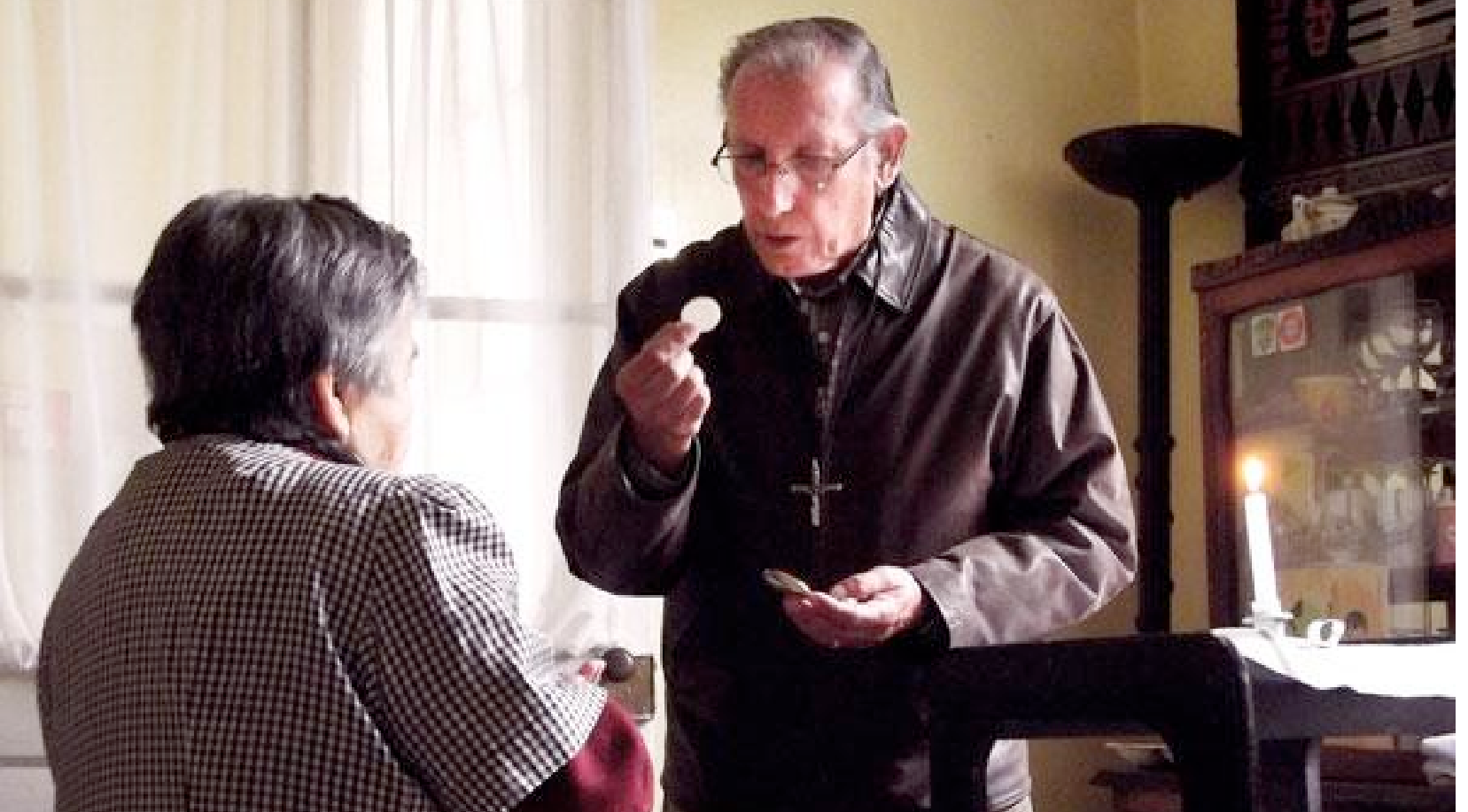
Q: I am a permanent deacon. Every Sunday I celebrate the Rite of Holy Communion outside of Mass in rural communities. Is the «Lamb of God» sung during these celebrations? Does one purify the hands, as does the priest when Mass is celebrated? I was taught that I should not do so. However, recently some women religious who came to help in the parish do both things and the community is somewhat confused. — J.G., Saltillo, Mexico
A: The Church has two universal rites for the distribution of Holy Communion outside of Mass. One is for giving Communion to the sick and the other, usually reserved for weekdays, for those faithful who desire to receive Communion but are unable to attend Mass.
Both rites have a similar structure and vary most of all in the prayer texts to be used.
There is no universal rite for Sundays because attendance at Mass is and remains the primary means of worship in the Church.
However, since there are objective situations when many faithful are deprived of the possibility of Sunday Mass for long periods, in 1988 the Holy See issued a directory for «Sunday Celebrations in the Absence of a Priest,» or to use a term that is often preferred, a community “awaiting a priest.” This document gives basic guidelines for episcopal conferences or individual bishops to prepare more specific norms and rituals to address the concrete pastoral necessities.
Chapter 3 of this document (Nos. 35-50) deals with the order of celebration:
«35. The order to be followed in a Sunday celebration that does not include Mass consists of two parts, the celebration of the word of God and the giving of holy communion. Nothing that is proper to Mass, and particularly the presentation of the gifts and the eucharistic prayer, is to be inserted into the celebration. The order of celebration is to be arranged in such a way that it is truly conducive to prayer and conveys the image not of a simple meeting but of a genuine liturgical assembly.
«36. As a rule, the texts for the prayers and readings for each Sunday or solemnity are to be taken from The Roman Missal and the Lectionary for Mass. In this way the faithful will follow the cycle of the liturgical year and will pray and listen to the word of God in communion with the other communities of the Church.
«37. In preparing the celebration the pastor together with the appointed laypersons may make adaptations suited to the number of those who will take part in the celebration, the ability of the leaders (animators), and the kind of instruments available for the music and the singing.
«38. When a deacon presides at the celebration, he acts in accord with his ministry in regard to the greetings, the prayers, the gospel reading and homily, the giving of communion, and the dismissal and blessing. He wears the vestments proper to his ministry; that is, the alb with stole, and, as circumstances suggest, the dalmatic. He uses the presidential chair.
«39. A layperson who leads the assembly acts as one among equals, in the way followed in the liturgy of the hours when not presided over by an ordained minister, and in the case of blessings when the minister is a layperson (‘May the Lord bless us …’; ‘Let us praise the Lord …’). The layperson is not to use words that are proper to a priest or deacon and is to omit rites that are too readily associated with the Mass, for example, greetings — especially «The Lord be with you» — and dismissals, since these might give the impression that the layperson is a sacred minister.
«40. The lay leader wears vesture that is suitable for his or her function or the vesture prescribed by the bishop. He or she does not use the presidential chair, but another chair prepared outside the sanctuary. Since the altar is the table of sacrifice and of the paschal banquet, its only use in this celebration is for the rite of communion, when the consecrated bread is placed on it before communion is given.
«Preparation of the celebration should include careful attention to a suitable distribution of offices, for example, for the readings, the singing, etc., and also to the arrangement and decoration of the place of celebration.
«41. The following is an outline of the elements of the celebration.
“— 1. Introductory rites. The purpose of these is to form the gathered faithful into a community and for them to dispose themselves for the celebration.
«— 2. Liturgy of the word. Here God speaks to his people, to disclose to them the mystery of redemption and salvation; the people respond through the profession of faith and the general intercessions.
«— 3. Thanksgiving. Here God is blessed for his great glory (see no. 45).
«— 4. Communion rites. These are an expression and accomplishment of communion with Christ and with his members, especially with those who on this same day take part in the eucharistic sacrifice.
«— 5. Concluding rites. These point to the connection existing between the liturgy and the Christian life.
«The conference of bishops, or the individual bishop himself, may, in view of the conditions of the place and the people involved, determine more precisely the details of the celebration, using resources prepared by the national or diocesan liturgical committee, but the general structure of the celebration should not be changed unnecessarily.
«42. In the introduction at the beginning of the celebration, or at some other point, the leader should make mention of the community of the faithful with whom the pastor is celebrating the eucharist on that Sunday and urge the assembly to unite itself in spirit with that community.
«43. In order that the participants may retain the word of God, there should be an explanation of the readings or a period of silence for reflection on what has been heard. Since only a pastor or a deacon may give a homily, it is desirable that the pastor prepare a homily and give it to the leader of the assembly to read. But in this matter the decisions of the conference of bishops are to be followed.
«44. The general intercessions are to follow an established series of intentions. Intentions for the whole diocese that the bishop may have proposed are not to be omitted. There should also often be intentions for vocations to sacred orders, for the bishop, and for the pastor.
«45. The thanksgiving may follow either one of the ways described here.
«— 1. After the general intercessions or after holy communion, the leader invites all to an act of thanksgiving, in which the faithful praise the glory and mercy of God. This can be done by use of psalm (for example, Psalms 100, 113, 118, 136, 147, 150), a hymn (for example, the Gloria), a canticle (for example, the Canticle of Mary), or a litanic prayer that the leader, standing facing the altar, recites together with the faithful.
«— 2. Before the Lord’s Prayer, the leader of the assembly goes to the tabernacle or other place where the eucharist is reserved and, after making reverence, places the ciborium with the holy eucharist on the altar. Then while kneeling before the altar he or she together with all the faithful sing or recite a hymn, psalm, or litany, which in this case is directed to Christ in the eucharist.
«But this thanksgiving is not in any way to take the form of the eucharistic prayer, the texts of the prefaces or eucharistic prayers from The Roman Missal (Sacramentary) are not to be used, and all danger of confusion is to be removed.
«46. For the communion rite the provisions given in The Roman Ritual for communion outside Mass are to be observed. The faithful are to be frequently reminded that even when they receive communion outside Mass they are united to the eucharistic sacrifice.
«47. For communion, if at all possible, bread consecrated that same Sunday in a Mass celebrated elsewhere is used; a deacon or layperson brings it in a ciborium or pyx and places it in the tabernacle before the celebration. Bread consecrated at the last Mass celebrated in the place of assembly may also be used. Before the Lord’s Prayer the leader goes to the tabernacle or place where the eucharist is reserved, takes the vessel with the body of the Lord, and places it upon the altar, then introduces the Lord’s Prayer — unless the act of thanksgiving mentioned in no. 45,2 is to take place at this point.
«48. The Lord’s Prayer is always recited or sung by all, even if there is to be no communion. The sign of peace may be exchanged. After communion, ‘a period of silence may be observed or a psalm or song of praise may be sung.’ A thanksgiving as described in no. 45,1 may also take place here.
«49. Before the conclusion of the assembly, announcements or notices related to the life of the parish or the diocese are read.
«50. ‘Too much importance can never be attached to the Sunday assembly, whether as the source of the Christian life of the individual and of the community, or as a sign of God’s intent to gather the whole human race together in Christ.
“’All Christians must share the conviction that they cannot live their faith or participate — in the manner proper to them — in the universal mission of the Church unless they are nourished by the eucharistic bread. They should be equally convinced that the Sunday assembly is a sign to the world of the mystery of communion, which is the eucharist.'»
To this may be added the note of the 1997 interdicasterial document «On Certain Questions Regarding the Collaboration of the Non-Ordained Faithful in the Sacred Ministry of Priest.» The text is found in the «Practical Provisions» section, Article 7, on «Sunday Celebrations in the Absence of a Priest»:
Ǥ1. In some places in the absence of priests or deacons, non-ordained members of the faithful lead Sunday celebrations. In many instances, much good derives for the local community from this useful and delicate service when it is discharged in accordance with the spirit and the specific norms issued by the competent ecclesiastical authority. A special mandate of the Bishop is necessary for the non-ordained members of the faithful to lead such celebrations. This mandate should contain specific instructions with regard to the term of applicability, the place and conditions in which it is operative, as well as indicate the priest responsible for overseeing these celebrations.
«§2. It must be clearly understood that such celebrations are temporary solutions and the text used at them must be approved by the competent ecclesiastical authority. The practice of inserting into such celebrations elements proper to the Holy Mass is prohibited. So as to avoid causing error in the minds of the faithful, the use of the eucharistic prayers, even in narrative form, at such celebrations is forbidden. For the same reasons, it should be emphasized for the benefit of those participating, that such celebrations cannot substitute for the eucharistic Sacrifice and that the obligation to attend mass on Sunday and Holy days of obligation is satisfied only by attendance at Holy Mass. In cases where distance or physical conditions are not an obstacle, every effort should be made to encourage and assist the faithful to fulfill this precept.»
In the light of the above we note that it is important to recall that one must follow whatever ritual is approved for the country where the celebration takes place and in accordance with the instructions of the diocesan bishop.
I have looked over several local rites for the Sunday celebration in the absence of a priest. None have included the rite of purification of hands or the «Lamb of God.»
I believe this is logical from a liturgical standpoint. We have seen above the insistence of the documents that no rite that is intrinsic to the Mass should be included.
The ancient rite in which the priest washes his hands while praying for purification is done before proclaiming the prayer over the gifts and initiating the Eucharistic Prayer. It is thus oriented toward the Eucharistic Prayer, and using it for the rite of communion would be excluded.
If by purification of the hands our reader refers to pouring a little water over his fingers after distributing Communion while purifying the sacred vessels, as is customarily done by some priests, this is a practical matter and can be done by any minister.
Likewise, the «Lamb of God» accompanies the fraction of the host at Mass. Since there is no fraction rite during the rite of communion outside of Mass, it makes little sense to use it at this time. It would also fall under the general prohibition to include elements proper to the celebration of Mass for this rite.
In conclusion, I believe our correspondent is correct in not including the above-mentioned rites during the Sunday celebrations in the absence of a priest.
I suggest he speak to the parish priest so that he can clarify the topic with the women religious who are generously assisting the needs of the faithful. In this way all ministers will follow the same rite, except that which is proper to the deacon as an ordained minister, and any confusion among the faithful can be avoided.
* * *
Readers may send questions to zenit.liturgy@gmail.com. Please put the word «Liturgy» in the subject field. The text should include your initials, your city and your state, province or country. Father McNamara can only answer a small selection of the great number of questions that arrive.
Thank you for reading our content. If you would like to receive ZENIT’s daily e-mail news, you can subscribe for free through this link.

Publicaciones relacionadas:
 Vatican approves new lectionary for Advent in England, Wales and Scotland
 Questions about liturgy: Genuflections Toward the Tabernacle
 The traditional Latin Mass celebrated in St. Peter’s Basilica marks a new chapter under the pontificate of Pope Leo XIV
 Questions about liturgy: Adoration When There Is No Tabernacle
