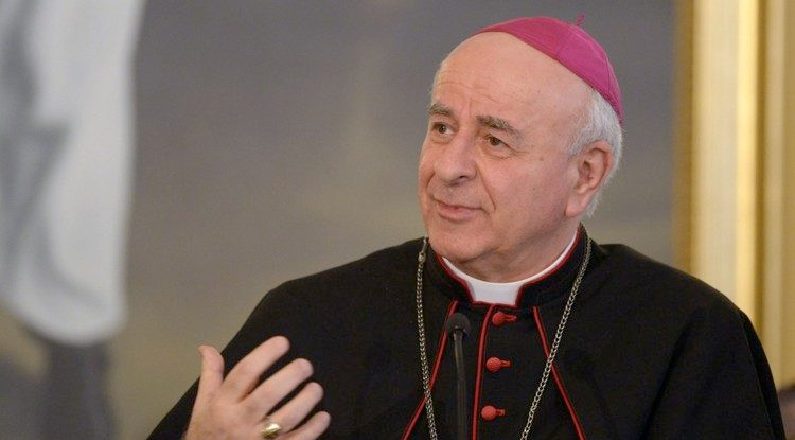
Livio Melina
(ZENIT News / Rome, 06.24.2026).- In an interview with Settimana News on May 21, 2026, Archbishop Vincenzo Paglia asserted his decisive role in the suppression of the John Paul II Institute for Studies on Marriage and Family and, therefore, in its replacement by a new academic entity, as well as in the radical transformation of the Pontifical Academy for Life. He also explained that these interventions aimed at a radical paradigm shift, one that for the first time was recognized as situated not only at the pastoral level, but also at the doctrinal level.
This «very profound» reform, according to Paglia, involved above all rethinking the very concept of «Natural Law.» This could no longer consist of immutable principles from which norms were deduced, but rather had to refer to a continuous historical discernment of subjective and cultural experience. Thus, a «theology in history and in the lives of people» had to be proposed, so as to overcome the «theology of the desk.»
First, however, we must ask ourselves whether this critique of his corresponds to the work carried out by the John Paul II Institute. Second, we must examine the soundness of Paglia’s new doctrinal proposals. Only then will it be possible to understand the true reason for the suppression of that academic Institute.
1. To answer this, it is necessary to start from both the original intention of John Paul II as well as to observe what the Institute developed, which he founded on May 13, 1981, the day after the first Synod on the Family and on the eve of Familaris Consortio.
Let us begin with the original intention of John Paul II. The careful study of his correspondence with Paul VI, carried out in the archives of the Archdiocese of Krakow by Pawel Gałuszka, has shown his great influence on the preparation and reception of the Encyclical Humanae Vitae. Saint John Paul II was deeply convinced that the question of conjugal and family morality presented a decisive challenge for the Church. But he also thought that the configuration of Moral Theology in Catholic textbooks was inadequate to address it. Neither the traditional Natural Law and legalistic approach, nor the one-sidedness of a personalism of conscience, detached from nature, can account for the positive value of conjugal sexuality or the personalist nature of procreation.
Archbishop Karol Wojtyła felt the need for an anthropology suited to the experience of love and a theology of the body. What had suggested to Paul VI he was able to accomplish once he became Pope. With his Catechesis on Human Love in the Divine Plan (1979-1984), he illustrated the greatness of the vocation to love, the gift of oneself, to the communion of persons, and to collaboration with God in the generation of new life.
At the same time, the Polish Pope soon realized that the resistance and challenges to Paul VI’s Encyclical were no longer merely partial and occasional, but were leading to a global and systematic questioning of the Church’s «sound moral doctrine.» And so, in the Encyclical Veritatis Splendor, he was able to indicate the path toward a personalist reinterpretation of Natural Law. Natural Law is understood through the language of self-giving, which the Creator has inscribed in the human body, a language that we can discover through the light of reason and the support of virtue (cf. n. 48). Natural Law arises from the capacity of reason to grasp, «in the light of the dignity of the person,» «the specific moral value of certain goods» toward which the person is naturally inclined. Thus «the goods of the person,» object of natural inclinations, become morally relevant in the perspective of «the good of the person» as such (Ibid).
In the Apostolic Constitution Magnum Matrimonii Sacramentum of October 7, 1982, which gave definitive legal form to the Institute for Studies on Marriage and Family, the Polish Pope explicitly cited Humanae Vitae. He also indicated as an object of study «God’s design for marriage and the family,» whose full truth had to be sought through an interdisciplinary approach. Two main lines of development for theological research were outlined: on the one hand, in the field of Theological Anthropology; on the other, in the field of Moral Theology.
Let us now see how the Institute developed these two areas during its 36 years of existence. We can observe an articulated proposal capable, on the one hand, of assuming the strong resistances that were opposed to it in a prejudiced manner and, on the other hand, of overcoming the narrowness of a vision of man and his creation centered on an anthropology of faculties, typical of Neo-Scholasticism.
a) From an anthropological perspective, a vision of humanity centered on the mystery of marriage was offered, demonstrating the dynamism that sexual difference introduces into human life insofar as it opens the possibility of a new love capable of generating. Human beings are contemplated precisely in their constitutive relationality. Human beings not only originate in love, but also open themselves to new relationships within love, which enrich their being. Thus, the decisive stages of human development can be proposed: becoming children, becoming spouses, and finally becoming parents. Nature is thus seen within the dynamic of growth effected by the gift of love, and not simply as a metaphysically predetermined development from which the rules of action could be deductively determined.
Within this framework, it is clear that the Institute did not focus, as Monsignor Paglia believes, on a restricted vision of the couple, neglecting to consider the family. On the contrary, from the beginning it was clear that the couple opens itself beyond itself, to all of creation and to all of society. The titles of some colloquia and publications confirm this: «For a Culture of the Family,» «Family and New Evangelization,» «Social Subjectivity of the Family,» «Anthropology and Generativity,» «Alliance of Generations,» «Family Assignments? Family and Sustainable Development,» «The Family, Light of God in a Society without God,» «Family and Dwelling: Building, Generating, Inhabiting,» «The Mystery of Childhood,» «Sacramental Action and Family Action,» «Parenthood»…
Furthermore, the Institute’s working method has always been developed as a dialogue with the human sciences, particularly Sociology and Psychology (a stable relationship exists with the Department of Family Studies at the University of Bologna and the Catholic University of the Sacred Heart in Milan). Likewise, seminars and dialogue congresses were held with great religious and wisdom-filled traditions: with the University of Bar Iland in Tel Aviv, with the Zeituna Islamic University in Tunisia, and with representatives of Buddhism and Hinduism.
b) In the line of moral reflection, a proposal was systematically developed, starting with the establishment of the International Area of Research in Moral Theology in 1997, that pivoted on the radical nature of the encounter with Christ as the original point of Christian moral experience. This was possible thanks to a precise vision of love as the foundational experience of morality, due to the transformation it entails and the fullness it promises, allowing for a clarification of what happiness is. In this light, it could be understood how the construction of the moral subject occurs not as an intrinsic imposition of an ideal, but as the result of a love that reorders life and gives meaning to freedom. Love, in effect, generates virtues as excellences of the subject that enable them to act excellently together with others. Charity as friendship with God and with others in the Church, thus manifests its great and definitive contribution to the general Christian subject.
For more than 22 years, the Area of Research in Moral Theology had set itself, at the suggestion of the then Cardinal Ratzinger, to engage in dialogue with moralist theologians from various schools of thought, even those opposed to the one developed at the Institute, and to adopt all the good that could be found in their research. Here, just to show a sample, are several names invited to the dialogue: W. Pannenberg, S. Pinckaers, R. Tremblay, B. Petrà, E. Schockenhoff, G. Angelini, P. Wadell, E. Falque, G. Abbà, E. Feder Kittay, A. Rodríguez Luño, F. Botturi, L.F. Ladaria, K. Flannery, B. Kiely, S. Hauerwas, Ph. Bordeyne, A. Ales Bello, P. Gilbert, M. Chiodi, S. P. Bonanni, J. Mimeault, M. Sherwin, M.S. Archer, P. Donati, E. Scabinj, J. Milbank, T. Rowland. Also in other moments of the life of the Institute: A.M. Pelletier, X. Lacroix, J. L. Marion, S. Ubbiali, C. Pagazzi, P. Gisel.
This dialogue enriched us, the professors, and our students. A look at the titles of some of the organized conferences also shows the breadth of the vision: «Question about the Good, Question about God; «What Motivation for Action? Epistemological Dimensions of Morality»; «The Path of Life: Education, a Challenge for Morality»; «Action, Source of Novelty»; «Intelligence of Love: A New Moral Epistemology Beyond the Dialectic of Norm and Case»; «Walking in the Light: Perspectives of Moral Theology Based on Veritatis Splendor«; «The Sequela Christi: Moral and Spiritual Dimension of the Christian Experience»; «The Logos of Agape: Love and Reason as Principles of Action»; «Love, Principle of Social Life»; «The Revelation of Love and the Response of Freedom»; «The Family: Key to the Church-World Dialogue»; «Reconstructing the Christian Moral Subject»; «The Moral Subjectivity of the Body.» But also from a more concrete pastoral perspective: «Loving Human Love»; «The Family: A Resource for Society»; «Oil on the Wounds: A Response to the Wounds of Abortion and Divorce»; «Mercy, Pastoral Truth.»
These two lines (anthropological and moral) found a decisive point of union in the sacramental perspective developed in the Institute. The Sacraments configure the ultimate meaning of human life and reality: to be a gift that, when we receive it, makes us capable of giving ourselves. Human action finds in the Sacraments that source which comes from God and includes the dynamism of our moral action in the action of Christ, so that it is possible to participate in His virtues.
Within the sacramental dynamic, marriage emerged as a strategic sacrament. As the primordial setting for the language of the body –understood as the language of the gift of self –, marriage reveals itself to be a privileged key for understanding the nature of the sacrament, particularly through its connection to the Eucharistic gift of the Body of Christ. From this perspective, initiatives arose to help spouses live out their vocation to holiness, alongside pastoral accompaniment pathways aimed at leading those not yet able to live according to Jesus’s teachings on marriage and family toward the truth of love.
The fruit of the research and teaching was precisely the most surprising aspect: students emerged with a new light, a desire to share it, and an awareness of how to accompany families. Upon returning to their home countries, they became beacons of light — demonstrating great pastoral creativity — while continuing to nurture the friendships they had forged with professors and fellow students. The Institute’s twelve branches, established across five Continents, stand as proof of the pastoral fruitfulness and potential universality of this vision and working method.
In light of all this, it is truly difficult to understand the criticism Paglia levels against the work of the Pontifical John Paul II Institute. Neither what has just been said regarding the Institute’s two fundamental lines of inquiry — nor the courses, doctoral research, articles in the journal Anthropotes, or published books — reflects an «desk theology» that is merely apologetic, centered on an ahistorical nature and moral absolutes, conceived as an abstract ethical deduction, and incapable of interpreting people’s lived experience. On the contrary, it was precisely a theology of love that sought to illuminate — through reasoned argument — that experience, which is fundamental to people’s lives, and to support them on their journey. Paglia’s criticism thus appears ideological and superficial, as it fails to engage with the merits of the scholarly work carried out at the Institute and wrongly equates it with a neo-scholastic approach.
2. Let us return to the radical paradigm shift advocated by Monsignor Paglia — which is articulated above all in the volume edited under his direction by the Pontifical Academy for Life titled *Etica Teologica della Vita: Scrittura, Tradizione, Sfide Pratiche* (Libreria Editrice Vaticana, Vatican City, 2022), a work to which he himself refers. It also includes a so-called «foundational document» that was intended to be an updated text for the Encyclical Humanae Vitae, though it was never actually published as a pontifical document. This material has already been the subject of detailed criticism in a volume edited by R. Fastiggi and M. Levering: Humanae Vitae and Catholic Sexual Morality: A Response to the Pontifical Academy for Life’s Etica Teologica della Vita (Sapientia Press, Ave Maria, FL, 2024).
The two theoretical pillars of Paglia’s document are the primacy of hermeneutics and the consequent primacy of subjective consciousness. The first assertion establishes the so-called «principle of immanence» characteristic of Modernism: the complete historicity of the interpreting subject, who is always situated within a specific perspective — conditioned by existential and cultural circumstances — and can never have immediate, direct contact with reality. «There are no facts, only interpretations,» said Nietzsche. In Theology, this implies that the much-desired pastoral conversion would require every statement to be contextualized, thereby allowing doctrine to be reshaped and rethought to suit the contemporary mindset. Thus, for instance, the situation of divorced and remarried persons or those living in cohabitation becomes an opportunity to reformulate the doctrine regarding adultery, extramarital sexuality, and the conditions for accessing the sacraments.
The second assertion reductively identifies the moral subject with their conscience, dissolving into it any prior datum that might serve as an objective criterion of truth — a veritable hypertrophy of conscience, since it is not merely a reflective judgment on the morality of an act but actually absorbs the moral norm itself. Thus, while adopting the old post-Tridentine casuistry framework — which pitted law against conscience in a systemic dialectic — the attempt is made to resolve the contradiction by abolishing the objective reference point. Given that «only the moral agent’s conscience can formulate the concrete norm for action,» that norm takes on the character of an autonomous, unappealable subjective «decision.» In this way, moral absolutes are denied — that is, the possibility of defining negative moral norms that are valid without exception because they pertain to actions that are intrinsically evil by virtue of their moral object.
The historical dimension of the human being — who always lives within a particular culture — must not, however, obscure the fact that there is something in man that transcends cultures. In Veritatis Splendor, Saint John Paul II reminds us that this «something» is precisely human nature, which therefore serves as the measure of culture (no. 53). This doctrine is not merely a matter of human reason — safeguarding it from a relativism that would open the door to violations of the rights of persons and peoples, as the history of 20th-century totalitarian regimes tragically demonstrated. It also pertains to the doctrine of faith, because the question of nature touches upon the ultimate Christological foundation and the very truth of redemption.
Indeed, the Encyclical Veritatis Splendor — echoing the teaching of the Second Vatican Council’s Constitution Gaudium et Spes — states: «The Church affirms that beneath all changes there are many things which do not change; they find their ultimate foundation in Christ, who is the sae yesterday and today and forever. He is the Principle who, having assumed human nature, definitively illuminates it in its constitutive elements and in its dynamism of charity towards God and neighbor» (n. 53).
3. An examination of what the Pontifical John Paul II Institute had offered, alongside the new paradigm proposed by Paglia, sheds light on the underlying reason for the Institute’s suppression. Paglia’s actions were not driven by theological considerations, but rather by an ideological critique of the Institute. Yet ideology — as Karl Marx taught us — serves as a cover for an unavowable interest. What, then, was the unavowable element in the case of such a flourishing Institute, one cherished by a saintly and prophetic Pope?
One might answer: the difficulty lies in embracing the message regarding marriage and family that the Church has put forward thus far –a message Paglia deemed unreasonable and impracticable. From this perspective, his intervention effectively blocked the further development of a proposal that could remain faithful to the Church’s traditional teaching while being presented in terms understandable to contemporary people — a proposal endowed with a pastoral fruitfulness that would truly enable individuals to live it out.
One need only consider the other key concept characterizing Paglia’s paradigm shift: the concept of the «possible good» becomes the criterion for establishing the effectively binding moral norm. The traditional principle that ad impossibilia nemo tenetur (no one is bound to do the impossible) is applied even to negative moral precepts — those prohibiting intrinsically evil actions. This runs counter to, based on a text by Saint Augustine: «No one ought to adopt that rash statement –condemned by the Fathers, under pain of excommunication — that it is impossible for the justified man to observe God’s Commandments. For God does not command the impossible; rather, in commanding, He exhorts you to do what you can, to ask for what you cannot do, and He helps you so that you may be able; for ‘God’s Commandments are not burdensome’ (cf. 1 John 5:3) and ‘His yoke is easy and His burden light’ (cf. Matthew 11:30).»
This is the teaching of Saint John Paul II in Veritatis Splendor, nos. 102–103, which warns against such reductions. He reminds us that the reality of Redemption is at stake here, because «only in the mystery of Christ’s Redemption do the concrete possibilities of man find their foundation.» Consequently, «it would be a very serious error to conclude that the norm taught by the Church is in itself merely an ideal to be subsequently adapted, proportioned, or graduated to — as is said — the concrete possibilities of man.»
The Pontifical John Paul II Institute — the original one, now suppressed — had demonstrated precisely the reasonableness of the Christian message, insofar as it corresponds to authentic human desire. It had also shown the practicability of this message, thanks to the sacraments and ecclesial accompaniment. Such accompaniment, in the concrete reality of its various communal forms, becomes the setting where the moral subject is rebuilt and reinvigorated through the transformation of his desires by means of the practices proposed to him. This path — the narrow path of the subject’s regeneration through the patience of a journey of healing and communal education — is the very path that Paglia’s actions sought to close off.
Such an undertaking, however, extended beyond the Institute’s classrooms and publications. It touched the Church herself, which today stands at a crucial crossroads. On the one hand, she can continue to propose the Gospel regarding the greatness of the human vocation –explaining who man is, what his sublime calling entails, the nature of marriage and the family, and the paths to living out this vocation to love. In other words, she can invite people to turn their gaze, above all, toward Christ and God’s original plan. On the other hand, she could abandon this perspective of the «narrow path,» closing her eyes to the greatness of this calling and reducing it to the actual capabilities of wounded man living in the current context.
What kind of morality does the Church desire? A morality of lowered standards — a sort of «Pelagianism of the minimum» — that, lacking trust in divine grace, ultimately renounces the fullness of life and justifies weaknesses and frailties as insurmountable? Or a morality that offers a path to those who humbly ask for the grace sufficient to live up to the vocation of self-giving, and who seek an ecclesial context in which to live it out? In other words, what hope does the Church have to offer the wounded person searching for meaning? The hope of someone who resigns themselves to their situation, or the hope of someone who knows they are called to a great destiny and sees before them a path made of small yet significant steps?
In reality, as we have seen, Paglia’s paradigm is by no means new; rather, it is an old paradigm — not only because it revives the post-Tridentine casuistic dialectic between law and conscience, but also because, at its core, it denies the enduring newness of Christ. Christ did not come to abolish the law, but to give us the ability to fulfill it and thus realize God’s great project of love. To be merciful, the Church need not lower the standard of the fullness of life or adapt to the world’s standards; instead, she must proclaim the Good News of the grace that enables us — despite our frailties and weaknesses — to live up to our divine vocation.