

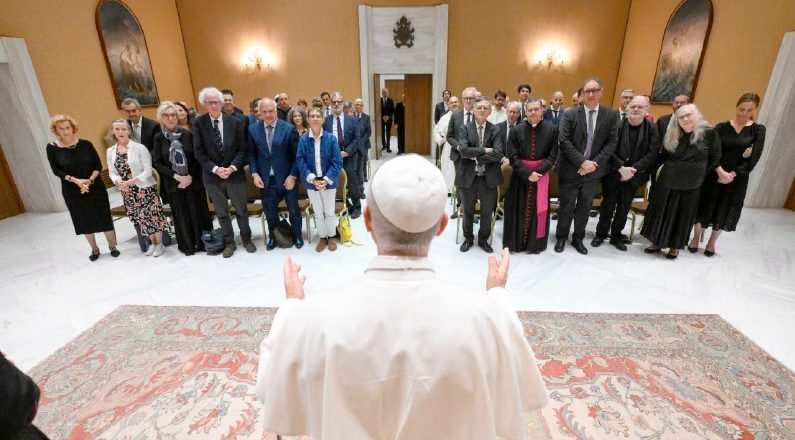
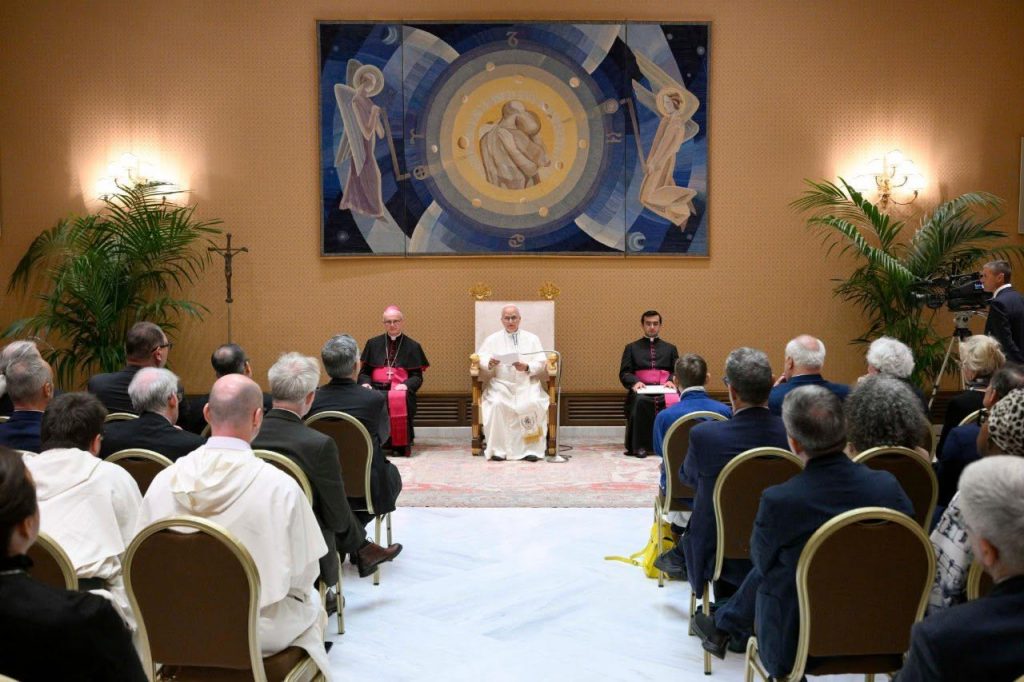
(ZENIT News / Vatican City, 06.24.2026).- Before the Wednesday general audience, Pope Leo XIV received a group of writers in a private audience to mark the 100th anniversary of the Vatican Publishing House. The audience took place in one of the rooms adjacent to the Paul VI Hall. Among the internationally renowned authors were Jon Fosse, Marilynne Robinson, Elizabeth Strout, Eric-Emmanuel Schmitt, Vittorio Lingiardi, Julia Navarra, Jonathan Safran Foer, Enrico Brizzi, Sorj Chalandon, Colum McCann, Daniele Mencarelli, Susanna Tamaro, and Mircea Cărtărescu. Below is the English translation of the Holy Father’s address:
***
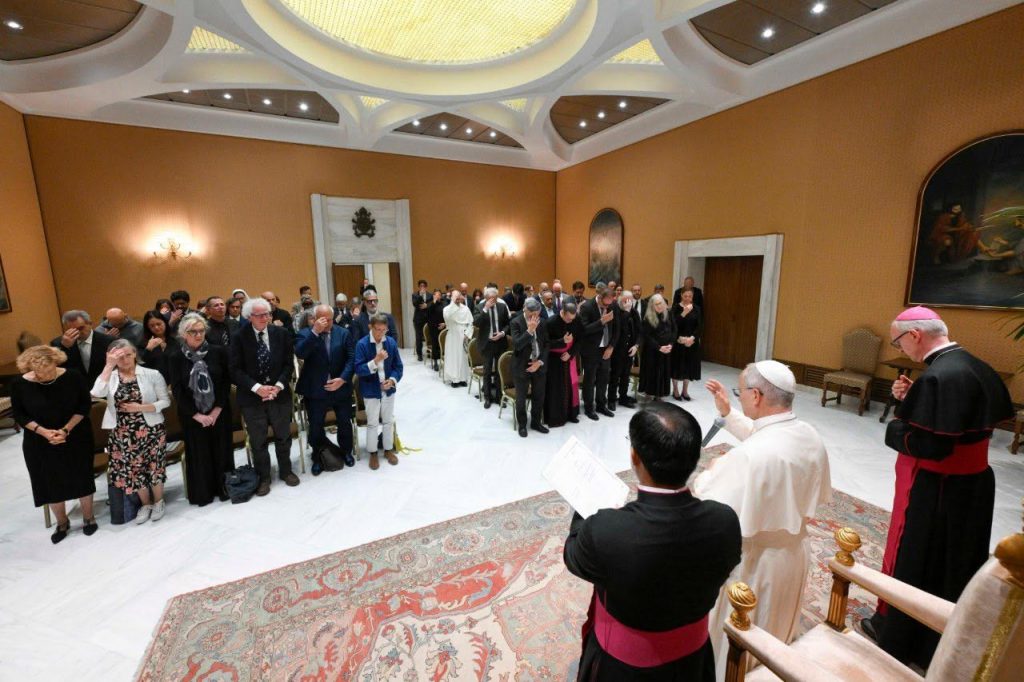
Buongiorno, good morning everyone, and welcome!
I am pleased to welcome you, writers from many parts of the world, who have gathered in Rome to mark the centennial of the founding of the Libreria Editrice Vaticana, the Holy See’s publishing house, which was established in 1926.
This is an opportune moment to reflect on the importance of books and of writing — a form of human expression in which you, with your variety of styles and languages, serve as teachers and as role models.
Writing, as you know, is an act of truth, of revelation, for it reveals who we are, what we believe and hope for, the world we strive toward and the future of which we dream. In this pursuit of truth, we sense that truth is subtle, revealing itself to us in our inner dialogue with God and in our open and respectful dialogue with our neighbors. Moreover, “truth is not a territory to be defended, but a good to be shared” (Magnifica Humanitas, 25). We are never masters of the truth; if anything, it is the truth that “conquers” us. That is why I hope you will inspire others to be drawn to the truth, because you yourselves are drawn to it.
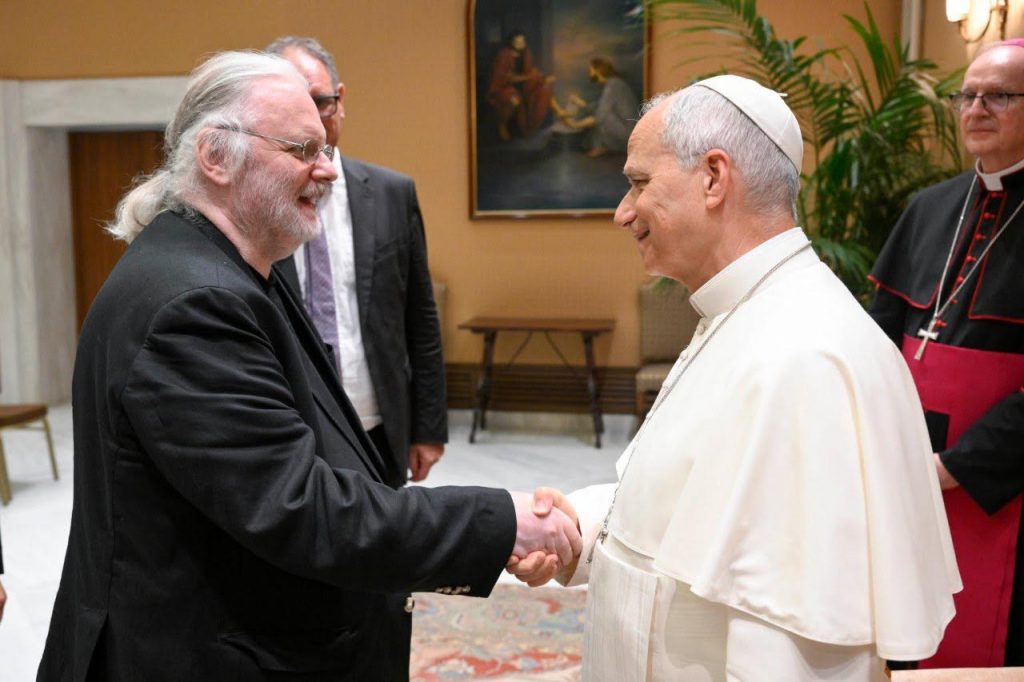
Furthermore, writing is an act of humanity. As the ancient author Terrence observed, “I am a human being, and I do not regard anything human as alien to me” (The Self-Tormentor, I, 1, 25). Literature, then, encompasses the full spectrum of human experience, so much so that Pope Francis highlighted its formative value: “Reading a literary text places us in the position of ‘seeing through the eyes of others’ [C.S. Lewis] thus gaining a breadth of perspective that broadens our humanity. We develop an imaginative empathy that enables us to identify with how others see, experience and respond to reality. Without such empathy, there can be no solidarity, sharing, compassion, or mercy. (Letter on the Role of Literature in Formation, 34).
When you write stories and develop your characters, you identify with them; you grasp their points of view, their emotions, their feelings, their attitudes. This is the great training ground of humanity that you allow your readers to experience, because, in a sense, readers “live” many lives in addition to their own. This helps us to discover different perspectives, to avoid treating our own views as absolute and to piece together, as in a mosaic, the outline of that truth which always transcends us.
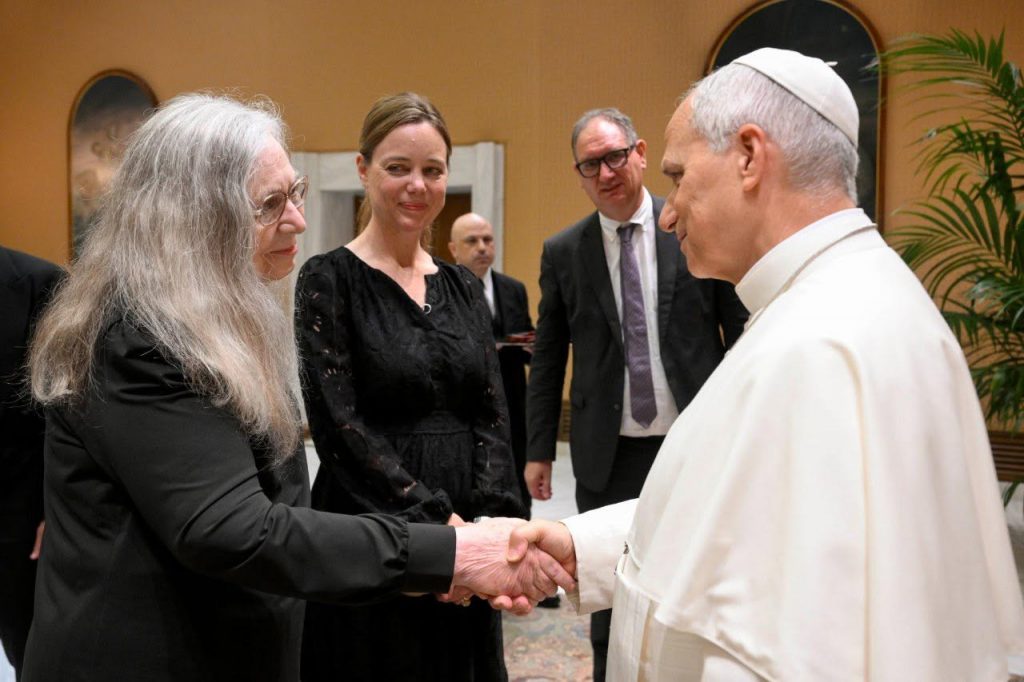
Finally, writing concerns God. It may seem a bold claim to make, but several theologians have reflected on and written about the harmony between the art of writing and the revelation of the biblical God. It is the very structure of Revelation that gives us the authority to do so. As Cardinal Radcliffe wrote, “For Christians, nothing human is alien to Christ. Every attempt to grapple with the fundamental questions of our lives — how to love, how to be just, how to be free, how to face suffering and death — helps us to understand Christ, the one who is most human of all.” (T. Radcliffe, Alive in God. A Christian Imagination, London 2019, p. 15).
When we delve into the very depths of our humanity, we are not far from God; for there, in the midst of very human stories, God reveals himself. The God of the Bible manifests himself in liberation from slavery, in the birth of a son when all hope seemed lost and in merciful and faithful love. He speaks through events and encounters, faces and stories. “God works in our lives through what we do and who we are and through the many people we meet” (Free Under Grace, Vatican City 2026, 83).
That is why I repeat to you, who are writers, what Saint Paul VI said to all artists: “We need you” (Homily, Mass with Artists, 7 May 1964). We need your imagination, your narrative creativity and your lively thinking. We need these to create spaces of freedom and authenticity, within which divine grace can make the promise of consolation and peace resound. I thank you for every time you have sown seeds of reconciliation, of encounter and of friendship.
For this reason, I encourage you in your work and gladly invoke the Lord’s blessing upon you and your loved ones. Thank you.
Thank you for reading our content. If you would like to receive ZENIT’s daily e-mail news, you can subscribe for free through this link.

Publicaciones relacionadas:
 Pope Leo XIV sends heaters to Ukrainian population ravaged by Russian bombs and very low temperatures
 Another Woman Appointed to the Dicastery for Bishops. Leo XIV Confirms Other Members
 Pope Leo XIV to Equatorial Guinea: video captures the Holy Father’s travel coordinator visiting the country ahead of a papal trip
 PHOTO GALLERY: Pope Leo XIV begins spiritual exercises
