

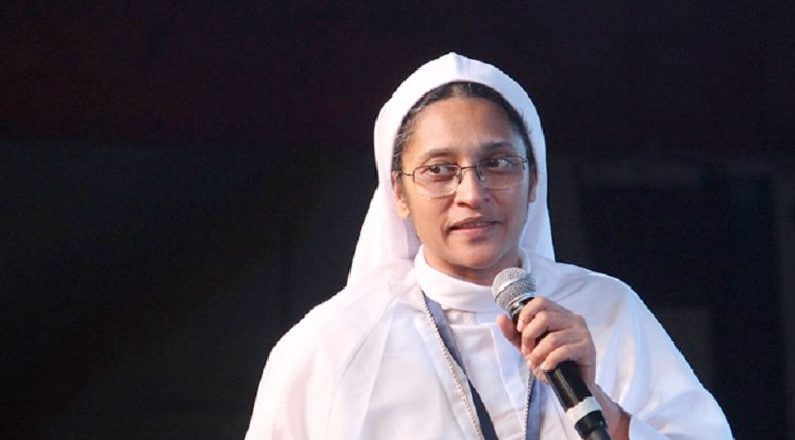
(ZENIT News / Rome, 05.03.2026).- In a country where more than 15 million abortions are recorded each year — a figure equivalent to one every two seconds –, Sister Paulina Melite’s work has become a benchmark within the Pro-Life Movement in India. Since 2016, this nun from the Congregation of the Missionary Sisters of Mary Immaculate has dedicated her life to defending the unborn and accompanying women in vulnerable situations, leading a Movement that, despite the difficulties, has continued to grow.
Sister Melite’s involvement in the pro-life cause is not the result of a specific pastoral experience. While working in the Diocese of Kalyan, in western India, she became aware of the magnitude of the abortion problem and the lack of support for mothers.
«It was there that I understood the needs of unborn children and their mothers,» she explained in a recent interview. Since then, she affirms, she has embraced this work as «a calling from God» that has led her to work at both the diocesan and national levels.
Her commitment grew until, in 2024, she was appointed National Coordinator of Indian Catholics United for Life, a network approved by the Catholic Bishops’ Conference of India that coordinates pro-life initiatives throughout the country.
One of the most important milestones of the Movement led by Sister Melite has been the organization of the National March for Life, which began in 2021. This annual event arose from the need to give visibility to a cause that, according to the nun, remained fragmented and without a unified voice.
«We realized that we needed to make the silent cry of the unborn audible,» she pointed out.
Since its first edition in New Delhi, with some 250 participants, the March has grown significantly. In recent years, it has brought together thousands of people from different faiths, including Christians, Muslims, Sikhs, and others. Furthermore, the Movement has incorporated educational exhibitions, awareness campaigns, and training programs in parishes, schools, and universities.
According to Sister Melite, the work is not limited to public protests: it includes retreats, moral formation, and support for families. These initiatives have already reached more than 40 dioceses in India.
Among the Movement’s main achievements are the consolidation of a national pro-life network and the growing involvement of young people and lay people. Youth participation, in particular, has been key to the Movement’s expansion, both in organizing events and in spreading its message.
Furthermore, petition campaigns have been launched, directed at the government, to request recognition of the right to life of the unborn, demonstrating an attempt to influence the political and legislative spheres as well.
Another significant development has been interreligious dialogue. Leaders from different traditions have begun to join common initiatives, recognizing abortion as a human issue that transcends doctrinal differences.
Despite these advances, Sister Melite’s mission faces significant challenges. One of the main ones is the legal framework: abortion has been legal in India since 1971, with recent expansions allowing it up to 24 weeks in certain cases, and even longer in exceptional situations.
The nun has expressed her concern about these legal expansions, noting that they «weaken the protection of the unborn» and could increase the number of abortions in the country.
Added to these are practical difficulties, such as a lack of funding. «It’s difficult to raise funds because the beneficiaries are unborn children,» she acknowledges. She also mentions the lack of social awareness and the cultural silence surrounding issues such as abortion, contraception, and in-vitro fertilization, even within religious communities.
Public criticism and rejection in certain sectors, especially in digital spaces, represent another obstacle. However, Sister Melite believes that these reactions also indicate that the issue is gaining visibility.
For Sister Paulina Melite, the defense of life is not only a social cause, but also a spiritual one. «It’s not just a campaign; it’s a spiritual battle,» she affirms, describing the magnitude of the challenge as the struggle of «David against Goliath.»
Despite the difficulties, she remains optimistic. The growing support from Bishops, priests, lay people, and young people, as well as the Movement’s expansion nationwide, gives her confidence that the pro-life message will continue to gain ground.
Inspired by figures like Mother Teresa, Sister Melite insists that the defense of life is fundamental to peace and human dignity. Given that India is a country marked by cultural and religious diversity, her work seeks to open a dialogue that, beyond differences, places the value of all human life at the center.

Publicaciones relacionadas:
 The “grandmother” who has spent a total of 11 years in jail for opposing abortion
 Ukrainian Nun Honored for Her Work Supporting Parents Facing Fatal Pregnancy Diagnoses
 Monaco reaffirms its Catholic identity by halting abortion reform: Prince refuses to enact the law
 The grandmother who went to jail for praying silently outside an abortion clinic
