

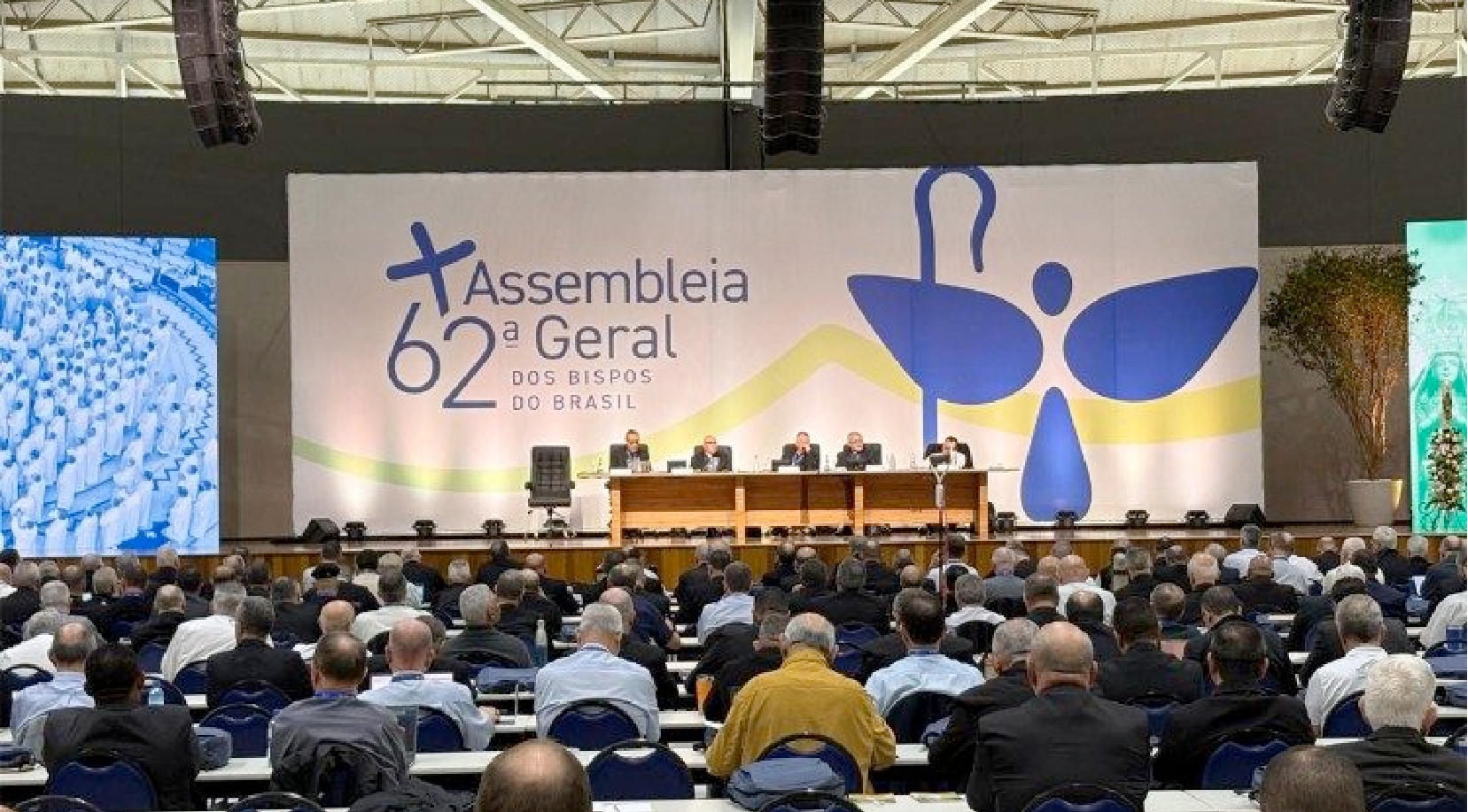
(ZENIT News / Aparecida, 05.02.2026).- As Catholic leaders across the globe grapple with declining participation and shifting religious identities, the Church in Brazil has taken a step that signals realism and pastoral urgency. During their plenary assembly in the penultimate week of April 2026, Brazil’s bishops approved the creation of a national data center designed to modernize the internal functioning of the Church while also increasing transparency regarding the status of clergy.
The initiative, though less publicly discussed than new national evangelization guidelines adopted at the same gathering, may prove just as consequential. At its core, the proposed system aims to streamline the flow of information between dioceses in a country where ecclesiastical administration still relies heavily on paper documentation and postal correspondence. Marriage files, records of religious institutes, and clerical documentation continue to circulate physically between diocesan chanceries, often introducing delays and inefficiencies into processes that require precision.
Among the most sensitive aspects of this information exchange is the verification of a priest’s canonical status. When clergy travel or temporarily minister outside their home dioceses—whether to celebrate a wedding, concelebrate Mass, or assist during a colleague’s absence—they must present documentation confirming their good standing, faculties, and suitability for ministry. At present, this process depends largely on individual initiative and manual communication between diocesan offices.
The proposed data center would seek to centralize and digitize such information, potentially making it accessible not only to Church officials but also, in some form, to the faithful. Advocates argue that such transparency could strengthen trust, allowing lay Catholics to verify that a priest exercising ministry is in good standing and free from canonical restrictions.
Yet the project raises complex questions that go beyond technical feasibility. While building a secure digital platform is relatively straightforward, ensuring the constant accuracy of its data is a far more demanding challenge. Diocesan personnel—already managing wide-ranging administrative and pastoral responsibilities—would need to update records promptly whenever a cleric’s status changes, such as in cases of suspension or restriction of faculties. Any delay or oversight could have serious pastoral and legal consequences.
This concern is not merely theoretical. Inaccurate or outdated information could expose the institution responsible for the database—likely the episcopal conference itself—to legal liability, particularly if harm results from reliance on erroneous data. Even robust disclaimers might not fully shield the Church from accountability in such scenarios. For this reason, similar initiatives have struggled to gain traction in other countries, where legal frameworks make centralized data systems particularly sensitive.
Brazil’s context, however, may offer a different testing ground. Its legal environment differs significantly from that of countries such as the United States, and Church leaders appear willing to explore whether a carefully managed system can balance transparency with institutional responsibility. Observers beyond Brazil are likely to watch closely, as the project could serve as a model—or a cautionary tale—for other episcopal conferences considering similar reforms.
At the same time, the bishops’ broader agenda makes clear that administrative reform is only one part of a larger response to a changing religious landscape. The newly approved evangelization guidelines reflect a growing awareness that Catholic identity in Brazil is no longer culturally assumed. Projections suggest that by 2030, Protestants could outnumber Catholics in the country, while an increasing segment of the population identifies with no religion at all.
In response, the bishops are calling for a renewed sense of missionary responsibility among the faithful, rooted in the Gospel mandate to proclaim the faith. They have pointed in particular to the national Eucharistic Congress scheduled for 2027 as a focal point for spiritual renewal and evangelizing momentum.
Seen in this light, the data center initiative is not merely a bureaucratic upgrade. It is part of a broader attempt to rebuild credibility, foster accountability, and support a more engaged and informed Catholic community.
Thank you for reading our content. If you would like to receive ZENIT’s daily e-mail news, you can subscribe for free through this link.

Publicaciones relacionadas:
 Pope’s Secretary of State visits Brazilian President and presides over opening of Brazilian Episcopate Assembly
 National controversy in Brazil over an archbishop’s disparaging remarks about receiving communion in the mouth
 Cardinal of Chicago asks not to kneel at communion: these are “his” reasons
 Iraqi Cardinal Warns Against Regime Change in Iran: «It Only Makes Things Worse»
